
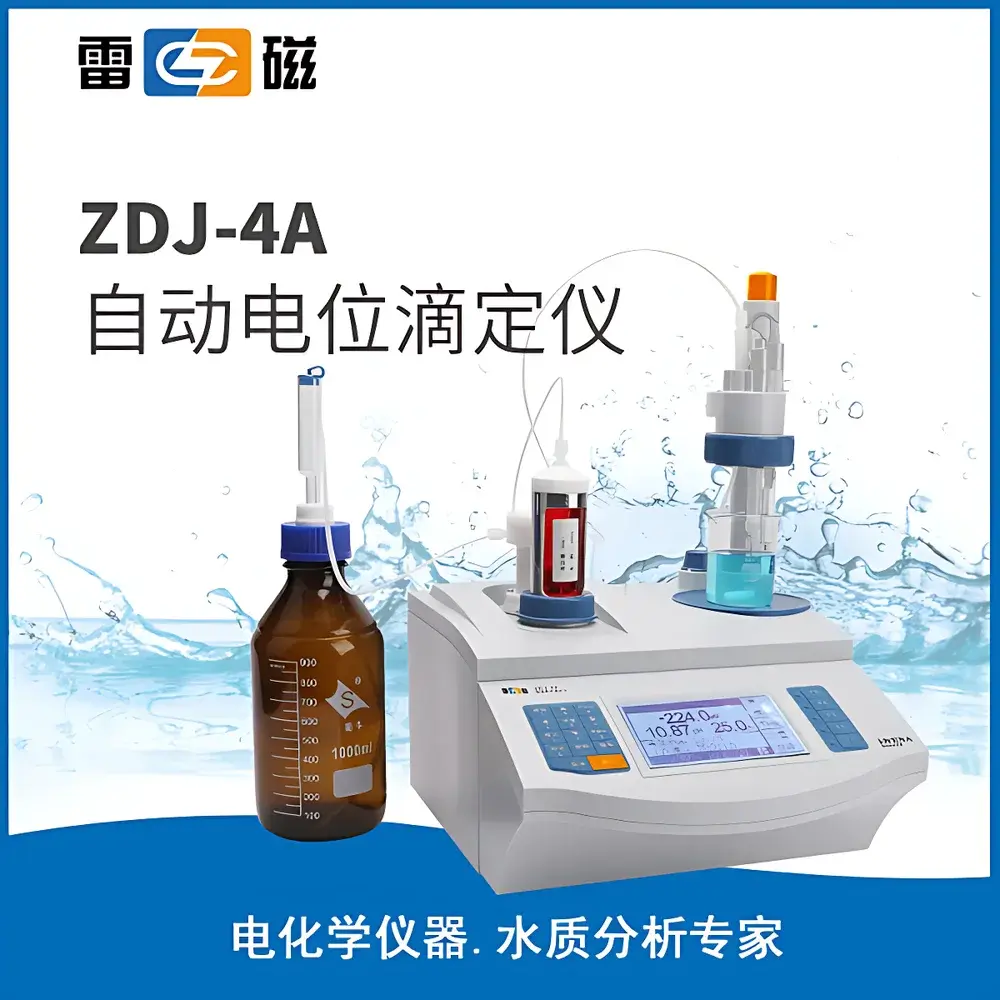
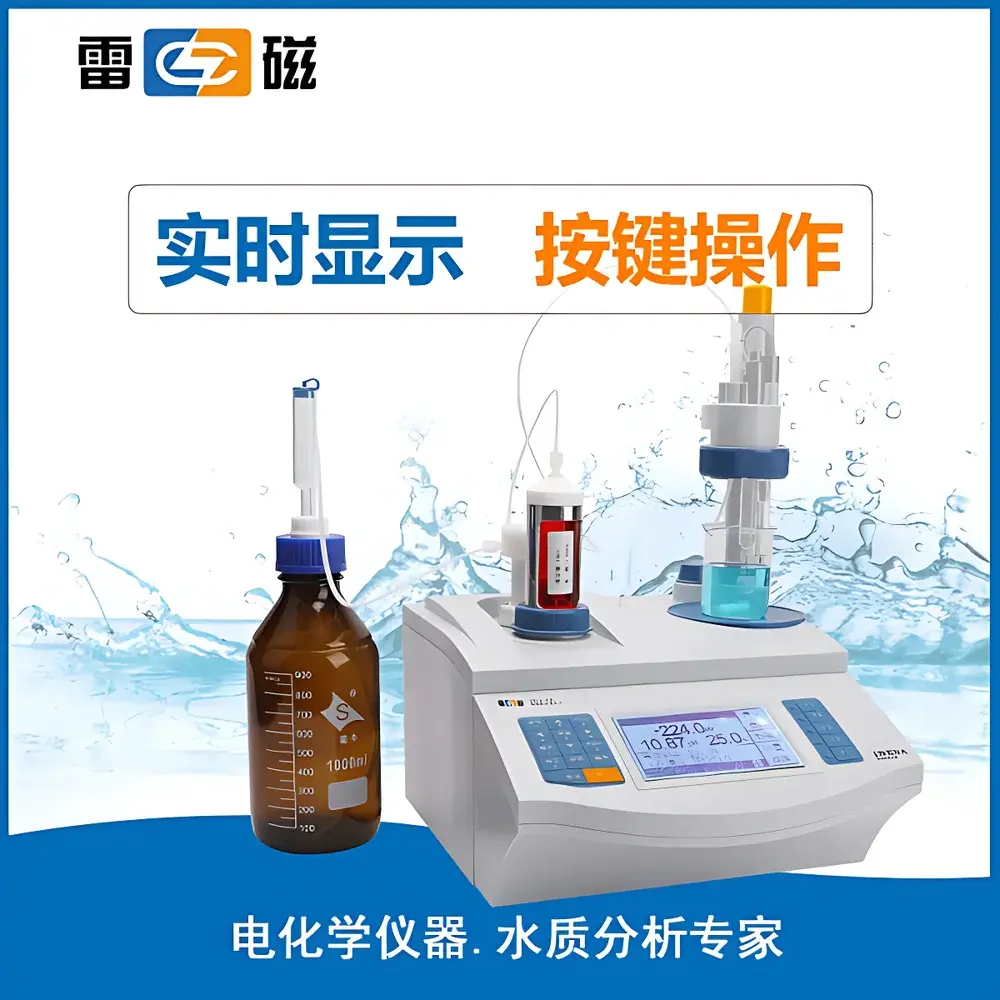
Leici ZDJ-4A Automatic Potentiometric Titrator
| Brand | Leici |
|---|---|
| Origin | Shanghai, China |
| Model | ZDJ-4A |
| Instrument Type | General-purpose Potentiometric Titrator |
| Application Scope | Universal |
| pH Range | (0.00–14.00) pH |
| mV Range | (−1800.0–+1800.0) mV |
| pH Accuracy | ±0.01 pH ±1 digit |
| pH Resolution | 0.01 pH |
| Titration Accuracy | ±0.01 pH ±1 digit |
| Titration Resolution | 1/14000 |
| pH/mV Stability | (±0.3 mV ±1 digit)/3 h |
| Temperature Compensation Range | (−5.0–105.0) °C |
| Temp. Resolution | 0.1 °C |
| Temp. Accuracy | ±0.3 °C |
| Titration Repeatability | 0.2% |
| 10 mL Burette Error | ±0.025 mL |
| 20 mL Burette Error | ±0.035 mL |
| 10 mL Burette Resolution | 1/10000 |
| 20 mL Burette Resolution | 2/10000 |
| Burette Fill/Dispense Time | (55 ±10) s (at full scale) |
| Power Supply | AC (220 ±22) V, 50 ±1 Hz |
| Dimensions (W×D×H) | 340 × 400 × 400 mm |
| Weight | 10 kg |
Overview
The Leici ZDJ-4A Automatic Potentiometric Titrator is a benchtop electrochemical analyzer engineered for high-precision volumetric analysis based on potentiometric endpoint detection. It operates on the fundamental principle of monitoring potential change (mV) or pH shift across a redox, acid–base, precipitation, complexometric, or non-aqueous titration system using a pair of reference and indicator electrodes. The instrument determines equivalence points by detecting inflection points in the titration curve—either through first-derivative analysis or fixed-endpoint logic—ensuring traceable, reproducible quantification of analytes in compliance with classical wet chemistry standards. Designed for routine QC, method validation, and research-grade titrimetric analysis, the ZDJ-4A meets the operational requirements of laboratories subject to GLP, ISO/IEC 17025, and pharmaceutical quality systems where documentation integrity and measurement traceability are mandatory.
Key Features
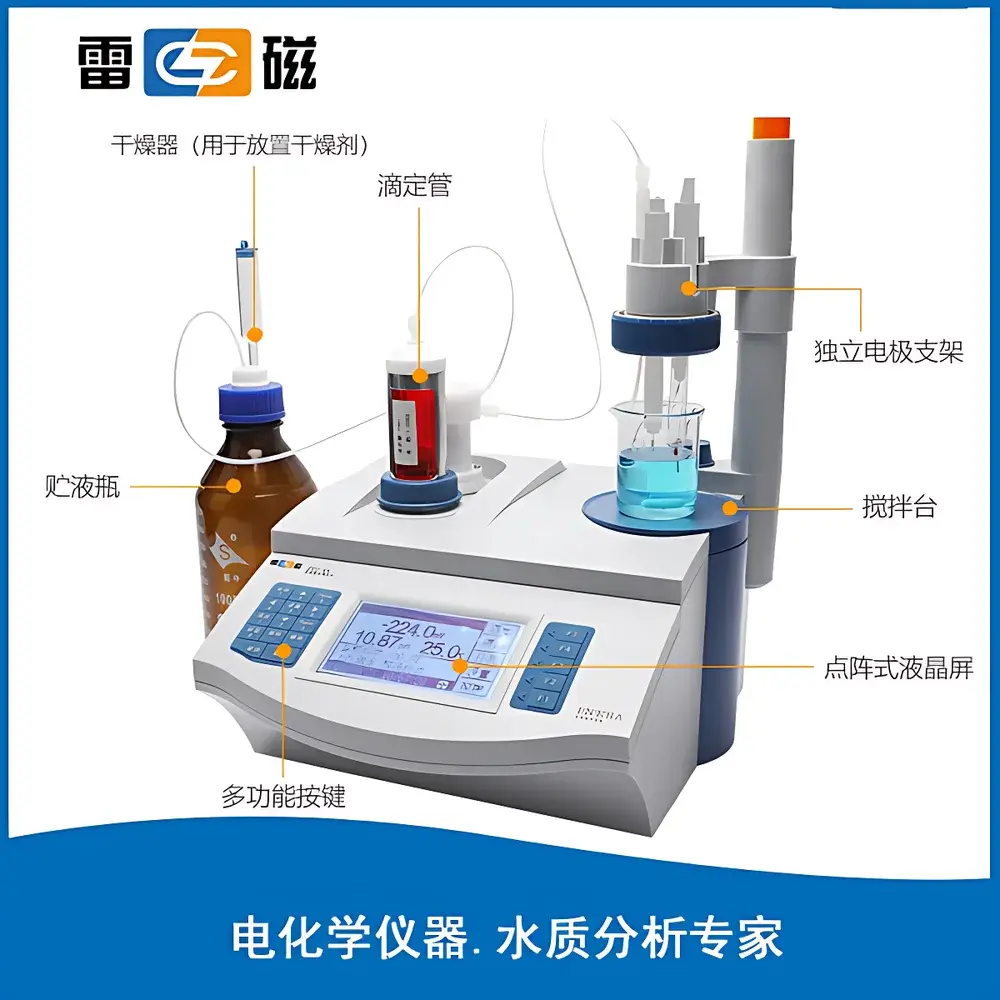
- High-resolution dot-matrix LCD display with intuitive keypad navigation, supporting real-time visualization of titration curves, current electrode potential, pH, temperature, volume delivered, and method status.
- Multi-mode titration engine: dynamic (curve-based), preset endpoint, equal-volume (incremental), and manual titration; users may save and recall up to 1 customized method template.
- Comprehensive titration method support: acid–base (e.g., HCl vs. NaOH, acetic acid in vinegar), redox (e.g., Ce⁴⁺ vs. Fe²⁺, KMnO₄ vs. oxalate), precipitation (e.g., AgNO₃ vs. Cl⁻), complexometric (e.g., EDTA vs. Ca²⁺/Mg²⁺), and non-aqueous (e.g., perchloric acid in glacial acetic acid).
- Integrated pH/mV measurement module with dual-range capability: (−1800.0 to +1800.0) mV and (0.00 to 14.00) pH, calibrated per IUPAC-recommended two-point or three-point procedures.
- PWM-controlled magnetic stirrer with software-adjustable speed (0–600 rpm), ensuring homogeneous mixing without vortexing or electrode disturbance during low-volume or viscous sample titrations.
- Burette drive system supports interchangeable 10 mL and 20 mL glass burettes, each certified to ISO 385 tolerances; resolution reaches 1/10000 (10 mL) and 2/10000 (20 mL), enabling sub-microliter dispensing precision.
- Robust data governance architecture: stores 1 active method + 50 completed titration records locally; all entries timestamped, user-ID tagged, and compliant with GLP audit trail requirements (no data overwriting, immutable result logs).
Sample Compatibility & Compliance
The ZDJ-4A accommodates aqueous, alcoholic, and low-water-content non-aqueous matrices typical in API assay, excipient purity testing, catalyst residue analysis, and metallurgical leachate characterization. Its electrode interface accepts standard single-junction, double-junction, combination pH, redox (Pt or Ag/AgCl), and ion-selective electrodes (e.g., fluoride, chloride). All measurements adhere to ASTM E2087 (Standard Practice for Potentiometric Titration), ISO 8655-6 (Piston burettes), and USP (Acid–Base Titrations). The device’s firmware and hardware design align with key elements of FDA 21 CFR Part 11 for electronic records—though full Part 11 compliance requires validated software deployment and administrative controls implemented by the end-user laboratory.
Software & Data Management
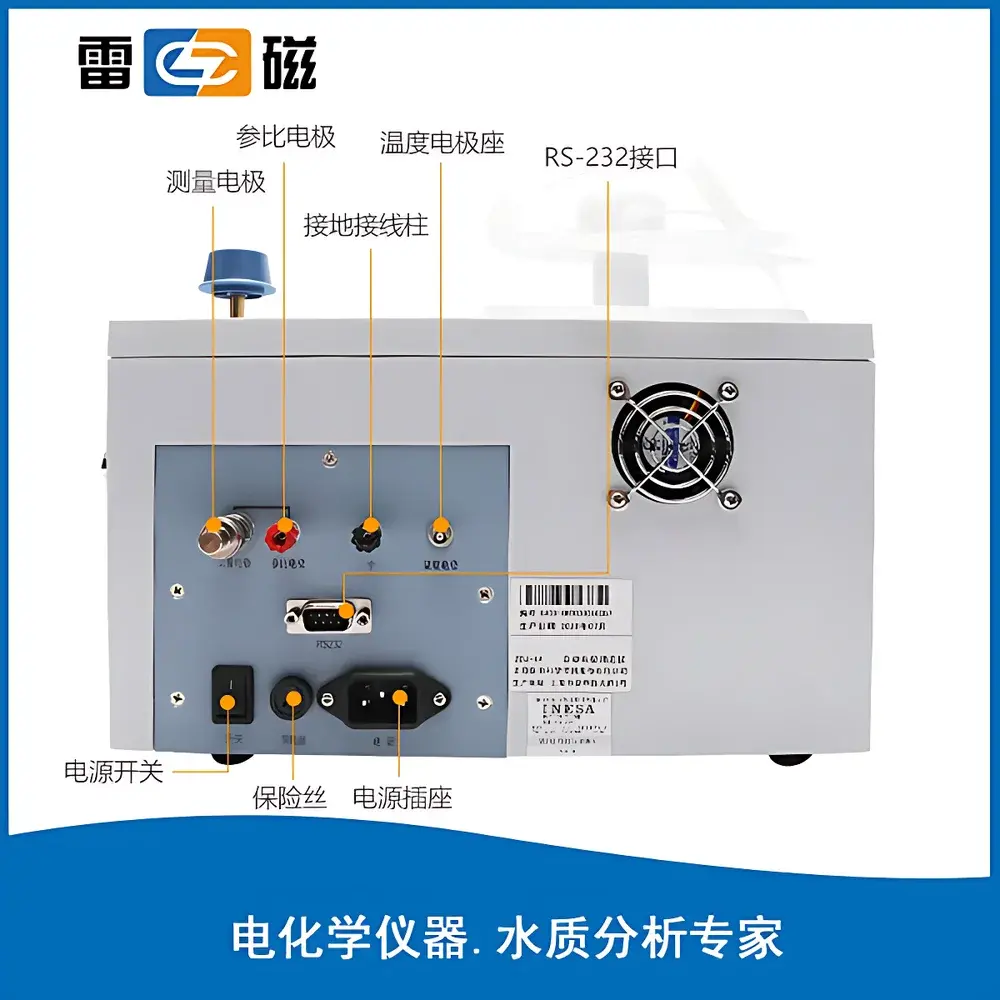
The dedicated ZDJ-4A PC software (Windows-compatible, USB/RS-232 interface) enables post-run reconstruction of full titration curves, derivative plots, equivalence point interpolation, and statistical summary (mean, RSD, confidence intervals) across replicate runs. Raw data export is supported in CSV and TXT formats for integration into LIMS or statistical packages (e.g., JMP, Minitab). The instrument logs all critical events—including calibration actions, method changes, power interruptions, and manual overrides—with timestamps and operator IDs. Local memory retains full audit trails even after power loss, reinforced by built-in EEPROM backup and automatic save-on-exit functionality.
Applications
- Pharmaceutical QC: assay of active ingredients (e.g., aspirin hydrolysis, amine content in APIs), chloride impurity in sodium chloride injectables, residual alkali in tablet excipients.
- Food & Beverage: titratable acidity in wines and dairy products, peroxide value in edible oils, sulfite determination in dried fruits.
- Environmental Testing: alkalinity and hardness profiling in surface water, cyanide quantification in industrial effluents (pyridine–barbituric acid method), chloride in wastewater per EPA Method 325.1.
- Chemical Manufacturing: assay of H₂SO₄, NaOH, and NH₃ solutions; purity verification of chelating agents (EDTA, DTPA); catalyst metal content (Ni, Co) in coordination complexes.
- Academic Research: teaching potentiometric fundamentals, developing novel titration protocols for weak acid mixtures, validating sensor response in mixed-solvent systems.
FAQ
Does the ZDJ-4A support GLP-compliant data handling?
Yes—the instrument stores user ID, date/time stamps, method parameters, raw titration data, and final results in non-volatile memory with no overwrite capability. All entries are sequentially numbered and cannot be edited or deleted without generating an audit log entry.
Can the ZDJ-4A perform Karl Fischer titration?
No—this model lacks the coulometric or volumetric KF reagent delivery system, moisture-specific electrodes, and solvent handling features required for water content analysis. It is not designed for hydrous/non-aqueous KF applications.
Is RS-232 the only communication interface available?
Yes—USB or Ethernet connectivity is not natively supported. Data transfer and remote control require RS-232 serial connection to a host PC running the official Leici software.
What electrode types are compatible with the ZDJ-4A?
Standard BNC-input electrodes: combination pH electrodes (e.g., Ag/AgCl gel-filled), platinum redox electrodes, silver/silver chloride reference electrodes, and select ion-selective electrodes (e.g., fluoride, bromide) with appropriate internal reference systems.
How is temperature compensation applied during titration?
The integrated Pt1000 temperature sensor automatically corrects electrode potential based on Nernst equation coefficients. Users may enable/disable auto-compensation and input solution-specific temperature coefficients for high-accuracy work in non-standard media.






