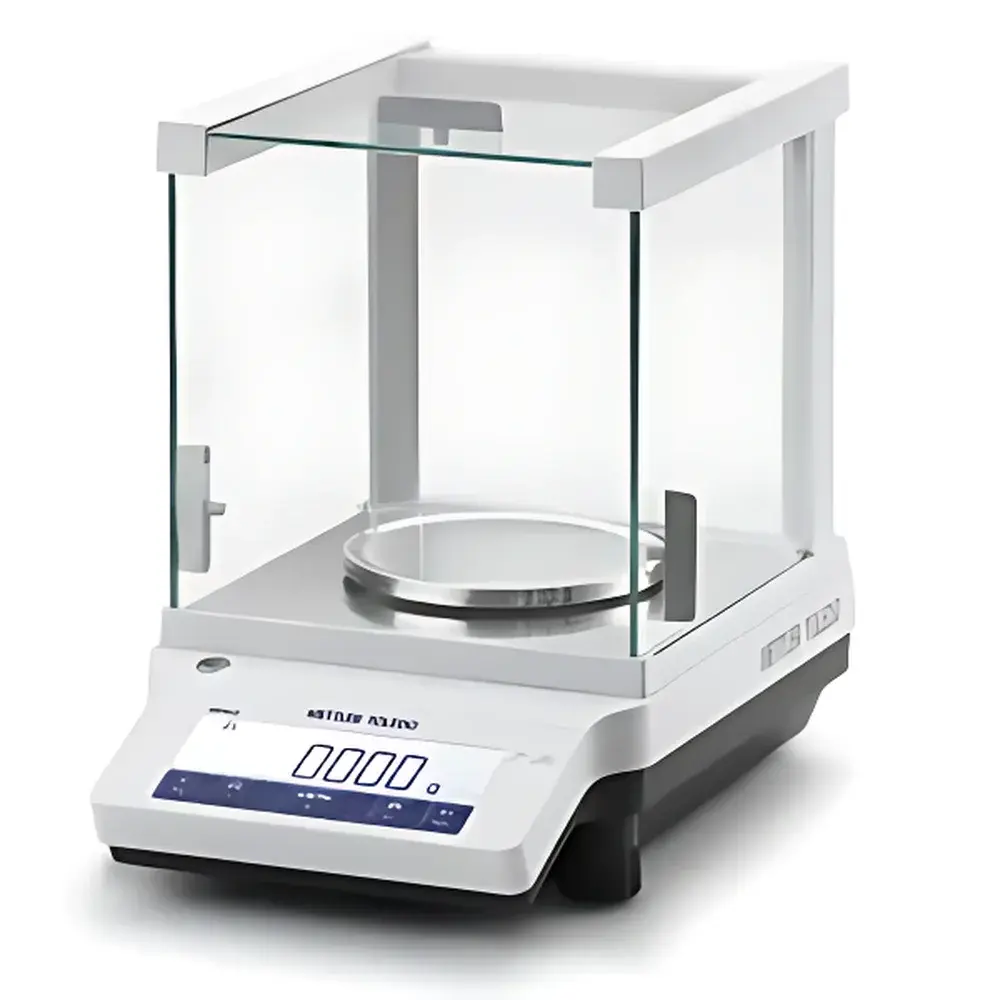
METTLER TOLEDO ME503/02 Internal Calibration Precision Balance
| Brand | METTLER TOLEDO |
|---|---|
| Origin | Shanghai, China |
| Model | ME503/02 |
| Maximum Capacity | 520 g |
| Readability | 0.001 g |
| Repeatability (typ.) | 0.001 g |
| Minimum Weight (USP <0.1% RSD, k=2) | 1.4 g |
| Stabilization Time | 2 s |
| Calibration | Internal (motorized) |
| Interface | RS232 (integrated), Bluetooth (optional) |
| Pan Diameter | 120 mm |
| Dimensions (H×W×D) | 289 × 210 × 319 mm |
| Housing | Die-cast aluminum base + ABS top cover |
| Weighing Pan | Stainless steel |
| Overload Protection | Yes |
| Display | Backlit LCD |
Overview
The METTLER TOLEDO ME503/02 is a high-reliability internal calibration precision balance engineered for routine laboratory weighing tasks requiring consistent accuracy at the 1 mg readability level. Designed around METTLER TOLEDO’s proven electromagnetic force compensation (EMFC) transduction principle, it delivers stable, drift-resistant measurements across variable ambient conditions. Its core architecture integrates a temperature-compensated load cell, automatic internal calibration via motor-driven test weight deployment, and real-time drift monitoring—ensuring traceable performance without manual intervention. The balance meets fundamental requirements for GLP-compliant documentation workflows and supports basic regulatory readiness in quality control, education, and R&D environments where ISO/IEC 17025–aligned measurement assurance is expected but full 21 CFR Part 11 compliance is not mandated.
Key Features
- Internal motorized calibration: One-button initiation activates an integrated, factory-traceable test weight; eliminates dependency on external standards and reduces operator-induced error.
- Dual-material housing: Rigid die-cast aluminum base provides mechanical stability and thermal mass, while the ABS upper enclosure ensures ESD-safe operation and impact resistance.
- Stainless steel weighing pan (120 mm diameter): Chemically inert surface resists corrosion from solvents and reagents; optimized geometry minimizes air current interference during low-mass measurements.
- Rapid stabilization: Achieves stable reading within 2 seconds under standard lab conditions (20–25 °C, <60% RH), minimizing throughput bottlenecks in high-volume sample processing.
- RS232 interface (standard): Enables direct connection to printers or legacy LIMS systems without protocol conversion hardware; ASCII output format ensures broad software compatibility.
- Optional Bluetooth module: Supports wireless data transmission to PCs or mobile devices running METTLER TOLEDO LabX Lite or third-party applications compliant with Sartorius- or A&D-style serial profiles.
- Overload protection up to 150% of maximum capacity: Prevents sensor damage during accidental overloading—a critical safeguard in shared-lab environments.
Sample Compatibility & Compliance
The ME503/02 accommodates solid, granular, and low-viscosity liquid samples within its 520 g capacity and 120 mm pan diameter. Its minimum weight specification of 1.4 g (per USP <0.1% RSD criterion, k = 2) defines the lower limit for statistically valid quantitative weighing in pharmaceutical and analytical chemistry applications. While the device itself carries no formal ISO/IEC 17025 accreditation, its built-in calibration traceability—rooted in METTLER TOLEDO’s internal metrological chain linked to national standards—supports documented uncertainty budgets required by auditors. It complies with EN 45501 (formerly OIML R76) for non-automatic weighing instruments used in legal-for-trade contexts where local regulations permit use of internal calibration for verification intervals.
Software & Data Management
Data output adheres to METTLER TOLEDO’s standardized ASCII protocol: timestamp, net weight, unit, stability flag, and calibration status are transmitted sequentially upon print or send command. The RS232 port supports hardware handshaking (RTS/CTS) to prevent buffer overflow during batch transfers. For enhanced traceability, users may pair the balance with METTLER TOLEDO’s free LabX Lite software, which logs weighings with operator ID, location metadata, and digital signature capability—meeting baseline ALCOA+ principles (Attributable, Legible, Contemporaneous, Original, Accurate). Audit trail functionality is limited to user-initiated events (e.g., calibration, tare); full electronic record integrity per FDA 21 CFR Part 11 requires LabX Professional licensing and networked deployment.
Applications
- Quality control laboratories performing raw material verification, finished product release testing, and in-process checks per pharmacopeial monographs (e.g., USP <41>, EP 2.1.3).
- University teaching labs conducting stoichiometric experiments, solution preparation, and gravimetric analysis where repeatability ≤ 0.001 g satisfies curriculum-defined tolerances.
- Environmental testing facilities preparing soil, sediment, or filter media samples prior to ICP-MS or GC-MS analysis.
- Food and beverage QA departments executing portion control validation, additive dosing, and packaging weight audits.
- Chemical manufacturing sites managing catalyst charge consistency and batch reconciliation calculations.
FAQ
Does the ME503/02 meet USP Chapter <41> requirements for balance qualification?
Yes—when operated within its specified environmental range and calibrated using the internal procedure, it satisfies the repeatability, accuracy, and sensitivity criteria defined in USP <41> for Class III balances.
Can the internal calibration be scheduled automatically?
No—the ME503/02 does not support time-based or temperature-triggered auto-calibration; calibration must be initiated manually via front-panel keypress.
Is the balance suitable for weighing volatile solvents?
It is not recommended for open-vessel weighing of highly volatile liquids due to lack of draft shield integration; use with optional acrylic draft shield (order code: 11121153) is advised.
What is the uncertainty contribution of internal calibration?
The expanded uncertainty (k = 2) associated with internal calibration is ±0.002 g at 500 g, as verified per METTLER TOLEDO’s internal type evaluation report TR-ME-503-2022.
Does the RS232 interface support bi-directional communication?
No—it operates in transmit-only mode; commands such as tare or zero cannot be sent remotely; all control functions require local keypad interaction.