
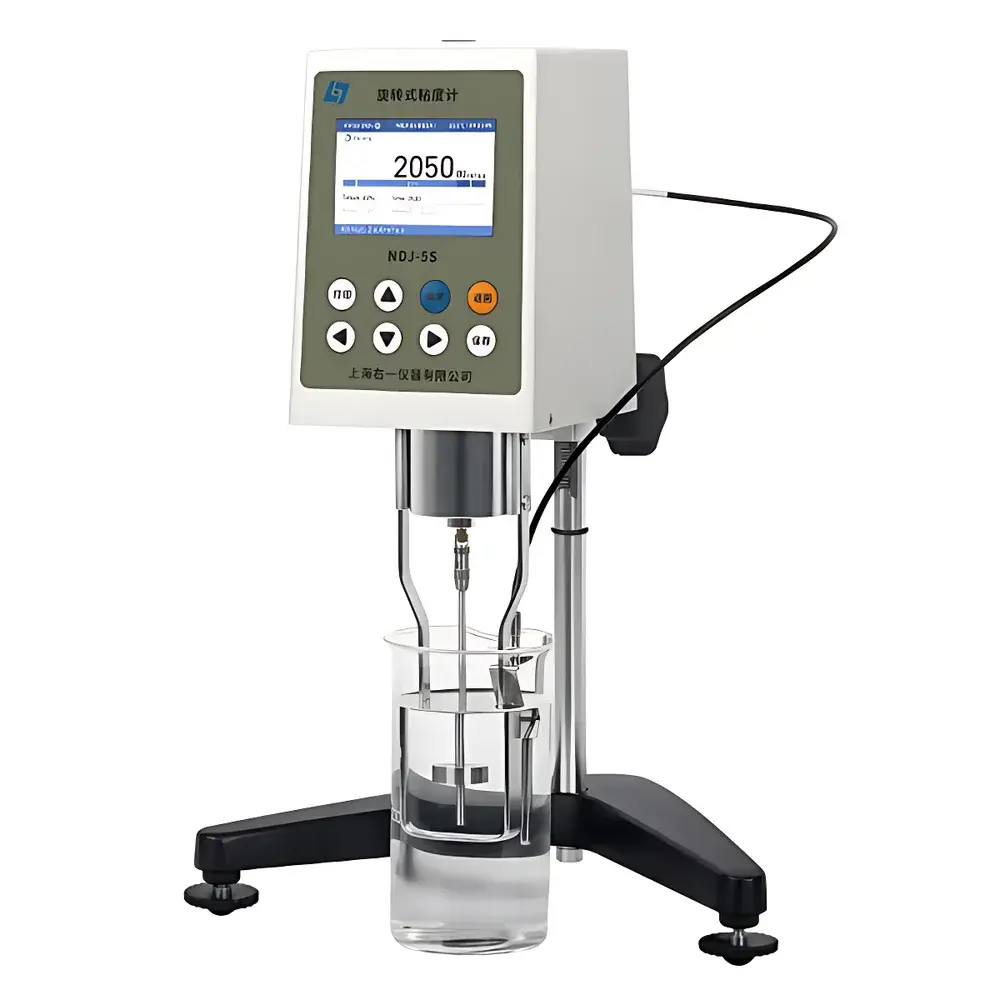
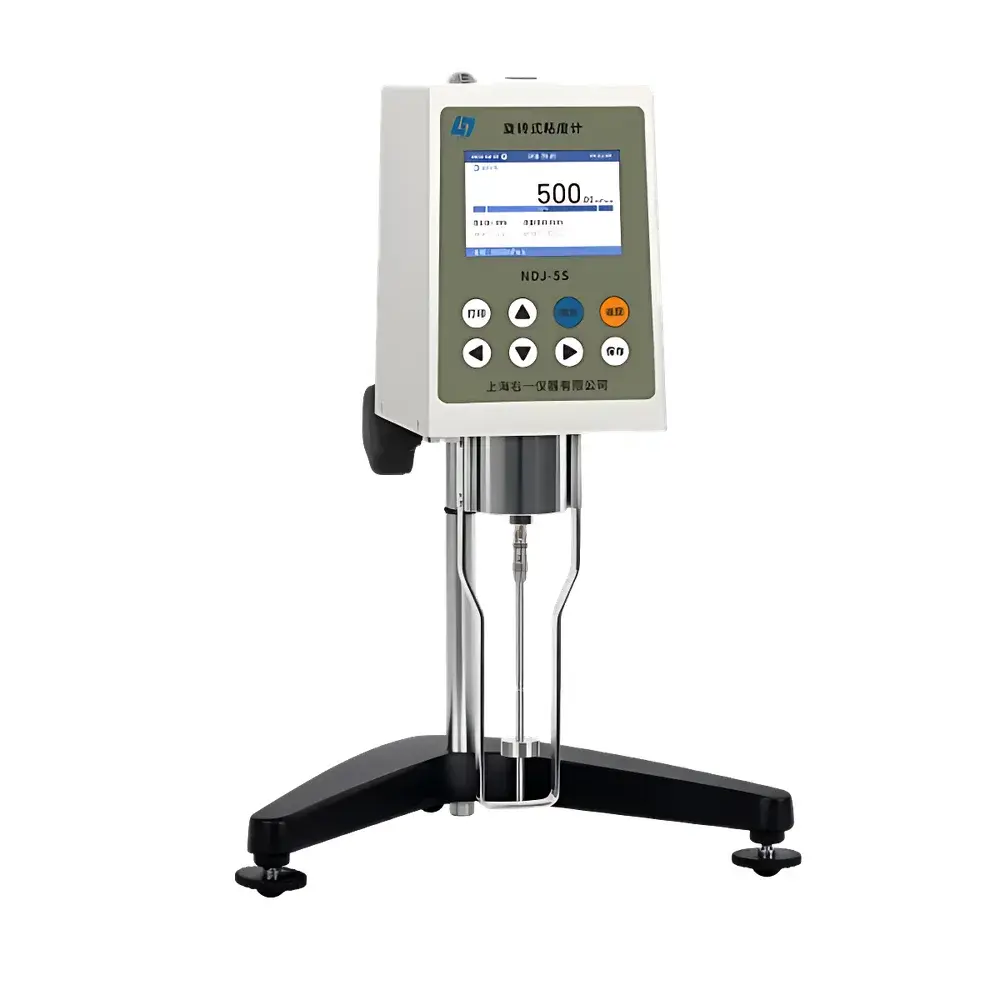
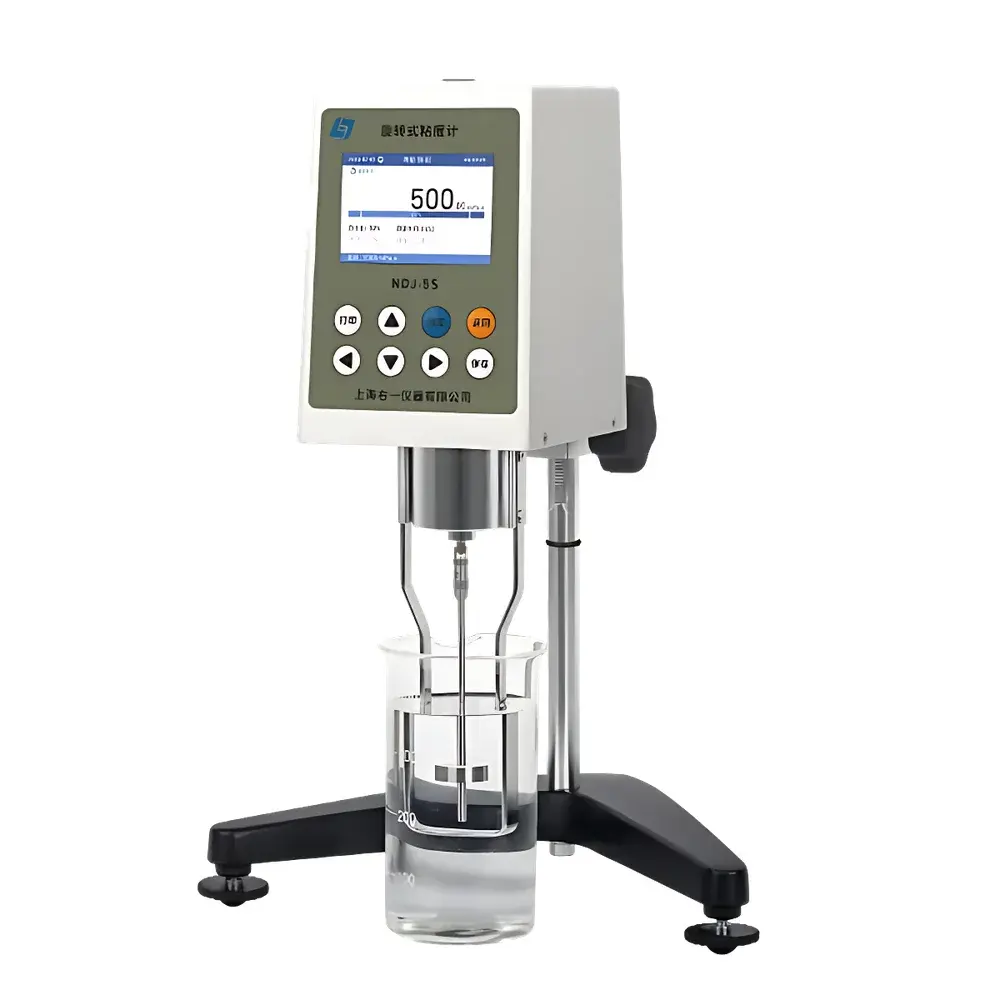
Yoyilab NDJ-5S Digital Rotational Viscometer
| Brand | Yoyilab |
|---|---|
| Origin | Shanghai, China |
| Manufacturer | Yoyilab Instruments Co., Ltd. |
| Model | NDJ-5S |
| Instrument Type | Rotational Viscometer |
| Operating Environment | Ambient Temperature |
| Viscosity Range | 10–1×10⁵ mPa·s |
| Speed Settings | 6, 12, 30, 60 rpm |
| Standard Spindles | #1–#4 |
| Display | 3.5″ IPS Color LCD |
| Resolution | 0.01 mPa·s |
| Accuracy | ±2% (for Newtonian fluids) |
| Repeatability | ±1% (for Newtonian fluids) |
| Data Storage | 50 records |
| Measurement Modes | Quick, Timed (up to 99 min), Auto-Scan |
| Interface | USB, RS-232, optional temperature probe input |
| Power Supply | 100–240 VAC, 50 Hz ±10% |
| Dimensions | 280 × 260 × 290 mm |
| Net Weight | 6.8 kg |
Overview
The Yoyilab NDJ-5S Digital Rotational Viscometer is a precision-engineered instrument designed for reliable and repeatable viscosity measurement of Newtonian and mildly non-Newtonian fluids under ambient conditions. Based on the Couette principle, it determines dynamic viscosity by quantifying the torque required to rotate a calibrated spindle—immersed in the sample—at a constant angular velocity. The device employs a synchronous motor-driven system with four fixed rotational speeds (6, 12, 30, and 60 rpm), paired with four standard spindles (#1–#4), yielding 16 distinct measurement configurations across a viscosity range of 10 to 1×10⁵ mPa·s. Its design prioritizes laboratory-grade stability, electromagnetic shielding, and mechanical rigidity—critical for minimizing drift and ensuring consistent torque transduction during extended QC or R&D sessions.
Key Features
- 3.5-inch high-resolution IPS color LCD display with intuitive menu navigation and real-time visualization of viscosity, spindle number, rotational speed, torque percentage, temperature (when probe is connected), and maximum measurable viscosity for the selected spindle–speed combination
- Microprocessor-based control system delivering precise data acquisition, low-latency response, and stable output across all operating modes
- Three configurable measurement modes: Quick mode (auto-terminates upon signal stabilization), Timed mode (user-defined duration up to 99 minutes), and Auto-Scan mode (algorithmically recommends optimal spindle and speed based on preliminary torque feedback)
- Integrated leveling system with adjustable feet and bubble level for accurate vertical alignment—essential for minimizing eccentricity-induced torque error
- Modular mechanical architecture: height-adjustable support column (250 mm travel), rigid one-piece housing with enhanced EMI shielding, and standardized spindle mounting interface compatible with optional #0 spindle for low-viscosity applications (e.g., solvents, thin coatings)
- Dual communication interfaces (USB and RS-232) supporting direct connection to PCs or thermal printers for traceable data export—including timestamp, spindle ID, speed, viscosity value, temperature, torque %, and measurement duration
Sample Compatibility & Compliance
The NDJ-5S is validated for routine viscosity assessment of homogeneous liquids and low-shear-rate suspensions commonly encountered in quality control laboratories across adhesive formulation, pharmaceutical excipient screening, food emulsion development, paint rheology profiling, and polymer solution characterization. While not intended for highly thixotropic, yield-stress, or time-dependent materials requiring controlled shear history, its fixed-speed operation meets ASTM D2196 and ISO 2555 standards for single-point viscosity determination when used with calibrated spindles and temperature-controlled baths (optional probe supports 0–150 °C monitoring). The instrument’s firmware and data handling comply with GLP documentation requirements, enabling audit-ready record retention for regulated environments where raw data integrity is essential.
Software & Data Management
No proprietary software installation is required—the NDJ-5S outputs ASCII-formatted data streams via serial or USB virtual COM port, facilitating seamless integration with third-party platforms such as LabVIEW, MATLAB, or LIMS systems. All measurements are timestamped and stored internally (50 records max); each entry includes spindle identifier, rotational speed, measured viscosity, torque %, and ambient/temperature-probe reading. Exported datasets include full metadata headers suitable for CSV ingestion into statistical process control (SPC) tools. Optional firmware updates—distributed via USB memory stick—maintain long-term compatibility with evolving lab informatics infrastructure without hardware modification.
Applications
- Batch release testing of solvent-based adhesives and sealants per internal SOPs aligned with ASTM D1084
- Viscosity grading of liquid pharmaceutical vehicles (e.g., syrups, suspensions) during formulation development
- In-process monitoring of ink dilution consistency in packaging printing operations
- Stability evaluation of edible oil blends and dairy-based emulsions under ambient storage conditions
- Routine QC of industrial lubricants, cutting fluids, and cleaning agents prior to packaging
- Educational use in university physical chemistry and materials science labs for introducing fundamental rheological concepts
FAQ
Is the NDJ-5S compliant with FDA 21 CFR Part 11 for electronic records?
The device itself does not provide electronic signature capability or audit-trail generation; however, exported ASCII logs—when captured and archived through validated external software—can be included in Part 11–compliant workflows.
Can I measure non-Newtonian fluids with this viscometer?
Yes, but only as single-point apparent viscosity values at fixed shear rates. It does not support flow curve generation, yield stress estimation, or time-dependent analysis.
What calibration standards are recommended?
NIST-traceable silicone oil standards (e.g., Cannon N47, N100) are advised for periodic verification at multiple points within the instrument’s range.
Does the NDJ-5S support temperature control?
It accepts optional PT100 temperature probes for ambient or bath temperature monitoring—but lacks integrated Peltier or jacketed cell control; external thermostatic baths are required for isothermal measurements.
How is repeatability verified during daily operation?
Users should perform three consecutive measurements on a certified reference fluid at identical spindle/speed settings and confirm standard deviation remains ≤±1% of mean viscosity—per ISO 16520 guidance for rotational viscometers.



