
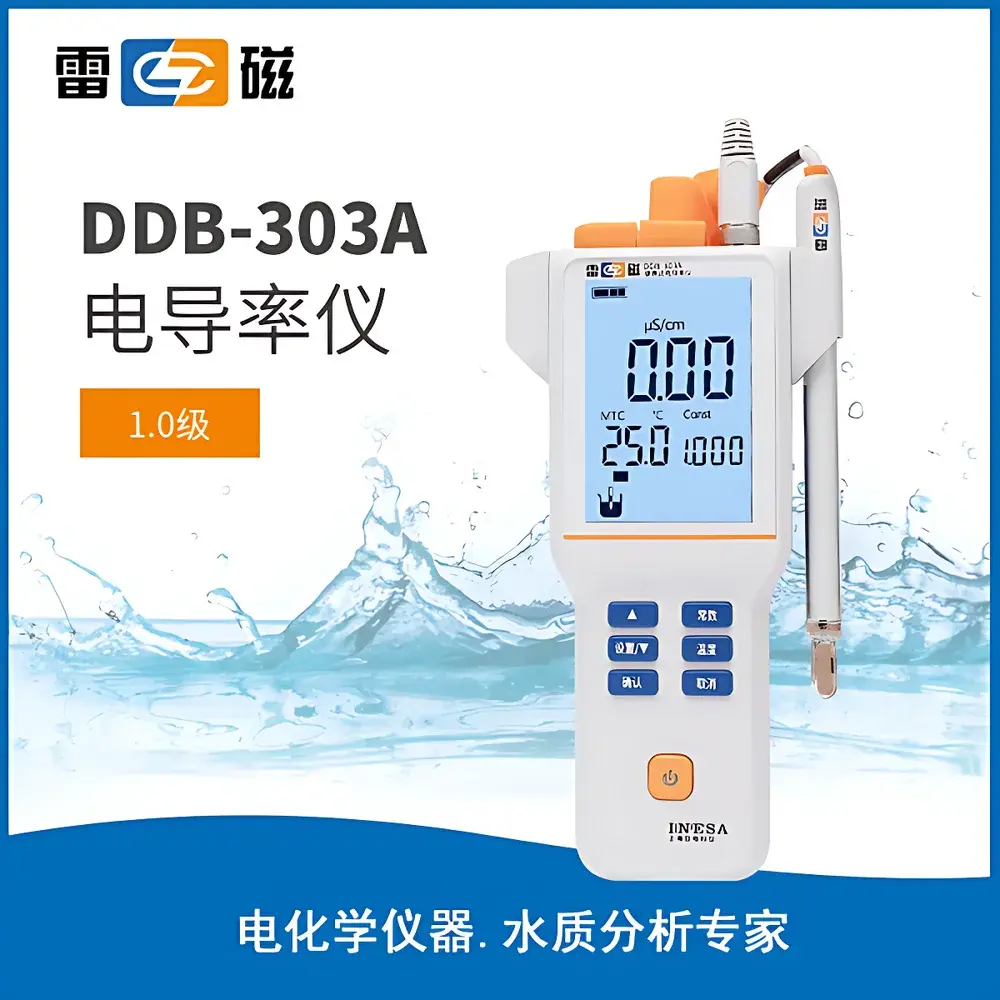
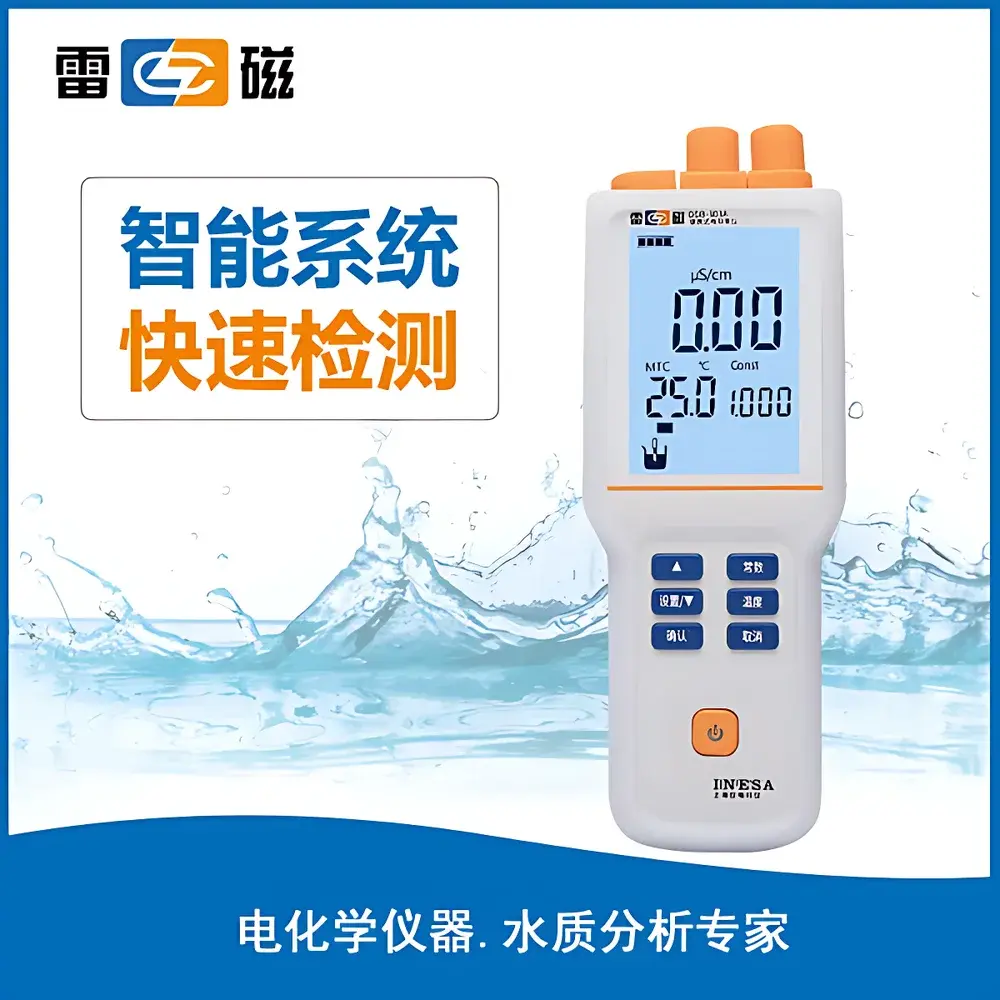
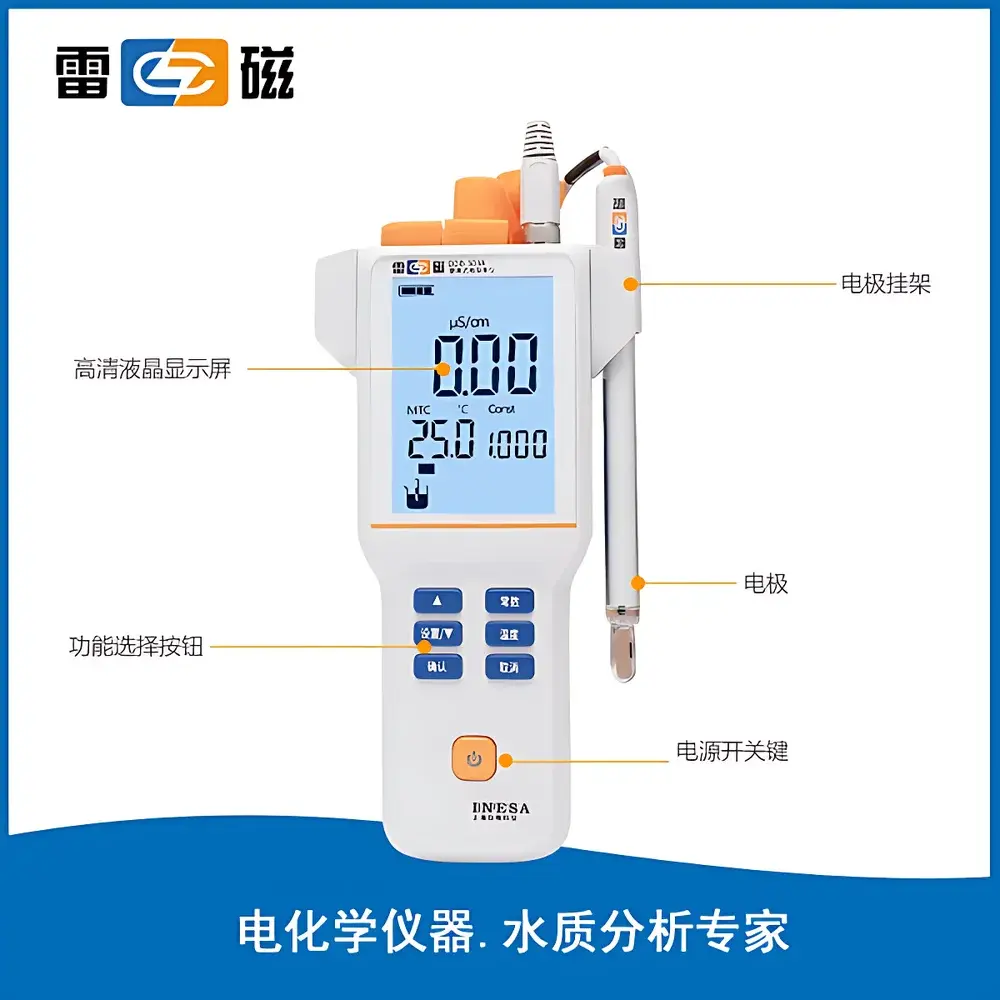
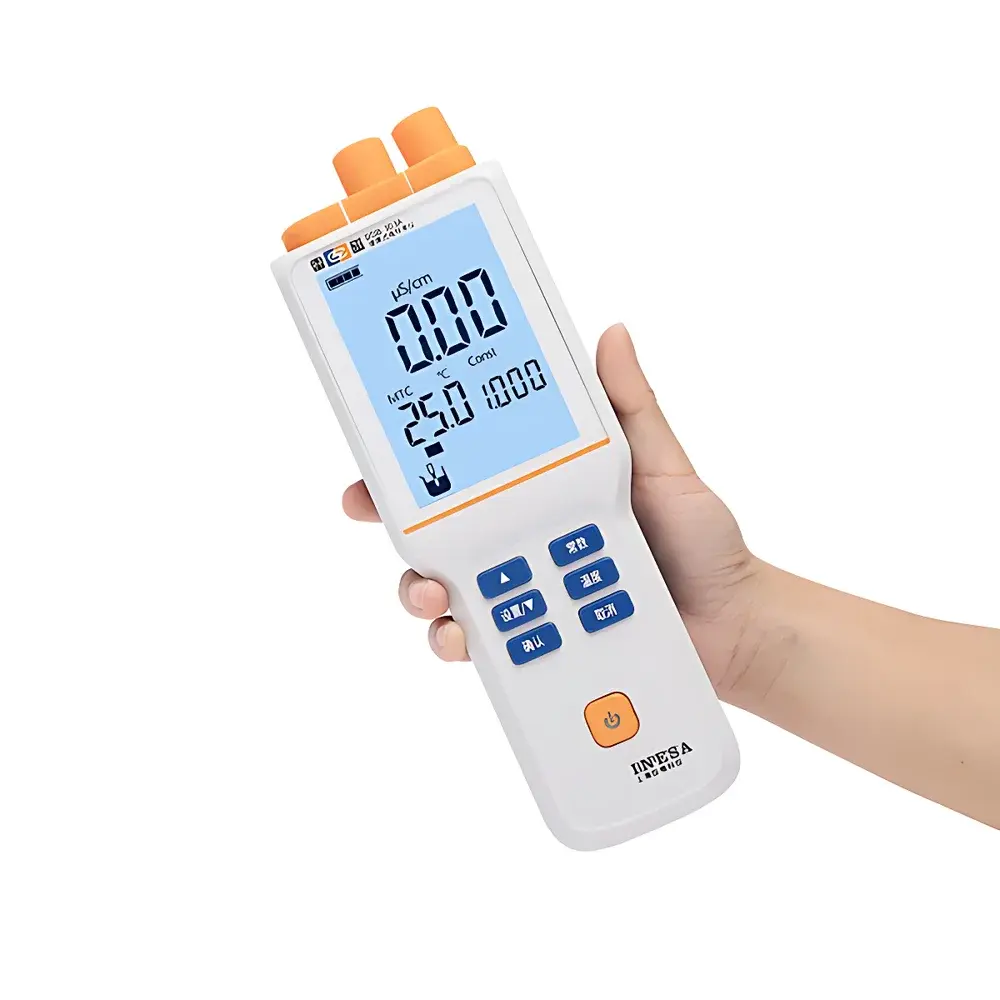
Leici DDB-303A Portable Conductivity Meter
| Brand | Leici |
|---|---|
| Origin | Shanghai, China |
| Model | DDB-303A |
| Portability | Portable |
| Intended Use | Laboratory & Field |
| Conductivity Range | 0.00 μS/cm to 100 mS/cm |
| Temperature Compensation | Manual (15.0–35.0 °C) |
| Accuracy | ±1.0% FS |
| Minimum Resolution | 0.01 μS/cm |
| Power Supply | Two AA alkaline batteries |
| Dimensions | 170 × 70 × 30 mm |
| Weight | 0.3 kg |
| Instrument Class | 1.0 |
Overview
The Leici DDB-303A Portable Conductivity Meter is a compact, battery-powered electrochemical instrument engineered for precise and reliable measurement of electrical conductivity in aqueous solutions. Based on the fundamental principle of two-electrode AC conductivity measurement—where a low-frequency alternating current is applied across a pair of platinum or stainless-steel electrodes to minimize polarization effects—the DDB-303A delivers stable readings across a wide dynamic range from ultra-pure water (0.00 μS/cm) to concentrated brines (100 mS/cm). Its design prioritizes operational simplicity and field readiness without compromising metrological integrity. As a Class 1.0 instrument per GB/T 6682–2008 (equivalent to ISO 8655-4 compliance for basic conductivity instrumentation), it meets the accuracy requirements for routine quality control, environmental sampling, and educational laboratory applications where trace-level sensitivity is not mandated but robustness and repeatability are essential.
Key Features
- True portable architecture: Powered by two standard AA alkaline batteries, enabling continuous operation for up to 200 hours under typical usage conditions—ideal for extended field campaigns, plant floor surveys, or teaching labs without fixed power infrastructure.
- Manual temperature compensation (MTC): User-adjustable reference temperature setting within 15.0–35.0 °C, supporting standardized reporting per ASTM D1125 and ISO 7888 when paired with calibrated thermistors or external digital thermometers.
- High-resolution display: Large backlit LCD panel shows conductivity value, unit, and active temperature setting simultaneously—optimized for readability under variable ambient lighting, including outdoor daylight and dimly lit utility corridors.
- Multi-cell compatibility: Supports interchangeable conductivity cells with cell constants of 0.01 cm⁻¹ (for ultrapure water), 1.0 cm⁻¹ (standard aqueous samples), and 10 cm⁻¹ (high-conductivity industrial effluents), allowing one instrument to serve diverse sample matrices without hardware replacement.
- Rugged mechanical design: Enclosure rated IP54 for dust resistance and limited water splashing protection; dimensions (170 × 70 × 30 mm) and mass (0.3 kg) optimized for single-hand operation and storage in standard lab coat pockets or field equipment pouches.
Sample Compatibility & Compliance
The DDB-303A is validated for use with non-aggressive, low-viscosity aqueous electrolytes—including tap water, surface runoff, wastewater effluent, boiler feedwater, and process rinse solutions. It is not intended for organic solvents, highly viscous suspensions, or strongly oxidizing media (e.g., >5% HNO₃ or ClO₄⁻-rich streams) due to electrode material limitations. While the instrument itself does not carry CE, UKCA, or FDA 510(k) certification, its measurement methodology aligns with internationally recognized protocols: conductivity data generated with proper calibration (using NIST-traceable KCl standards at 25 °C) is admissible in GLP-compliant environmental monitoring reports (per EPA Method 120.1) and internal QC documentation for ISO 9001-certified facilities. Cell constant verification and daily zero-point checks are recommended prior to critical measurements.
Software & Data Management
The DDB-303A operates as a standalone, firmware-based meter with no embedded memory or USB/Bluetooth connectivity. All measurements are displayed in real time and must be manually recorded—ensuring full audit trail transparency and eliminating risks associated with unverified digital data transfer. This architecture supports strict regulatory environments where electronic record integrity is governed by 21 CFR Part 11 Annex 11 principles: absence of automated data export precludes unauthorized modification, while manual transcription into bound logbooks or validated LIMS templates satisfies ALCOA+ (Attributable, Legible, Contemporaneous, Original, Accurate) data governance criteria. Calibration records—including date, standard concentration, measured value, and operator ID—must be maintained separately per ISO/IEC 17025 clause 7.7.
Applications
- Environmental field screening: Rapid assessment of stream conductivity as a surrogate indicator for total dissolved solids (TDS) and ionic contamination following ASTM D5907 guidelines.
- Pharmaceutical water system validation: Monitoring purified water (PW) and water-for-injection (WFI) loops during commissioning, per USP conductivity limits, when used with a certified 0.01 cm⁻¹ cell and strict temperature control.
- Academic instruction: Teaching foundational concepts of ionic mobility, Kohlrausch’s law, and temperature dependence of electrolyte conductance in undergraduate physical chemistry laboratories.
- Industrial pretreatment verification: Confirming desalination unit performance (e.g., RO reject streams) or detecting cooling tower blowdown anomalies before full-scale process integration.
- Research-grade baseline characterization: Establishing reference conductivity values for synthetic electrolyte solutions prior to advanced electrochemical testing (e.g., EIS or cyclic voltammetry).
FAQ
Does the DDB-303A support automatic temperature compensation (ATC)?
No—it provides manual temperature compensation only. Users must measure sample temperature externally and input the value via front-panel keys to apply the standard 2%/°C correction factor.
Can this meter be used for ultrapure water (UPW) below 0.1 μS/cm?
Yes, when equipped with a certified 0.01 cm⁻¹ cell and operated in a clean, low-humidity environment with minimized electrostatic interference—but note that the specified resolution (0.01 μS/cm) limits quantitative confidence below 0.05 μS/cm.
Is calibration traceable to national standards?
Calibration requires NIST-traceable KCl reference solutions (e.g., 1413 μS/cm at 25 °C); the instrument itself does not store calibration coefficients, so full procedural documentation is required for traceability.
What maintenance is required for long-term reliability?
Rinse electrodes thoroughly with deionized water after each use; store dry in protective caps; inspect platinum black coating annually for flaking; replace batteries before voltage drops below 1.2 V per cell to prevent reading drift.
Does Leici provide GMP-compliant documentation for this model?
Leici supplies factory calibration certificates and user manuals compliant with IEC 61000-4 electromagnetic compatibility standards, but formal IQ/OQ documentation packages must be developed internally per site-specific validation protocols.





