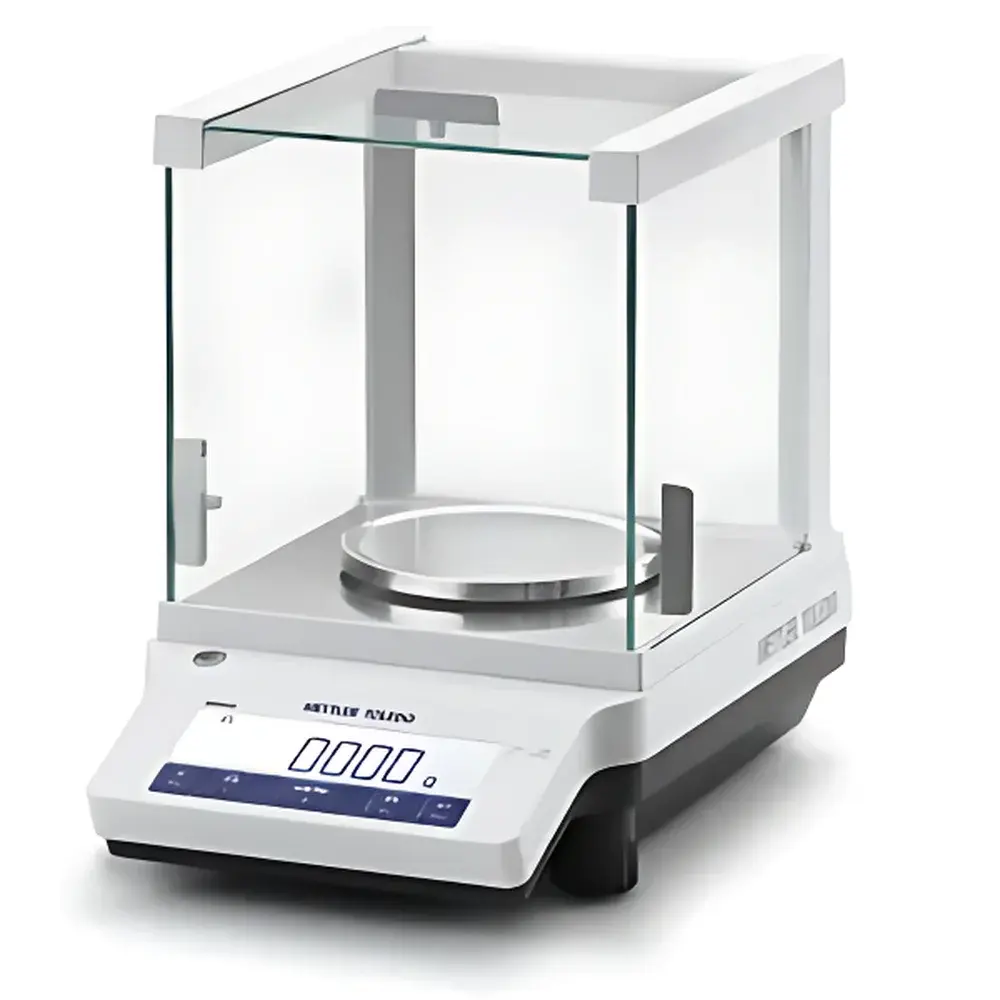
METTLER TOLEDO ME303E Precision Balance (0.001 g readability, 320 g capacity)
| Brand | METTLER TOLEDO |
|---|---|
| Origin | Shanghai, China |
| Model | ME303E /02 |
| Instrument Type | Precision Balance |
| Maximum Capacity | 320 g |
| Readability | 0.001 g |
| Repeatability (typical) | 0.7 mg |
| Minimum Weight (USP <0.1% RSD, k=2) | 1.4 g |
| Stabilization Time | 1.5 s |
| Calibration | External |
| Interface | RS232 (integrated), optional Bluetooth |
| Display | Backlit LCD |
| Pan Diameter | 120 mm |
| Dimensions (H×W×D) | 289 × 210 × 319 mm |
| Housing | Die-cast aluminum and ABS |
| Base | Robust metal base with stainless steel pan and overload protection |
Overview
The METTLER TOLEDO ME303E Precision Balance is an entry-level analytical-grade instrument engineered for consistent, traceable mass measurement in routine laboratory, quality control, and educational environments. Operating on electromagnetic force compensation (EMFC) principle, it delivers high reproducibility and long-term stability without mechanical levers or knife-edges. With a maximum capacity of 320 g and 1 mg readability, the ME303E meets the performance requirements for general-purpose weighing tasks where precision—rather than ultra-micro sensitivity—is critical. Its design adheres to fundamental metrological principles defined in OIML R 76 and ISO/IEC 17025–compliant weighing practices, ensuring results are suitable for documentation in GLP and GMP-regulated workflows when paired with appropriate procedural controls.
Key Features
- Electromagnetic force compensation sensor delivering stable, drift-resistant measurements under ambient laboratory conditions
- Backlit LCD display with intuitive menu navigation for rapid access to calibration, unit selection, and application modes
- Robust die-cast aluminum housing combined with a stainless steel weighing pan and integrated overload protection (up to 500 g)
- Adjustable leveling feet with built-in bubble level for fast, reliable setup on standard lab benches
- Integrated RS232 interface enabling direct connection to printers or PCs for data capture; optional Bluetooth module supports wireless transmission to LIMS or ELN systems
- External calibration capability using certified weights (e.g., Class M2 or better), supporting periodic verification per ISO 9001 and internal audit requirements
Sample Compatibility & Compliance
The ME303E accommodates a wide range of solid and granular samples—including powders, tablets, reagents, and small components—on its 120 mm diameter stainless steel pan. Its minimum weight of 1.4 g (at USP <0.1% RSD, k = 2) defines the lower operational limit for quantitative assays requiring regulatory compliance. While the instrument itself does not carry CE marking for medical devices or FDA 510(k) clearance, it is routinely deployed in non-clinical QC labs performing raw material checks, formulation batch release, and stability study sample preparation. Users must implement documented procedures—including daily verification, environmental monitoring, and calibration records—to satisfy ISO/IEC 17025 accreditation criteria or internal SOPs aligned with ICH Q7 and USP .
Software & Data Management
Data output is standardized via ASCII protocol over RS232, compatible with METTLER TOLEDO’s free LabX Lite software for basic export to CSV or Excel. For environments requiring audit trails and electronic signatures, integration with full LabX software (licensed separately) enables 21 CFR Part 11–compliant data handling—including user authentication, change logging, and secure archiving. The balance supports printouts with timestamp, net/gross/tare values, and operator ID when connected to ESC/POS-compatible thermal printers. No onboard memory or internal database is present; all data persistence relies on external systems, reinforcing separation of duties in regulated operations.
Applications
- Quality control of incoming raw materials and finished products in pharmaceutical, chemical, and food manufacturing
- Weighing of standards and reference substances during assay development and method validation
- Preparation of buffer solutions and titrant stock solutions in analytical chemistry labs
- Student experiments and teaching demonstrations in university laboratories requiring reliable 1 mg resolution
- Inventory management of high-value consumables where weight-based tracking improves accountability
FAQ
What is the recommended calibration frequency for the ME303E in a GLP environment?
Calibration should be performed before first use, after relocation, following any impact event, and at intervals defined by risk assessment—typically daily or per shift for critical applications. A full external calibration using traceable weights is required at least once per day if used for USP-compliant testing.
Does the ME303E support internal calibration?
No. The ME303E requires external calibration with certified weights. Internal motorized calibration is available only on higher-tier models such as the ME-T or XSR series.
Can this balance be connected to a networked LIMS system?
Yes—via RS232 to a serial-to-Ethernet converter or through optional Bluetooth to a gateway device. Direct Ethernet or Wi-Fi is not supported natively.
Is the ME303E suitable for weighing volatile or static-prone samples?
Its open pan design and lack of draft shield make it unsuitable for low-mass, volatile, or electrostatically sensitive materials. For such applications, a microbalance with draft enclosure or anti-static accessories is recommended.
What documentation is provided with the instrument for IQ/OQ validation?
METTLER TOLEDO supplies a Factory Acceptance Test (FAT) report and mechanical/electrical specifications. Full Installation Qualification (IQ) and Operational Qualification (OQ) protocols must be developed internally or with third-party validation services, as no pre-validated templates are included.