
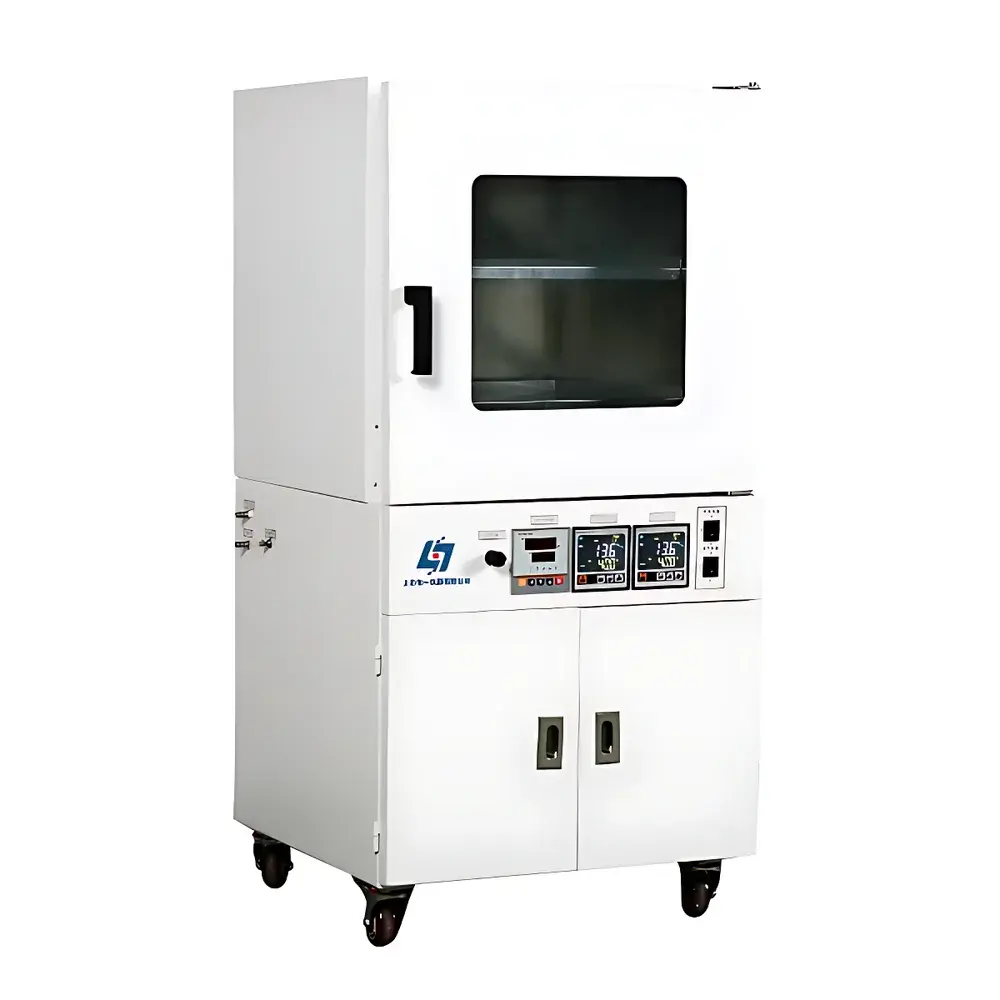
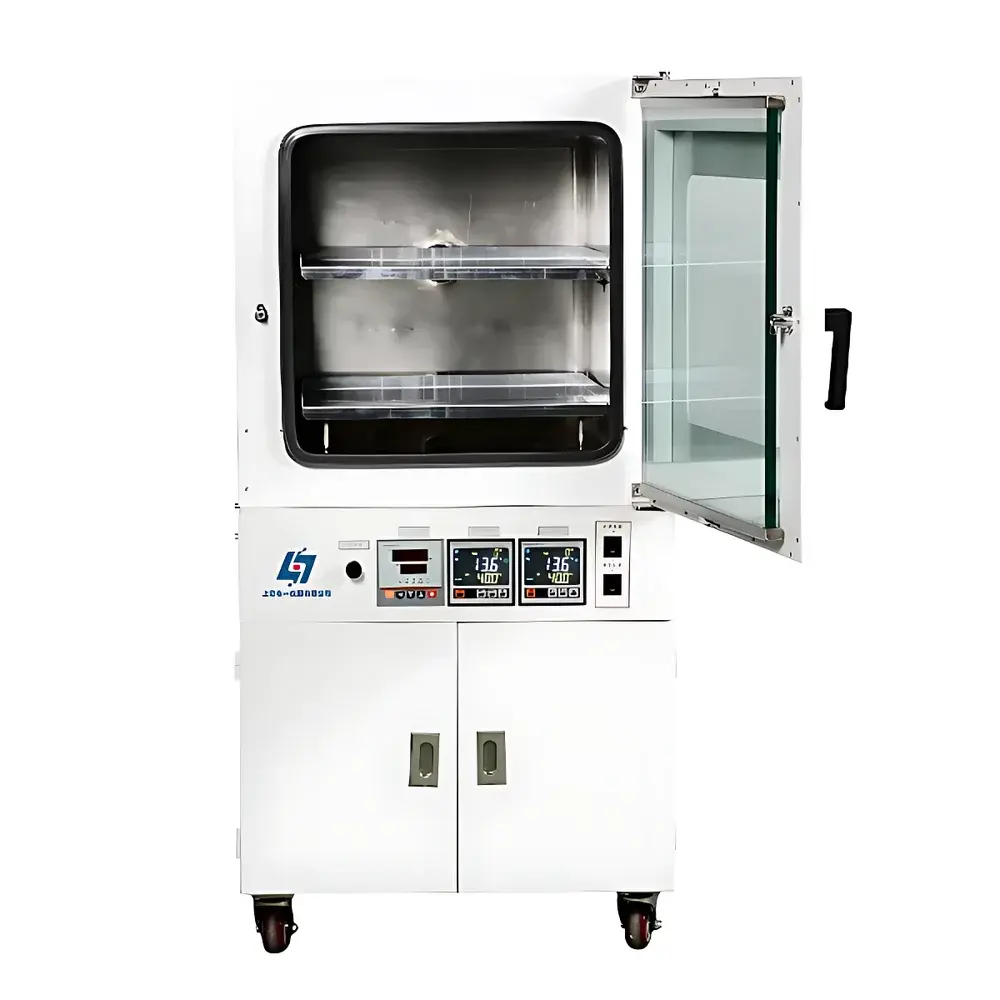
Yoyi DZF-6210SC Automatic Nitrogen-Purged Vacuum Drying Oven with Pressure & Temperature Control
| Brand | Yoyi |
|---|---|
| Origin | Shanghai, China |
| Manufacturer Type | Direct Manufacturer |
| Product Category | Domestic |
| Model | DZF-6210SC |
| Instrument Type | Vacuum Oven |
| Temperature Range | RT+10°C to 250°C |
| Temperature Uniformity | ±1°C |
| External Dimensions | 720 × 805 × 1680 mm |
| Internal Chamber Dimensions | 560 × 600 × 640 mm |
| Temperature Resolution | 0.1°C |
| Chamber Material | Stainless Steel |
| Ultimate Vacuum Level | ≤133 Pa |
| Vacuum Control | Electromagnetic Valve, 5-Stage Programmable Pressure Holding (0–9999 min per stage) |
| Nitrogen Inlet | Quick-Connect Φ10 mm Fitting |
| Power Input | 220 V AC, 50 Hz, 2200 W |
Overview
The Yoyi DZF-6210SC is an engineered vacuum drying oven designed for controlled inert-atmosphere thermal processing under reduced pressure and regulated nitrogen backfilling. It operates on the principle of simultaneous vacuum evacuation and programmable inert gas reintroduction—enabling precise maintenance of low-oxygen environments during heating and drying cycles. Unlike conventional convection ovens, this system eliminates oxidative degradation pathways by removing ambient air prior to thermal treatment and sustaining a stable, low-pressure nitrogen atmosphere throughout operation. Its architecture integrates vacuum thermodynamics with microprocessor-based environmental regulation, making it suitable for applications where sample integrity depends on oxygen exclusion, moisture removal under mild thermal conditions, and reproducible pressure-temperature profiles.
Key Features
- Microprocessor-controlled PID temperature regulation with 0.1°C resolution and ±1°C uniformity across the 560 × 600 × 640 mm stainless steel chamber
- Electromagnetically actuated vacuum control system supporting 5-stage, 5-segment programmable pressure holding—each segment adjustable from 0 to 9999 minutes
- Integrated quick-connect nitrogen inlet (Φ10 mm) enabling automatic purging, pressure stabilization, and timed inert-gas replenishment
- Double-layer tempered glass observation door with silicone gasket seal, rated for sustained operation at ≤133 Pa ultimate vacuum
- Ceramic fiber insulation between outer cold-rolled steel casing and inner stainless steel chamber, minimizing thermal loss and improving energy efficiency
- Aluminum alloy shelving fabricated via high-temperature stamping—resistant to oxidation up to 250°C and optimized for rapid, uniform heat transfer
- Intelligent power recovery function preserving set parameters after unexpected power interruption or system reset
- Backlit LCD interface displaying real-time vacuum level (LED digital readout), temperature, elapsed time, and active program stage
Sample Compatibility & Compliance
The DZF-6210SC accommodates thermally sensitive, oxidation-prone, or compositionally complex samples—including pharmaceutical intermediates, polymer precursors, battery electrode slurries, biological extracts, and nanomaterials. Its ability to operate between ambient +10°C and 250°C under sub-atmospheric conditions ensures compatibility with ASTM E145 (Standard Practice for Gravity-Convection and Forced-Ventilation Ovens), ISO 12099 (Animal feeding stuffs — Guidance on laboratory quality assurance), and USP & EP chapters governing residual solvent analysis and stability testing. While not intrinsically certified for GMP/GLP environments, its programmable vacuum-nitrogen cycling, parameter logging capability, and deterministic control logic support audit-ready workflows when integrated into validated laboratory systems compliant with FDA 21 CFR Part 11 requirements.
Software & Data Management
The embedded controller supports non-volatile memory storage for up to 10 user-defined drying protocols, each comprising multiple temperature ramps, dwell times, vacuum hold stages, and nitrogen injection sequences. All operational parameters—including actual chamber temperature, measured vacuum level, elapsed cycle time, and alarm events—are timestamped and retained in internal memory. Data export is accessible via RS-232 serial interface (optional USB adapter available) for integration with LIMS or custom SCADA platforms. The system logs critical fault conditions (e.g., overtemperature, vacuum failure, door interlock breach) with persistent event history, facilitating root-cause analysis and compliance documentation.
Applications
- Drying of heat-labile APIs and excipients without decomposition or Maillard reactions
- Moisture removal from lithium-ion battery cathode/anode materials prior to cell assembly
- Stabilization of metal-organic frameworks (MOFs) and porous carbons under inert conditions
- Preparation of calibration standards for trace moisture analysis (e.g., Karl Fischer titration)
- Accelerated aging studies of adhesives, coatings, and composite resins under controlled oxygen depletion
- Residual solvent evaporation from chromatographic fractions or synthetic reaction mixtures
- Dehydration of botanical extracts and enzyme preparations while preserving bioactivity
FAQ
What vacuum level can the DZF-6210SC achieve?
The unit achieves an ultimate vacuum of ≤133 Pa when paired with the included oil-lubricated rotary vane vacuum pump.
Can the nitrogen purge sequence be synchronized with temperature ramping?
Yes—the 5-stage vacuum/pressure program allows independent timing of nitrogen introduction relative to temperature setpoints.
Is the chamber volume sufficient for industrial-scale sample batches?
With 212 L internal capacity (560 × 600 × 640 mm), it supports medium-throughput R&D and pilot-scale drying, though not continuous production.
Does the system comply with electromagnetic compatibility (EMC) standards?
It meets CE marking requirements per EN 61326-1 for laboratory electrical equipment in industrial environments.
How is temperature uniformity verified across the working chamber?
Uniformity is validated using calibrated PT100 sensors placed at nine standardized locations per IEC 60068-3-5, confirming ±1°C tolerance at steady state.



