
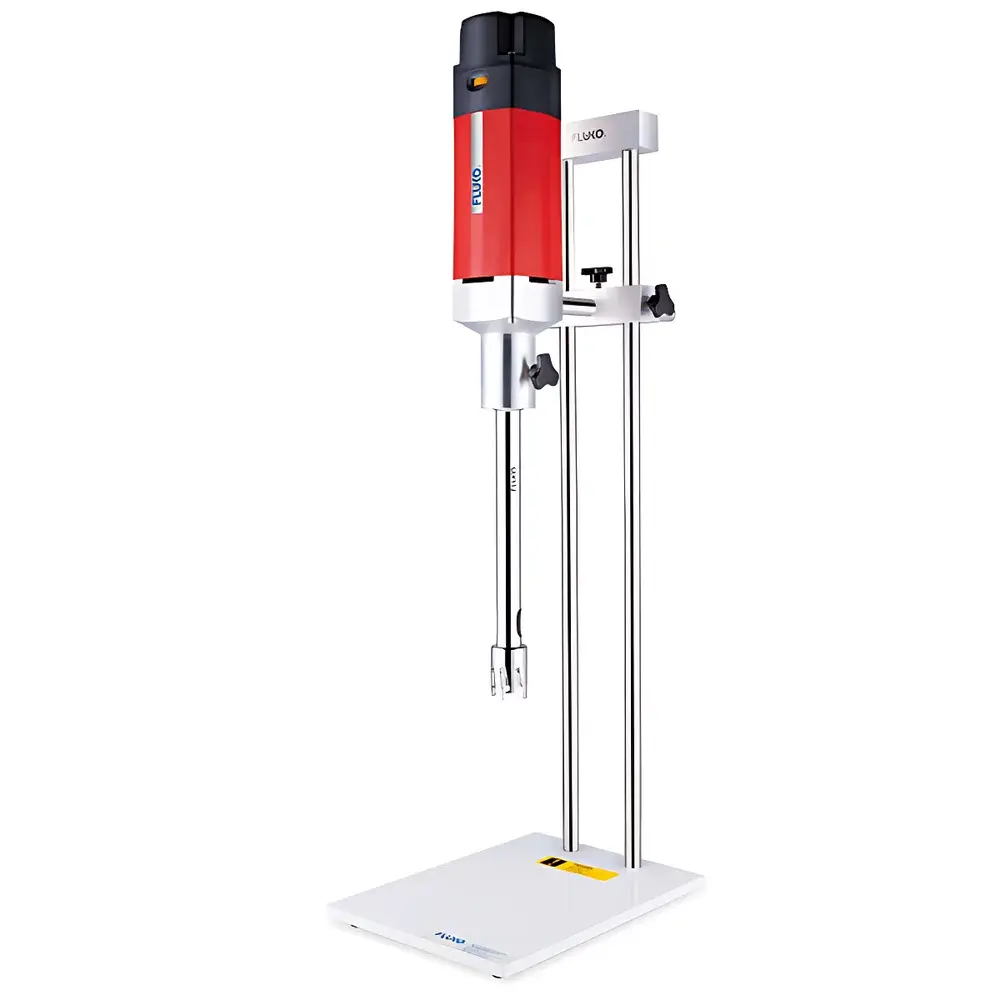
FLUKO FA40 High-Shear Disperser and Homogenizer
| Brand | FLUKO |
|---|---|
| Origin | Shanghai, China |
| Manufacturer Type | Authorized Distributor |
| Country of Origin | China |
| Model | FA40 |
| Instrument Type | Probe-Type Rotor-Stator Homogenizer |
| Dimensions (W×D×H) | 250 × 375 × 860 mm |
| Processing Volume | 500–15,000 mL |
| Motor Power | 1800 W |
| Voltage/Frequency | 220 V, 50/60 Hz |
| Speed Range | 2,500–23,500 rpm |
| Maximum Tip Speed | 40 m/s |
| Max. Viscosity | 8,000 cP |
| Shaft Seal Material | PTFE |
| Wetted Parts Material | SS316L |
| Speed Display | Analog Dial |
| Speed Control | Continuous Variable |
| Ambient Temperature Range | 5–40 °C |
| Relative Humidity Limit | ≤80% |
| Protection Rating | IP20 |
| Net Weight | ~12 kg |
Overview
The FLUKO FA40 High-Shear Disperser and Homogenizer is an industrial-grade laboratory rotor-stator system engineered for reproducible, scalable processing of demanding colloidal and multiphase systems. Operating on the principle of controlled hydrodynamic cavitation and intense shear generation within a fixed-gap stator-rotor geometry, the FA40 delivers consistent energy input across batch volumes from 500 mL to 15,000 mL. Its high-speed induction motor—rated at 1800 W—enables rotational speeds up to 23,500 rpm, translating to tip speeds of 40 m/s at the 40 mm diameter working head. This kinetic energy density facilitates efficient particle size reduction, droplet breakup, cell lysis, and interfacial stabilization in emulsions and suspensions. Designed for benchtop-to-pilot transition workflows, the FA40 integrates mechanical robustness with modular ergonomics, supporting routine use in QC laboratories, formulation development, and process optimization under GLP-aligned conditions.
Key Features
- High-torque, brushless induction motor delivering stable performance across full speed range (2,500–23,500 rpm) without thermal derating
- SS316L wetted components compliant with ISO 8503-2 surface roughness standards for pharmaceutical and biotech applications
- PTFE-sealed shaft assembly ensuring chemical resistance and low maintenance in aqueous and solvent-based media
- Modular probe design with standardized 40M stator-rotor head; interchangeable with other FLUKO FA-series heads (e.g., 25M, 60M) for viscosity- or scale-matched operation
- Analog dial speed indicator offering immediate visual feedback without digital latency or calibration drift
- Stainless steel support stand and heavy-duty base providing vibration damping during high-load operation
- IP20-rated motor housing suitable for controlled laboratory environments (5–40 °C, ≤80% RH), compatible with fume hood integration
Sample Compatibility & Compliance
The FA40 accommodates a broad spectrum of sample types—including low- to high-viscosity Newtonian and non-Newtonian fluids (up to 8,000 cP), heat-sensitive biological suspensions, abrasive pigment dispersions, and thermally labile polymer melts—without requiring pre-dilution or temperature compensation. Its SS316L contact surfaces meet ASTM F899 requirements for stainless steel composition and passivation validation. While not certified for GMP manufacturing environments per FDA 21 CFR Part 11, the device supports audit-ready documentation when paired with external electronic lab notebooks (ELNs) and calibrated torque/speed verification protocols aligned with ISO/IEC 17025 guidelines. Routine maintenance logs, head replacement records, and speed calibration certificates can be maintained to satisfy internal QA requirements for method transfer and equipment qualification (IQ/OQ).
Software & Data Management
The FA40 operates as a standalone analog instrument with no embedded firmware or data logging capability. Speed settings are manually adjusted via continuous variable control, eliminating software dependencies and cybersecurity concerns associated with connected devices. For traceable operation, users integrate the unit into validated workflows using external timing devices, digital tachometers (e.g., Fluke 901), and calibrated torque sensors. When deployed in regulated environments, SOPs define maximum allowable run durations, post-use cleaning verification (e.g., ATP swab testing), and periodic mechanical inspection intervals—ensuring consistency across operators and shifts. Data generated (e.g., time, speed, volume, temperature) is recorded manually or imported into LIMS-compatible spreadsheets meeting ALCOA+ principles (Attributable, Legible, Contemporaneous, Original, Accurate, Complete, Consistent, Enduring, Available).
Applications
- Preparation of oil-in-water and water-in-oil emulsions for cosmetic and food R&D
- Dispersion of nanomaterials (e.g., graphene oxide, metal oxides) in polymer matrices and aqueous surfactant systems
- Cell disruption and subcellular fractionation in microbiology and protein purification workflows
- Homogenization of vaccine adjuvants and lipid nanoparticle (LNP) formulations prior to extrusion or filtration
- Viscosity reduction and deagglomeration of ceramic slurries and battery electrode pastes
- Accelerated stability testing of suspensions via controlled shear history application
FAQ
Is the FA40 suitable for sterile processing?
No—the FA40 is not autoclavable or designed for aseptic operation. Sterile applications require post-processing filtration or integration with closed-system adapters validated separately.
Can the FA40 be used with corrosive solvents like THF or DMF?
Yes, provided the SS316L and PTFE components remain intact; however, prolonged exposure to strong oxidizers (e.g., nitric acid) or halogenated solvents above 60 °C may compromise seal integrity.
What is the recommended maintenance schedule?
Inspect rotor-stator clearance and bearing play every 200 operating hours; replace PTFE shaft seals annually or after 500 cycles, whichever occurs first.
Does FLUKO provide IQ/OQ documentation templates?
Yes—FLUKO’s regional technical support team supplies editable qualification templates aligned with ISO 13485 and USP frameworks upon request.
Is speed accuracy traceable to NIST standards?
Speed indication is analog and uncalibrated by default; users must verify actual rpm using an external Class 1 tachometer traceable to national metrology institutes.



