
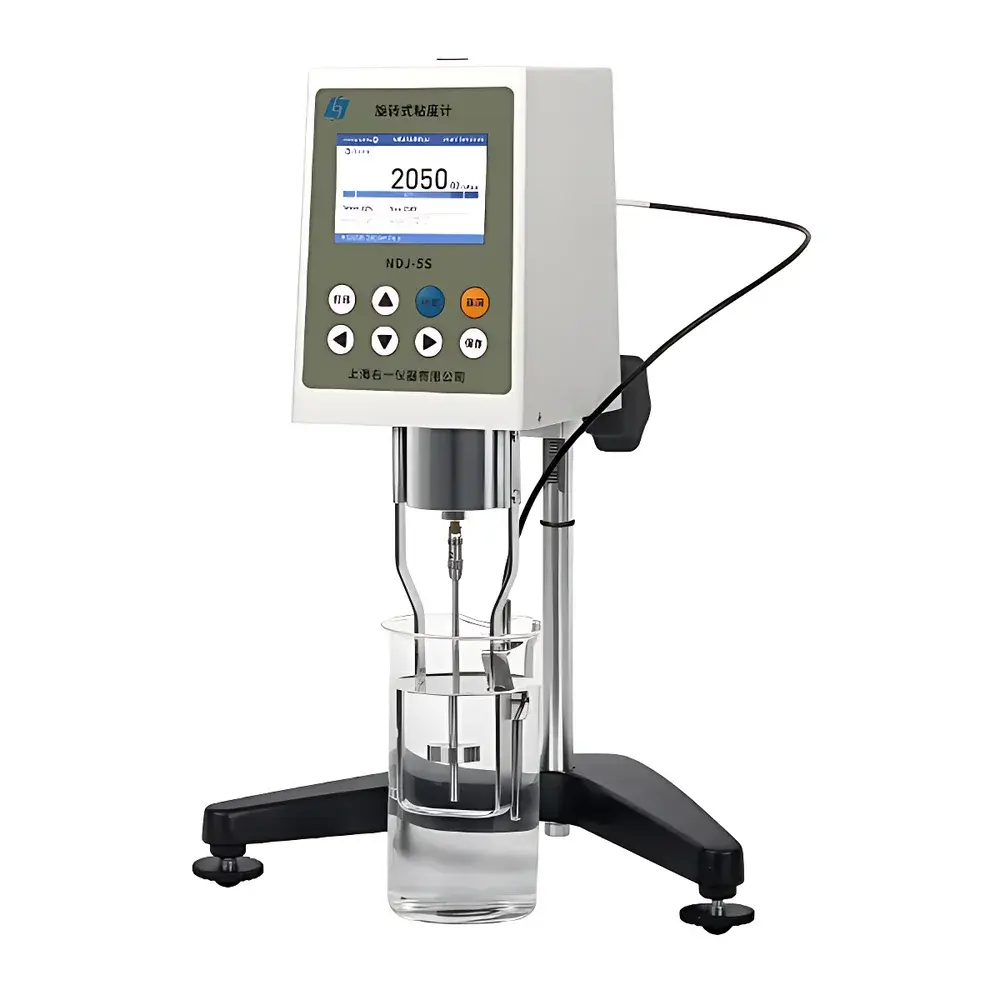
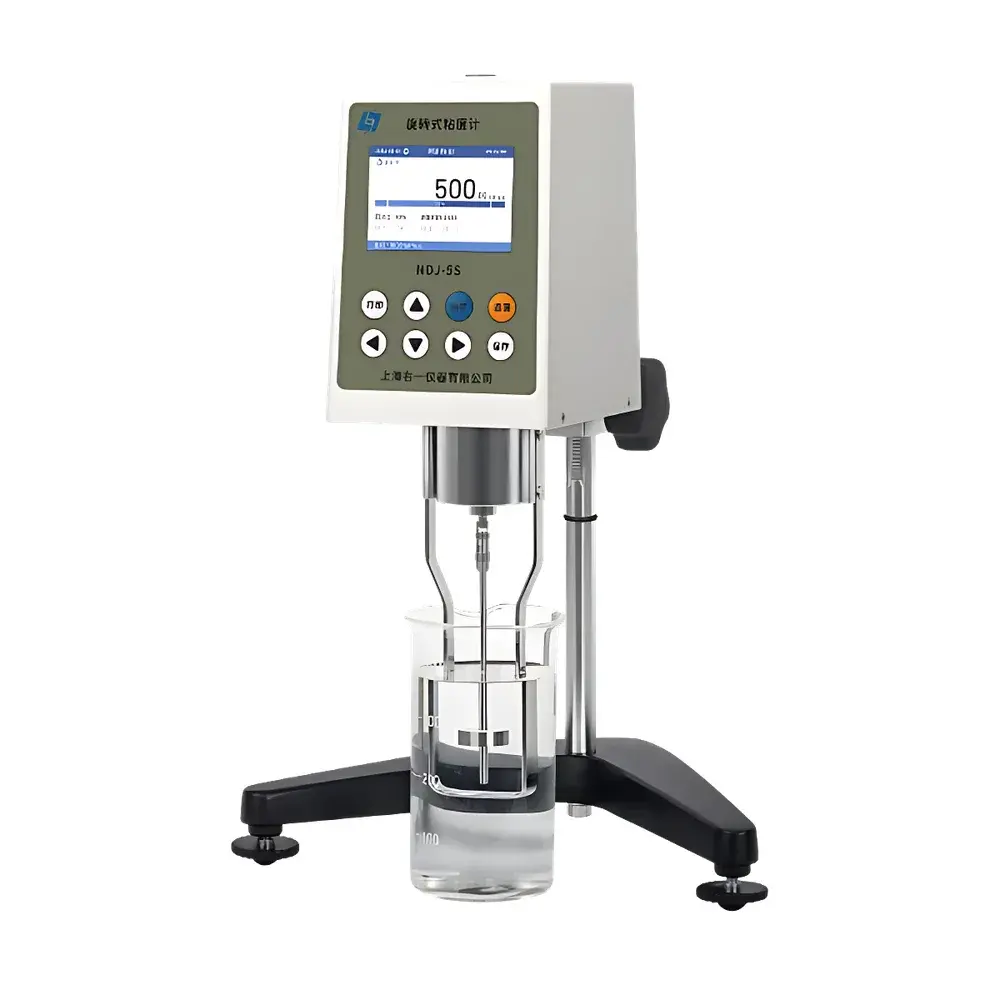
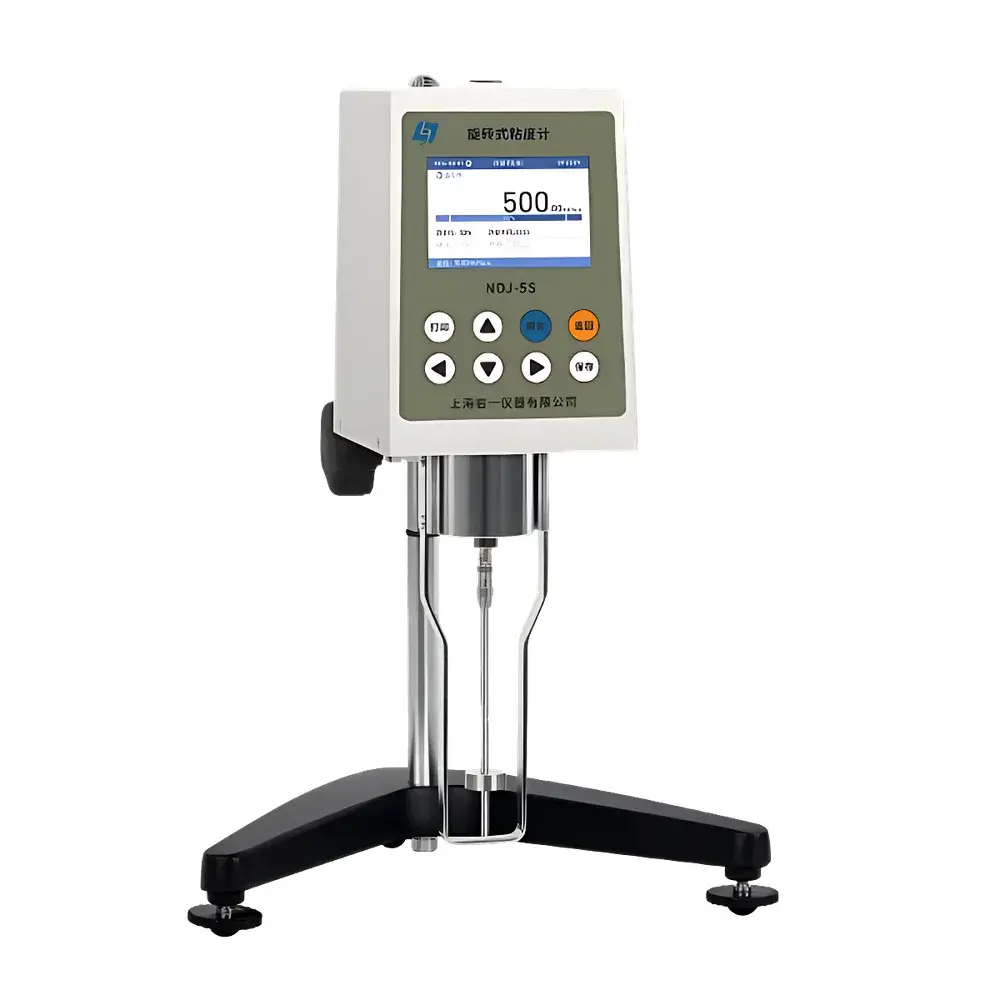
Yoyilab NDJ-5S Digital Rotational Viscometer with 3.5-inch IPS High-Resolution Color Display
| Brand | Yoyilab |
|---|---|
| Origin | Shanghai, China |
| Manufacturer Type | Direct Manufacturer |
| Model | NDJ-5S |
| Viscosity Range | 0.1–100,000 mPa·s |
| Temperature Range | 0–150 °C |
| Temperature Resolution | 0.01 °C |
| Temperature Accuracy | ±2 °C |
| Viscosity Resolution | 0.01 mPa·s |
| Measurement Accuracy | ±2% (for Newtonian fluids) |
| Repeatability | ±1% (for Newtonian fluids) |
| Speed Settings | 6, 12, 30, 60 rpm |
| Standard Spindles | #1–#4 |
| Compliance | JJG 1002–2005 (Chinese National Verification Regulation for Rotational Viscometers) |
Overview
The Yoyilab NDJ-5S Digital Rotational Viscometer is a precision-engineered instrument designed for reliable and repeatable viscosity measurement of Newtonian and mildly non-Newtonian fluids across laboratory, quality control, and R&D environments. Based on the Couette principle, it determines dynamic viscosity by measuring the torque required to rotate a spindle—immersed in the sample—at a constant angular velocity. The resulting shear stress and shear rate relationship enables quantification of apparent viscosity under defined rotational conditions. This model is calibrated and verified per JJG 1002–2005, China’s national metrological verification regulation for rotational viscometers, ensuring traceable performance within specified uncertainty limits. Its compact benchtop architecture integrates mechanical stability, electromagnetic shielding, and ergonomic height-adjustable support, making it suitable for routine testing where reproducibility, operator independence, and regulatory alignment are essential.
Key Features
- 3.5-inch IPS high-resolution color display offering crisp, sunlight-readable visualization of real-time viscosity, spindle number, rotational speed, sample temperature, torque percentage, and maximum measurable viscosity for the selected spindle–speed combination
- Microprocessor-based control system with embedded firmware supporting three distinct operational modes: Quick Mode (auto-hold upon signal stabilization), Timed Mode (programmable duration up to 99 minutes), and Auto-Scan Mode (intelligent spindle/speed recommendation based on preliminary torque feedback)
- Four fixed-speed settings (6, 12, 30, 60 rpm) paired with four standard spindles (#1–#4), delivering 16 discrete measurement configurations optimized for the 0.1–100,000 mPa·s range
- Integrated USB and RS-232 interfaces enabling direct data export to PCs or printers—including timestamp, spindle ID, speed, viscosity value, temperature reading, torque %, and measurement duration—for audit-ready documentation
- Adjustable leveling base with bubble level and 250 mm vertical travel range, facilitating precise immersion depth control and alignment across diverse sample containers
- Onboard memory stores up to 50 measurement records; supports kinematic viscosity conversion when density input is provided; optional temperature probe enables real-time thermal monitoring during testing
Sample Compatibility & Compliance
The NDJ-5S is validated for use with low-to-medium-viscosity liquids exhibiting predominantly Newtonian behavior, including solvent-based adhesives, pharmaceutical suspensions, food emulsions, water-based coatings, polymer solutions, and chemical intermediates. While not intended for highly thixotropic, yield-stress, or time-dependent materials without protocol adaptation, its fixed-speed design ensures consistent shear history for comparative QC workflows. Compliance with JJG 1002–2005 confirms conformance to national metrological requirements for accuracy, repeatability, and environmental robustness. Though not certified to ISO/IEC 17025 or ASTM D2196/D1084, the instrument’s documented calibration traceability, stable thermal response, and deterministic torque transduction support GLP-aligned data generation when operated within its specified ambient conditions (0–40 °C, ≤80% RH) and using validated spindles.
Software & Data Management
No proprietary software installation is required—the NDJ-5S operates as a standalone instrument with full local data handling. All measurements are timestamped and stored internally with metadata (spindle, speed, temperature, torque %). Exported CSV-formatted reports via USB or RS-232 contain structured fields compatible with LIMS integration, Excel analysis, or statistical process control (SPC) platforms. The device supports bilingual UI (English/Chinese), allowing seamless operation in multilingual lab environments. While it does not implement FDA 21 CFR Part 11 electronic signature or audit trail features, its deterministic measurement logic, non-volatile memory retention, and immutable raw parameter logging provide foundational integrity for internal QA documentation and batch release verification under GMP-adjacent protocols.
Applications
- Quality assurance of industrial lubricants, ink formulations, and resin dilutions prior to coating or casting
- Routine viscosity checks of syrups, dressings, and dairy-based beverages to ensure consistency in texture and pumpability
- Stability assessment of topical gels and ophthalmic solutions during formulation development
- Batch-to-batch verification of adhesive viscosity in electronics assembly and packaging lines
- Educational demonstrations of rheological principles—including shear-thinning behavior—using standardized reference oils
- Pre-screening of polymer melt precursors before advanced rheometry or extrusion trials
FAQ
What spindle configurations are included with the NDJ-5S?
The instrument ships with four standard spindles (#1, #2, #3, and #4). A #0 spindle is available as an optional accessory for extended low-viscosity measurement down to 0.1 mPa·s.
Is temperature control built into the instrument?
No—the NDJ-5S does not include active temperature regulation. It accepts an external PT100-compatible temperature probe (optional) for ambient or bath-measured sample temperature input.
Can measurement data be exported in real time?
Yes—via USB or RS-232, the device streams live parameters (viscosity, speed, torque %, temperature) at user-defined intervals, enabling synchronized acquisition with external DAQ systems or custom scripts.
How is calibration verified?
Calibration is performed using NIST-traceable silicone oil standards. Users may conduct intermediate verification using certified reference fluids; full recalibration should be performed annually or after mechanical impact per JJG 1002–2005 guidelines.
Does the NDJ-5S meet international regulatory requirements for pharmaceutical testing?
It complies with Chinese national metrological standards (JJG 1002–2005) and supports data integrity practices common in pharmaceutical QC labs. However, for USP or EP 2.9.36 compliance, method validation—including specificity, linearity, and robustness—must be conducted per site-specific SOPs.



