
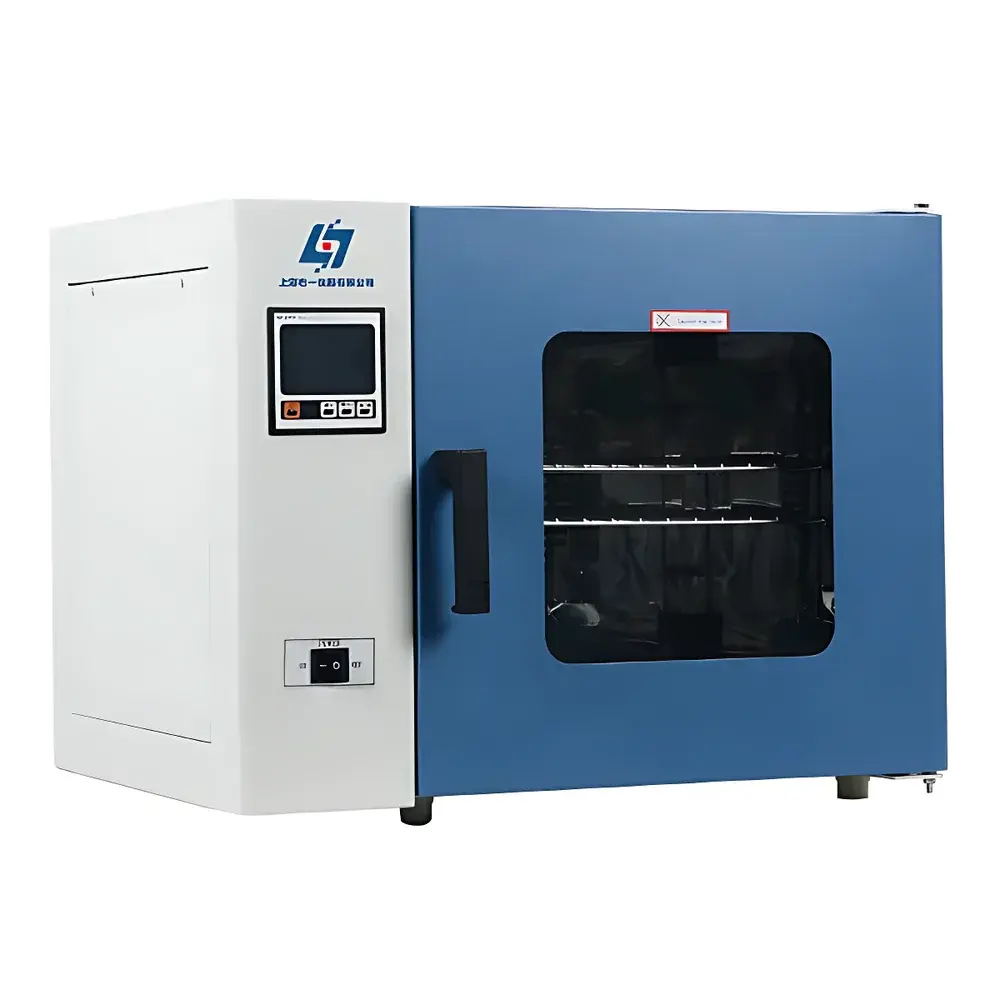
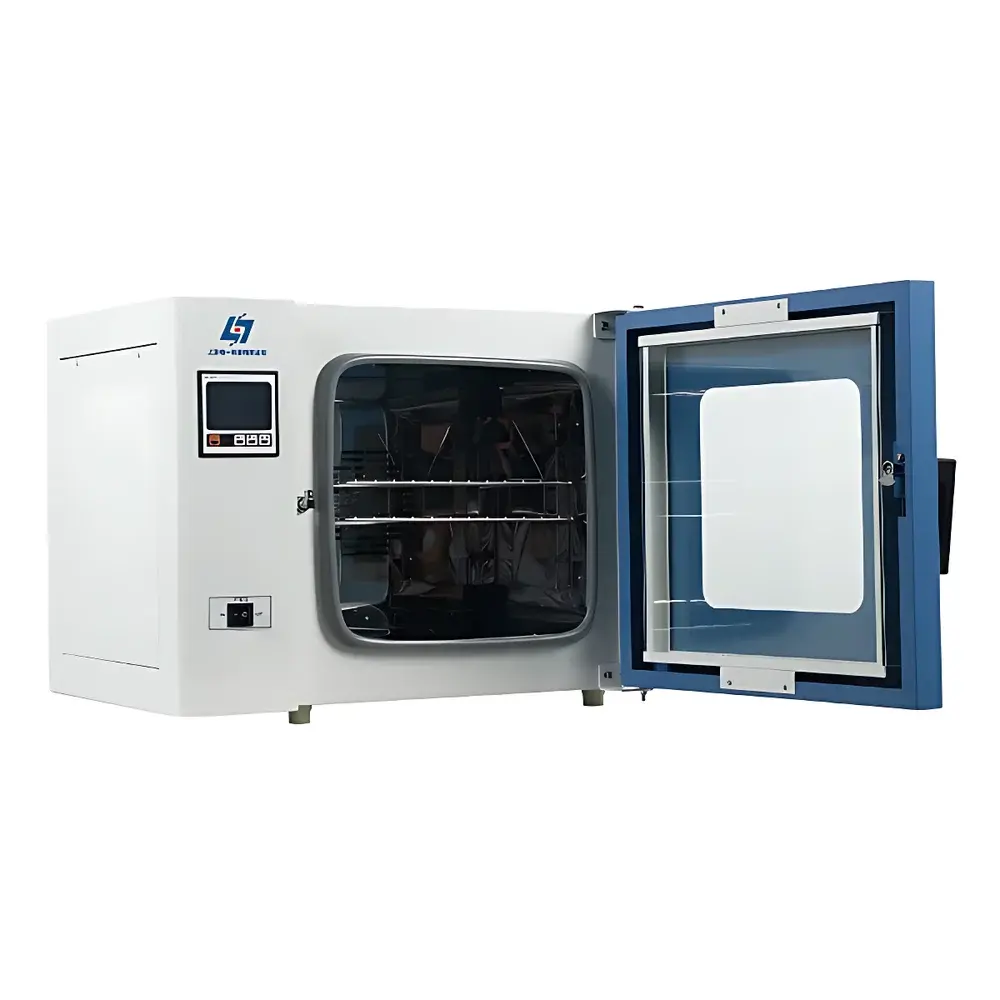
Yoyilab DHG-9070A Precision Forced-Air Drying Oven
| Brand | Yoyilab |
|---|---|
| Origin | Shanghai, China |
| Manufacturer Type | Direct Manufacturer |
| Product Category | Domestic |
| Model | DHG-9070A |
| Instrument Type | Precision Drying Oven |
| Temperature Range | RT+10°C to 250°C |
| Temperature Uniformity | ±2.5% (at 100°C) |
| Temperature Fluctuation | ±1°C |
| Temperature Resolution | 0.1°C |
| External Dimensions | 735 × 615 × 630 mm |
| Internal Chamber Dimensions | 450 × 400 × 450 mm |
| Internal Chamber Material | Mirror-Finish Stainless Steel (SUS304) |
| Heating Method | Forced-Air Circulation via Rear-Mounted Centrifugal Blower |
| Power Supply | AC 220 V, 50 Hz |
| Rated Power | 1550 W |
| Net Volume | 80 L |
| Load Capacity | 2 Adjustable Stainless Steel Shelves |
| Timer Range | 1–9999 min |
| Operating Ambient | 5–40°C, ≤80% RH (non-condensing) |
| Compliance | GB/T 30435–2013 |
Overview
The Yoyilab DHG-9070A is a precision forced-air drying oven engineered for laboratory and industrial applications requiring stable, uniform thermal environments across a wide operating range (RT+10°C to 250°C). Its design follows the fundamental principle of convective heat transfer enhanced by an optimized rear-mounted air circulation system—featuring a centrifugal blower and directional ductwork—to ensure rapid temperature recovery and high spatial uniformity (±2.5% at 100°C, per GB/T 30435–2013 test protocol). Unlike natural convection ovens, this model delivers consistent airflow throughout the chamber, minimizing thermal stratification and reducing process variability during drying, baking, sterilization, polymer curing, or moisture loss analysis. The unit is constructed for long-term reliability in regulated environments, with structural integrity validated under continuous operation at maximum setpoint and compliance-aligned validation support documentation available upon request.
Key Features
- Microprocessor-based intelligent temperature controller with dual-display LCD interface—simultaneously showing setpoint, real-time chamber temperature, and remaining timer duration
- Programmable over-temperature cut-off circuit (optional independent safety limiter) that interrupts heating if user-defined threshold is exceeded, meeting basic functional safety requirements for unattended operation
- Double-layer tempered glass observation window with silicone gasket seal—enabling visual monitoring without thermal disturbance or condensation interference
- Mirror-finish SUS304 stainless steel interior chamber and adjustable heavy-duty stainless steel shelves—resistant to corrosion, easy to clean, and compatible with routine disinfection protocols
- Electrostatically coated cold-rolled steel exterior housing—providing mechanical robustness and resistance to abrasion in shared lab spaces
- Integrated rear air intake/exhaust ports with passive humidity venting—automatically expelling condensed water vapor during low-temperature drying cycles without manual damper adjustment
- Power-loss recovery function—retains programmed parameters (setpoint, timer, alarm settings) after unexpected shutdown, resuming operation upon power restoration
Sample Compatibility & Compliance
The DHG-9070A supports diverse sample types including glassware, metal components, polymer films, biological substrates (e.g., agar plates post-incubation), pharmaceutical excipients, and ceramic precursors. Its 80 L working volume accommodates standard ISO/IEC 17025-compliant sample racks and multi-tier tray configurations. The oven conforms to GB/T 30435–2013 (“Electric Hot Air Drying Ovens”), which defines performance criteria for temperature stability, uniformity, and recovery time under no-load conditions. While not certified to UL/CSA or IEC 61010-1 out-of-the-box, its electrical architecture—including grounded chassis, thermal fusing, and isolation-rated control circuits—aligns with foundational safety expectations for Class II laboratory equipment. For GLP/GMP environments, optional RS485 communication enables integration into electronic lab notebook (ELN) systems with audit-trail-capable data logging when paired with compliant software.
Software & Data Management
Standard configuration includes local parameter storage and real-time display only. Optional interfaces expand traceability and automation capability: an RS485 port (with Modbus RTU protocol support) allows bidirectional communication with SCADA or LIMS platforms; an embedded thermal printer (optional) produces time-stamped hardcopy records of temperature profiles; and a 25 mm or 50 mm calibrated test port facilitates external probe insertion for independent validation (e.g., using NIST-traceable thermocouples). All optional peripherals are CE-marked and supplied with calibration certificates. Firmware supports firmware update via USB—ensuring compatibility with evolving data integrity standards such as FDA 21 CFR Part 11 when deployed with appropriate access controls and electronic signature modules.
Applications
- Drying of moisture-sensitive samples prior to gravimetric analysis (e.g., soil, feedstuffs, filter papers)
- Baking of coated substrates and printed circuit boards (PCBs) in electronics manufacturing QA labs
- Thermal conditioning of polymeric materials for tensile testing per ASTM D638
- Pre-sterilization warming of surgical instruments and glassware in hospital central supply departments
- Accelerated aging studies of packaging materials per ISO 11607
- Residual solvent removal from pharmaceutical intermediates under cGMP-aligned environmental controls
- Heat treatment of calibration standards and reference materials in metrology laboratories
FAQ
What is the temperature uniformity specification, and how is it verified?
Temperature uniformity is specified as ±2.5% at 100°C under no-load conditions, measured per GB/T 30435–2013 using nine calibrated PT100 sensors placed on a 3×3 grid within the working chamber.
Can the DHG-9070A be used for sterilization applications?
It is not designed or validated for microbial sterilization (e.g., autoclaving); however, dry-heat sterilization of glassware and metal tools at ≥160°C for ≥2 hours may be performed subject to internal validation per ISO 17665–1.
Is the oven suitable for inert-atmosphere processing?
Yes—optional inert gas inlet (with needle valve and float-type flowmeter) enables nitrogen or argon purging to suppress oxidation during thermal treatment of reactive materials.
Does the unit support multi-segment temperature programming?
Not in standard configuration; however, the optional multi-stage programmable controller (sold separately) provides up to 30 segments with ramp/soak logic and event-triggered outputs.
What maintenance is required to sustain performance accuracy?
Biannual verification of temperature sensor drift using a secondary reference thermometer and annual inspection of door gasket compression force and blower motor bearing condition are recommended per manufacturer’s maintenance schedule.



