
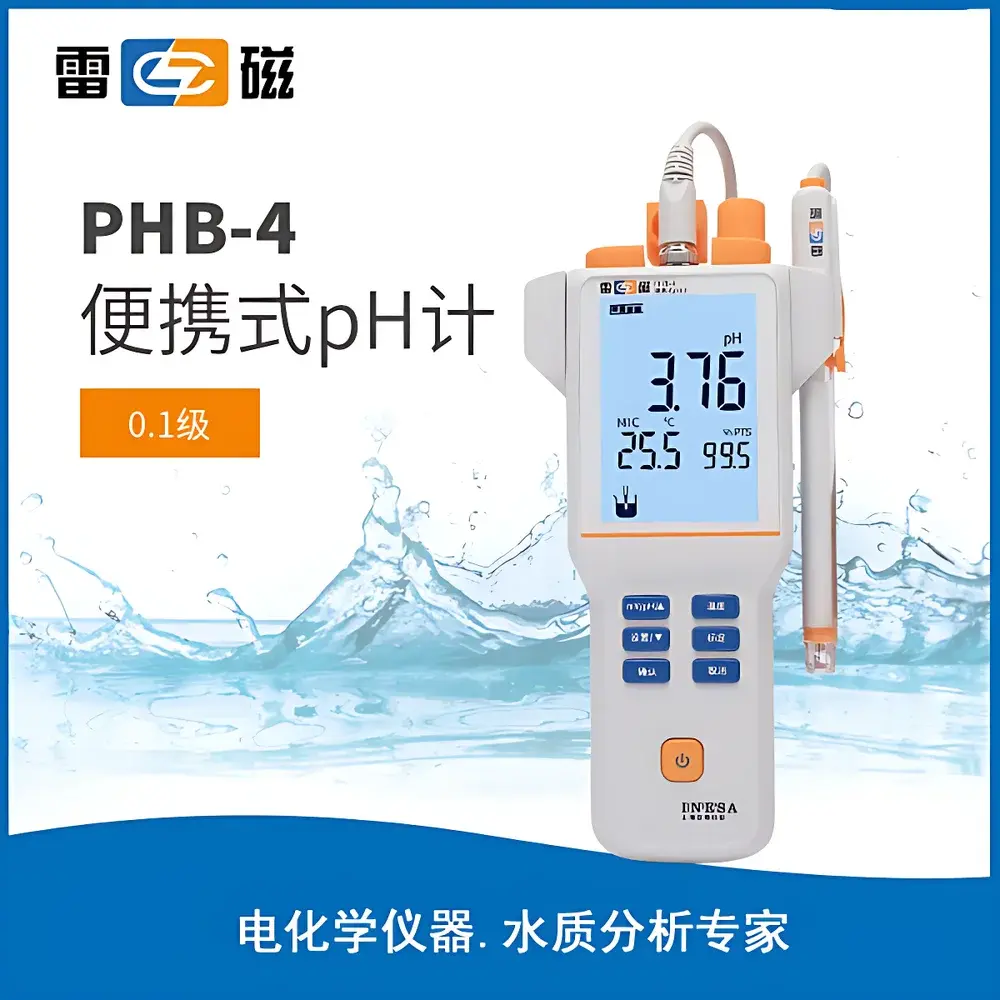
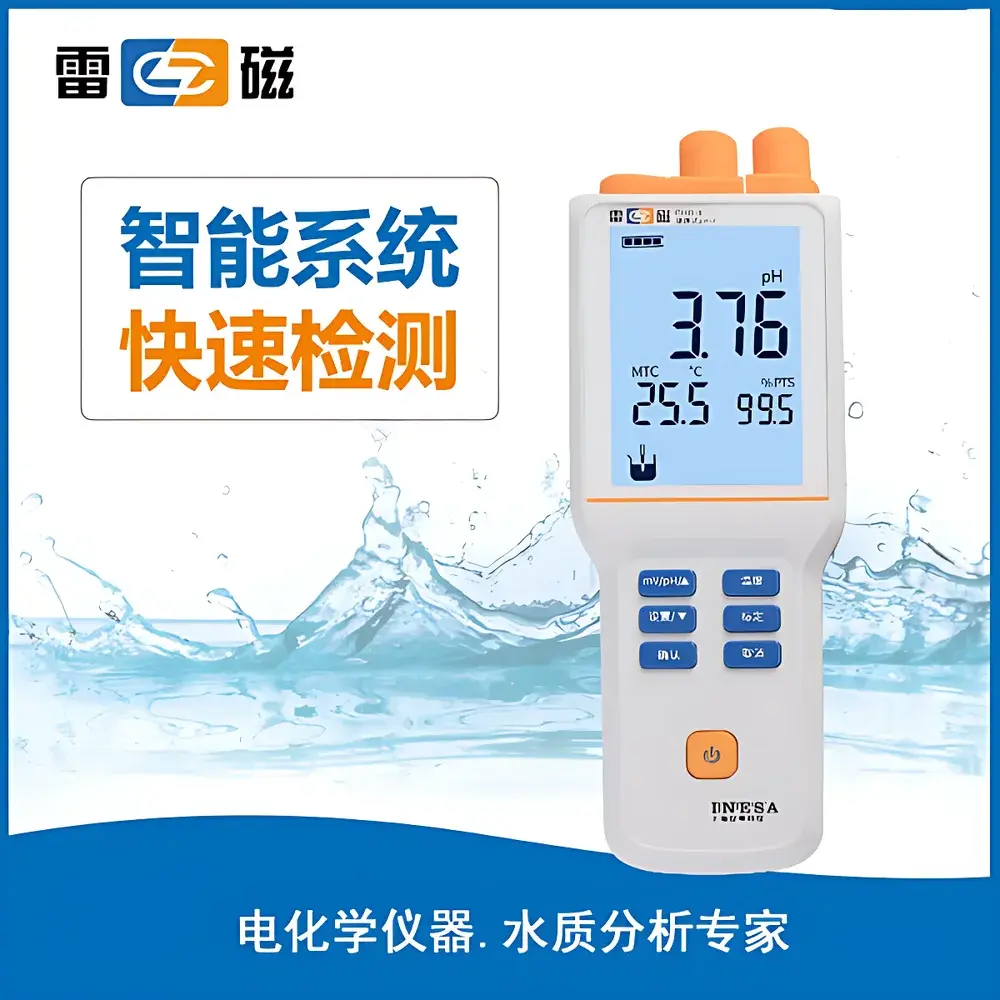
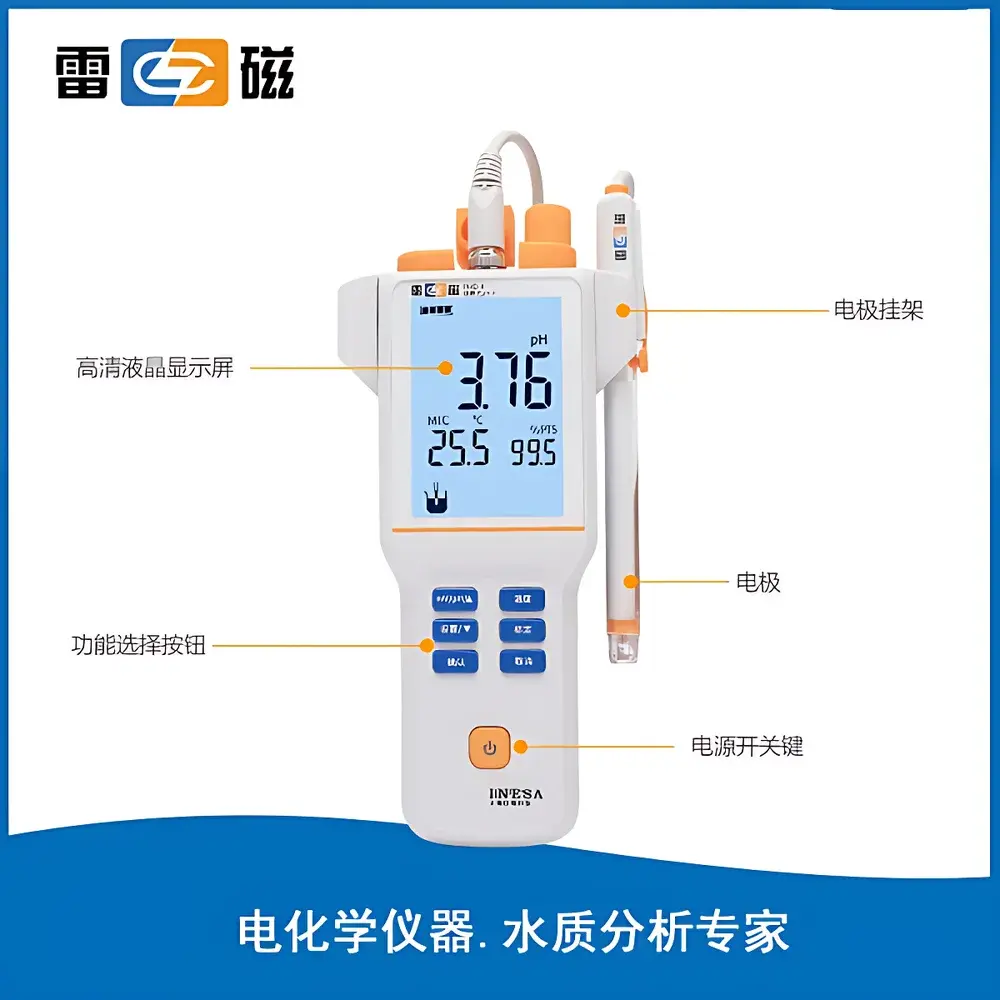
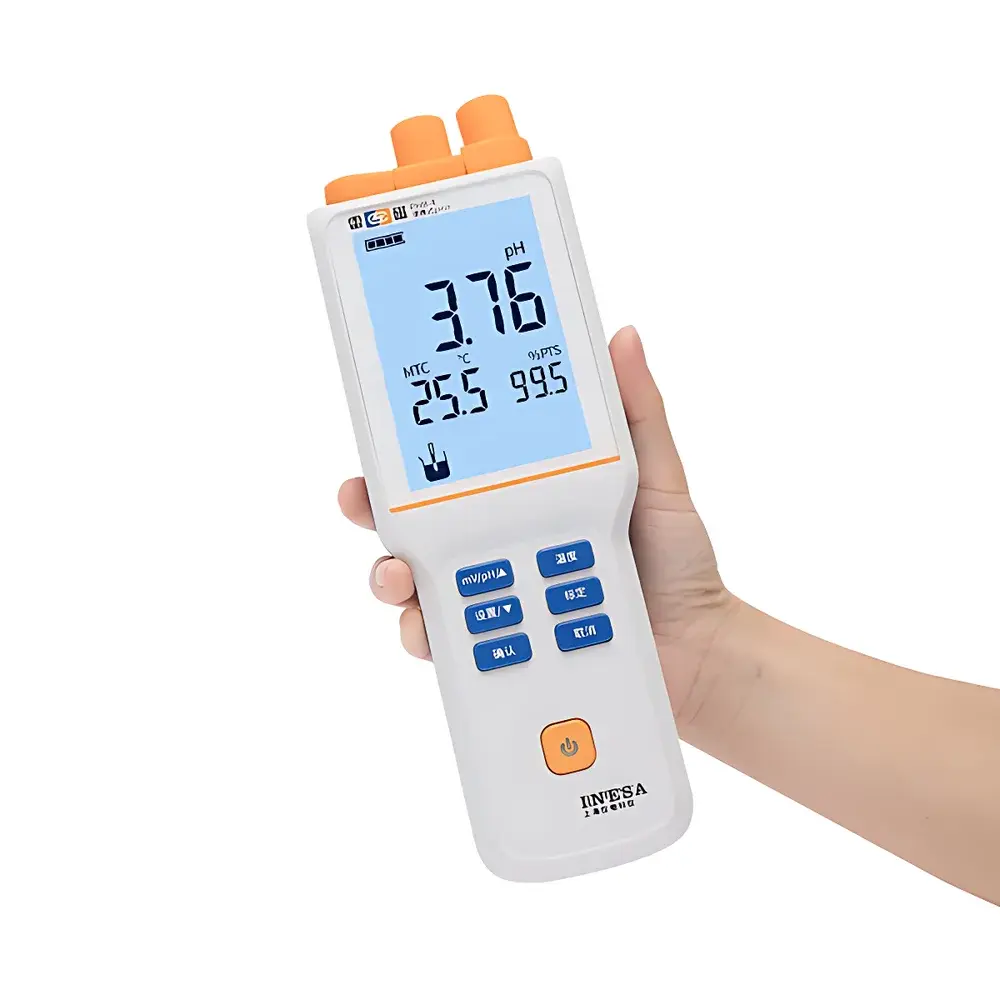
Leici PHB-4 Portable pH Meter
| Brand | Leici |
|---|---|
| Origin | Shanghai, China |
| Model | PHB-4 |
| Instrument Type | Portable |
| Parameter Type | Single-parameter (pH/mV) |
| Measurement Range | 0.00–14.00 pH |
| Resolution | 0.01 pH |
| Accuracy | ±0.01 pH ±1 digit |
| Temperature Compensation | Manual |
| Calibration Buffers | pH 4.01, 7.00, and 9.18 standard solutions |
| Display | Backlit LCD showing pH/mV and temperature simultaneously |
| Stability | ±0.03 pH ±1 digit / 3 h |
| Power Supply | 2 × AA alkaline batteries |
| Dimensions | 170 × 75 × 30 mm |
| Weight | 0.5 kg |
| Basic Error | ±0.03 pH |
Overview
The Leici PHB-4 Portable pH Meter is a compact, field-deployable electrochemical instrument engineered for reliable and repeatable measurement of hydrogen ion activity in aqueous solutions. Based on the potentiometric principle—where the potential difference between a pH-sensitive glass electrode and a stable reference electrode is converted into a logarithmic pH reading—the PHB-4 delivers traceable, NIST-traceable-compatible measurements across the full operational range of 0.00 to 14.00 pH. Designed for routine quality control and environmental monitoring tasks, it conforms to fundamental metrological requirements defined in ISO 7888 (Water quality — Determination of pH), ASTM D1293 (Standard Test Methods for pH of Water), and supports compliance with GLP documentation workflows when paired with manual logbook entries.
Key Features
- Backlit monochrome LCD display enabling clear visibility under low-light or outdoor conditions, simultaneously presenting pH (or mV/ORP) and temperature readings
- Manual temperature compensation (MTC) functionality, allowing users to input ambient or sample temperature values to correct for thermal drift in electrode response
- Two-point calibration protocol using standardized buffer solutions at pH 4.01 and 7.00 (or 9.18 for alkaline-range verification), ensuring linearization of electrode slope and offset
- Integrated mV (ORP) measurement mode with ±1400 mV range and 1 mV resolution, suitable for redox process monitoring in wastewater treatment or disinfection validation
- Rugged, ergonomic housing (170 × 75 × 30 mm; 0.5 kg) optimized for handheld operation, battery-powered portability, and resistance to incidental moisture exposure
- Low-power design powered by two AA alkaline cells, supporting continuous operation for up to 200 hours under typical usage conditions
Sample Compatibility & Compliance
The PHB-4 is intended for use with aqueous liquid samples exhibiting conductivity ≥50 µS/cm and total dissolved solids (TDS) < 10,000 ppm. It is not recommended for non-aqueous solvents, highly viscous media, or suspensions containing particulates that may foul the glass membrane. Electrode compatibility includes standard Leici E-201-C or equivalent combination pH electrodes with integrated Ag/AgCl reference systems. While the instrument itself does not provide electronic audit trails or user access controls, its manual calibration and measurement workflow aligns with foundational GLP practices for laboratories performing non-regulated testing. For regulated environments requiring 21 CFR Part 11 compliance, external data logging via serial output (optional RS232 interface) and paper-based record retention are supported.
Software & Data Management
The PHB-4 operates as a standalone, embedded-system device without onboard memory or USB connectivity. All measurements are displayed in real time and require manual transcription into laboratory notebooks or LIMS-compatible spreadsheets. Optional analog/digital output modules (e.g., 0–5 V or 4–20 mA transmitters) can be interfaced for integration into SCADA or PLC-based process monitoring networks. Firmware updates are not field-upgradable; calibration constants and system settings remain fixed per factory configuration to ensure measurement integrity and reproducibility across instrument lifecycles.
Applications
- Environmental field surveys: On-site pH assessment of surface water, groundwater, effluent streams, and soil leachates
- Educational laboratories: Undergraduate chemistry and environmental science instruction where robustness and ease-of-use outweigh advanced data handling needs
- Pharmaceutical water systems: Monitoring purified water (PW) and water-for-injection (WFI) distribution loops during routine checks—subject to supplementary validation per USP
- Food and beverage QA/QC: Batch verification of rinse water, brine solutions, and processing tank contents prior to product contact
- Municipal and industrial wastewater treatment: Tracking neutralization efficiency across lime dosing stages or biological reactor influents/effluents
FAQ
What calibration buffers are required for daily operation?
The PHB-4 requires at least two certified NIST-traceable buffer solutions—typically pH 4.01 and 7.00—for two-point calibration. A third point at pH 9.18 is recommended when measuring alkaline samples regularly.
Does the instrument support automatic temperature compensation (ATC)?
No. The PHB-4 implements manual temperature compensation only; users must enter the measured sample temperature via keypad before initiating calibration or measurement.
Can the PHB-4 be used with non-Leici electrodes?
Yes, provided the electrode features a BNC connector, standard Ag/AgCl reference system, and output impedance compatible with high-impedance (>1012 Ω) input circuitry.
Is the device suitable for ISO/IEC 17025-accredited testing?
It may serve as a secondary or screening tool within accredited labs, but full compliance requires documented electrode certification, traceable buffer verification, and procedural adherence to ISO/IEC 17025 Clause 6.4 on equipment management.
How often should the electrode be cleaned and stored?
Electrodes should be rinsed with deionized water after each use, immersed in 3 mol/L KCl storage solution when not in service, and cleaned periodically with mild detergent or enzyme solution depending on sample matrix fouling.





