
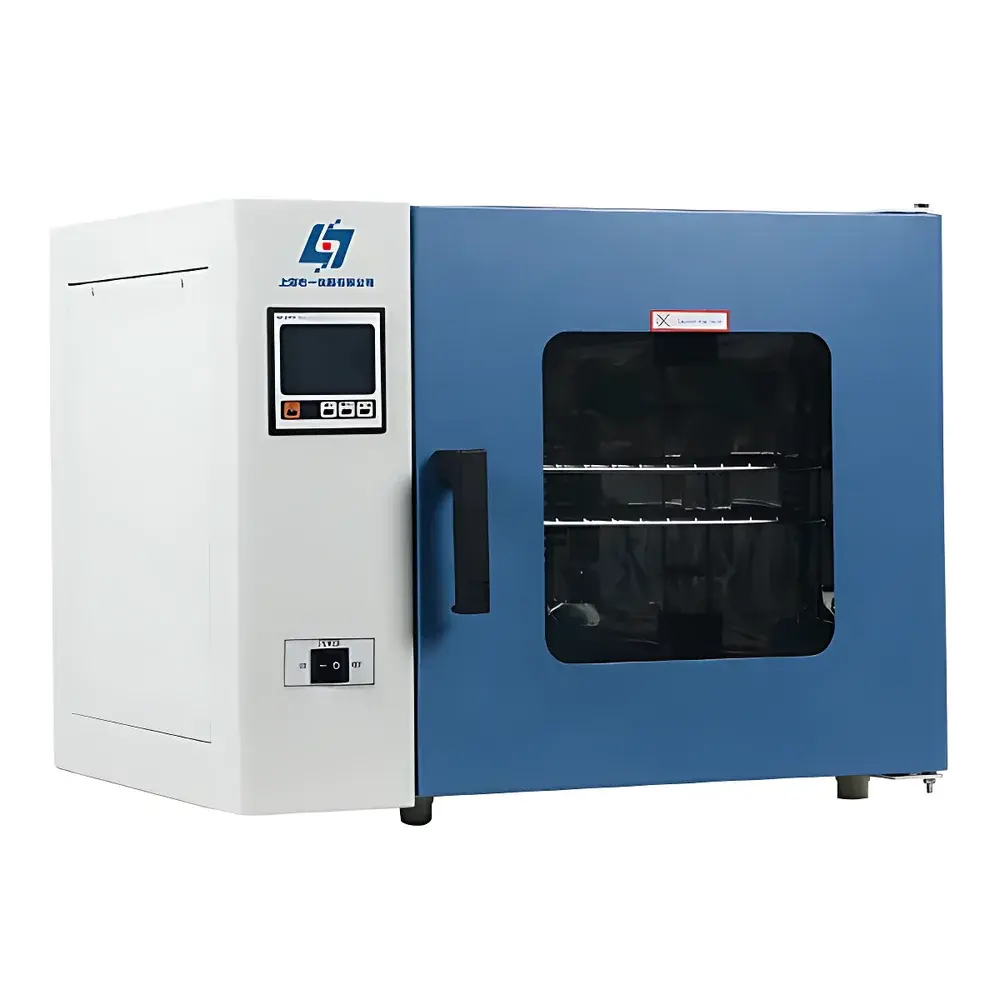
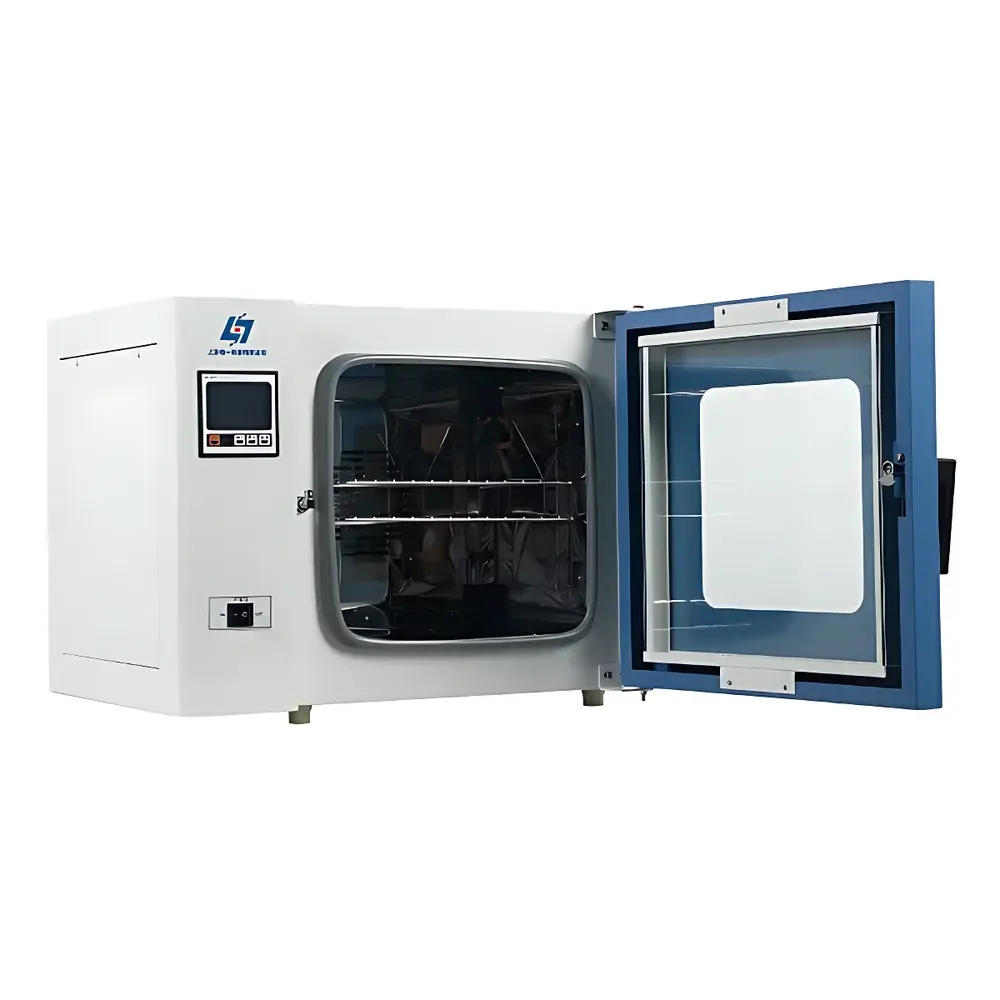
Yoyilab DHG-9050A Precision Forced-Air Drying Oven
| Brand | Yoyilab |
|---|---|
| Origin | Shanghai, China |
| Manufacturer Type | Direct Manufacturer |
| Product Category | Domestic |
| Model | DHG-9050A |
| Temperature Range | RT+10 °C to 250 °C |
| Temperature Uniformity | ±2.5% (at 100 °C) |
| Temperature Fluctuation | ±1 °C |
| Temperature Resolution | 0.1 °C |
| External Dimensions | 705 × 610 × 530 mm |
| Internal Chamber Dimensions | 420 × 350 × 390 mm |
| Internal Chamber Material | Mirror-Finish Stainless Steel (SUS304) |
| Heating Method | Forced-Air Circulation via Rear-Mounted Centrifugal Blower |
| Power Input | 1100 W |
| Rated Voltage/Frequency | AC 220 V / 50 Hz |
| Working Environment | 5 °C to 40 °C ambient, ≤80% RH |
| Net Volume | 50 L |
| Standard Shelving | 2 adjustable stainless steel trays |
| Timer Range | 1–9999 minutes |
| Compliance | GB/T 30435–2013 |
Overview
The Yoyilab DHG-9050A is a precision forced-air drying oven engineered for laboratory and industrial applications requiring stable thermal environments, high repeatability, and uniform heat distribution. Based on the principles of convective heat transfer, it employs a rear-mounted centrifugal blower and optimized ducted airflow architecture to ensure consistent temperature profiles across its 50 L stainless steel chamber. Designed in strict accordance with GB/T 30435–2013 (the Chinese national standard for electric heating drying ovens), the DHG-9050A delivers reliable performance for drying, baking, sterilization, moisture removal, polymer curing, and pre-conditioning of samples prior to analytical testing. Its operational range from ambient +10 °C up to 250 °C supports diverse material processing protocols—including pharmaceutical excipient drying, electronic component desiccation, biological sample preparation, and thermal stability assessment of polymers and composites.
Key Features
- Microprocessor-based PID temperature controller with intuitive LCD menu interface—displays setpoint, real-time chamber temperature, elapsed time, and remaining hold duration simultaneously
- Mirror-finish SUS304 stainless steel interior chamber and adjustable stainless steel shelving for corrosion resistance, easy cleaning, and long-term dimensional stability
- Double-layer tempered glass observation window with silicone gasket seal—enables non-intrusive visual monitoring without thermal loss or condensation interference
- Optimized air circulation system featuring a rear-mounted blower and directional ductwork—achieves ±2.5% temperature uniformity at 100 °C (per GB/T 30435 test methodology)
- Dual safety architecture: primary over-temperature protection via digital controller + optional independent mechanical over-limit cut-off (available as accessory)
- Power-loss recovery function—automatically resumes prior operating parameters after interruption, preserving experimental integrity
- Electrostatically coated cold-rolled steel exterior with ergonomic handle and robust door latch mechanism
- Integrated rear exhaust/intake ports with passive vapor management—eliminates manual vent adjustment during extended drying cycles
Sample Compatibility & Compliance
The DHG-9050A accommodates a broad spectrum of sample types—including glassware, metal parts, ceramic substrates, polymer films, filter papers, powder reagents, and pre-weighed crucibles—without risk of contamination or cross-reactivity. Its inert stainless steel chamber and absence of organic insulation materials prevent outgassing under elevated temperatures. The unit conforms to GB/T 30435–2013 for thermal performance, safety, and electromagnetic compatibility. While not certified to ISO/IEC 17025 or GLP/GMP out-of-the-box, its programmable timer, data logging readiness (via RS485), and audit-ready parameter retention support integration into regulated workflows. Optional accessories—including calibrated independent limit controllers and embedded printers—facilitate compliance with internal SOPs aligned with FDA 21 CFR Part 11 data integrity expectations when paired with validated software systems.
Software & Data Management
The DHG-9050A supports external data acquisition through its optional RS485 serial interface (Modbus RTU protocol), enabling bidirectional communication with laboratory information management systems (LIMS) or SCADA platforms. When equipped with the optional embedded thermal printer, it generates timestamped hardcopy records of temperature profiles and cycle completion events—critical for batch documentation in QC/QA environments. Firmware logs all user-modified parameters, including setpoints, dwell times, and alarm thresholds, with automatic timestamping. Though the base controller does not include built-in Ethernet or cloud connectivity, its open communication protocol allows third-party integration with enterprise-grade environmental monitoring suites compliant with ISO 14644-1 cleanroom validation requirements.
Applications
- Drying of moisture-sensitive reagents, filters, and chromatography media in analytical laboratories
- Baking and degassing of printed circuit boards (PCBs) and electronic assemblies prior to conformal coating
- Thermal conditioning of polymer pellets and composite prepregs in R&D settings
- Moisture content determination per ASTM D229 and ISO 1183 standards using gravimetric methods
- Pre-sterilization drying of surgical instruments and glassware in biomedical facilities
- Curing of epoxy adhesives, encapsulants, and potting compounds in electronics manufacturing
- Accelerated aging studies of packaging materials under controlled thermal stress
FAQ
What is the maximum safe operating temperature for continuous use?
The DHG-9050A is rated for continuous operation up to 250 °C, with thermal stability maintained within ±1 °C fluctuation under load conditions.
Can the oven be used for sterilization of microbiological equipment?
While capable of achieving dry-heat sterilization temperatures (e.g., 160 °C for 2 hours), validation per ISO 17665 or EN 554 requires additional mapping, biological indicators, and documented cycle development—not provided by default.
Is the stainless steel chamber electropolished or passivated?
The interior uses standard mirror-finish SUS304; electropolishing is available upon request for enhanced corrosion resistance in aggressive chemical environments.
Does the unit meet CE or UL safety certification requirements?
It complies with GB standards and meets basic EMC and low-voltage directive principles; formal CE/UL listing requires regional certification by an accredited body and may involve minor hardware modifications.
How is temperature uniformity verified during factory calibration?
Uniformity is validated using nine calibrated PT100 sensors placed at standardized locations (center + eight corners) per GB/T 30435 Annex B, with results documented in the出厂 calibration report supplied with each unit.
Related Products



