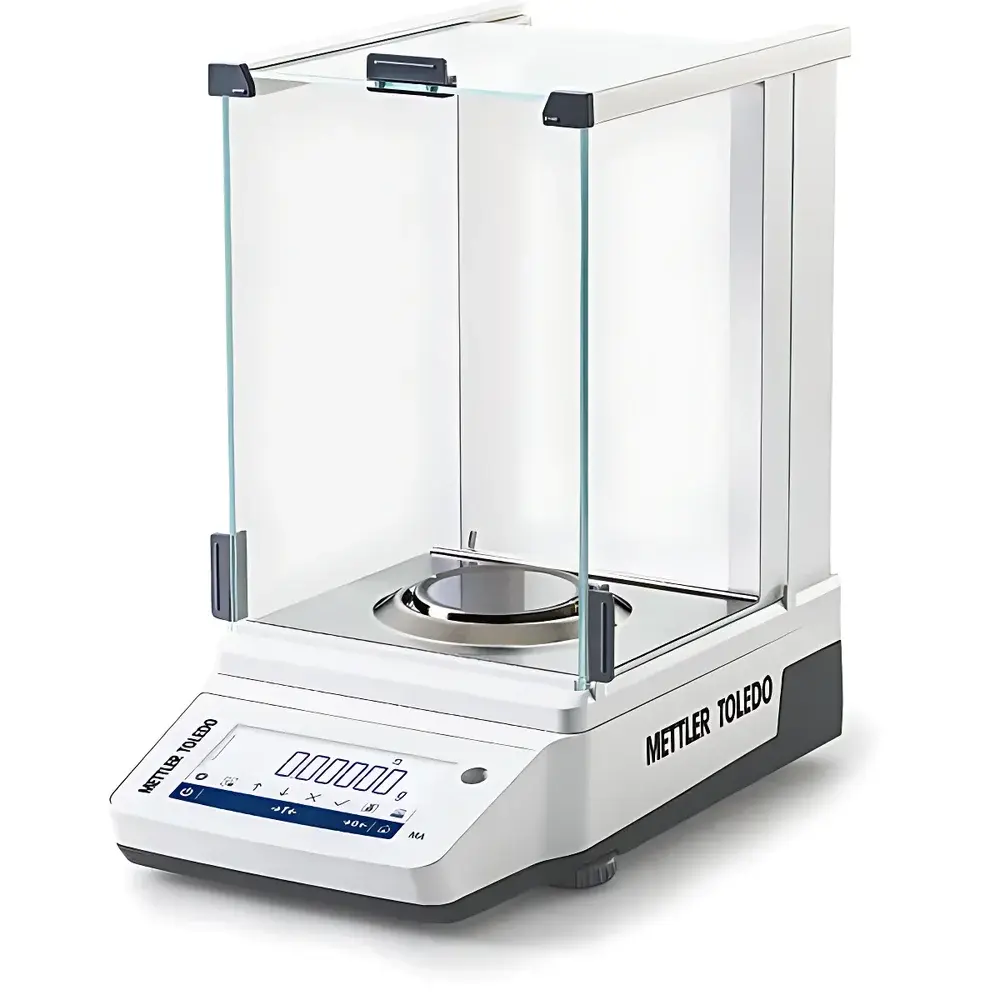
METTLER TOLEDO MA55/A Advanced Analytical Balance with 0.01 mg Readability
| Brand | METTLER TOLEDO |
|---|---|
| Origin | Shanghai, China |
| Manufacturer Type | Authorized Distributor |
| Product Category | Domestic |
| Model | MA55/A |
| Instrument Type | Analytical Balance |
| Maximum Capacity | 52 g |
| Readability | 0.01 mg |
| Repeatability (typ.) | 0.015 mg |
| Minimum Weight (USP <41>, 0.1% tolerance, typ.) | 30 mg |
| Stabilization Time | 4 s |
| Calibration | Internal |
| Interface | RS232, USB-A, Bluetooth (optional) |
| Display | LCD hybrid touch screen |
| Pan Diameter | 80 mm |
| Dimensions (H×W×D) | 354 mm × 209 mm × 354 mm |
| Construction | Corrosion-resistant metal base and reinforced housing |
| Compliance | Legal-for-trade certified (OIML R76), USP <41> compliant, GLP/GMP-ready |
Overview
The METTLER TOLEDO MA55/A is a high-precision analytical balance engineered for laboratories requiring consistent, traceable, and legally valid mass measurements at the sub-milligram level. Operating on electromagnetic force compensation (EMFC) principle, it delivers stable and reproducible results under variable environmental conditions—including minor air currents, temperature fluctuations, and mechanical vibrations—common in QC labs, pharmaceutical R&D, and academic research settings. With a readability of 0.01 mg and maximum capacity of 52 g, the MA55/A meets the stringent performance criteria defined in USP for minimum weight determination and ISO/IEC 17025–accredited testing environments. Its OIML R76 certification confirms compliance for legal-for-trade applications, including formulation, raw material verification, and reference standard preparation where regulatory auditability is mandatory.
Key Features
- Electromagnetic force compensation sensor architecture ensuring long-term stability and minimal drift over time
- Internal calibration system with motorized test weight deployment, eliminating manual intervention and reducing operator-induced error
- Hybrid touch-and-button interface with intuitive, icon-driven menu navigation—designed for rapid method execution without training overhead
- Corrosion-resistant stainless-steel weighing pan and chemically inert housing surface compatible with routine exposure to solvents, acids, and bases
- Integrated leveling assistance via dynamic bubble indicator and adjustable feet—ensuring optimal mechanical alignment prior to measurement
- GLP/GMP-compliant data handling: automatic timestamping, user ID logging, and electronic signature support via optional software integration
- USB-A and RS232 ports enable direct connection to LIMS, ELN, or ERP systems; Bluetooth module available for wireless data transmission to tablets or PCs
Sample Compatibility & Compliance
The MA55/A accommodates a broad range of sample types—from hygroscopic powders and volatile liquids (when used with draft shields) to dense metallic standards and micro-vials. Its 80 mm diameter weighing pan provides sufficient surface area for standard labware while maintaining sensitivity. The balance conforms to multiple international regulatory frameworks: OIML R76 Class I for legal metrology, USP for pharmaceutical weighing validation, and ISO 9001/ISO/IEC 17025 quality system requirements. All internal diagnostics, calibration logs, and weighing records are timestamped and attributable to individual users—supporting FDA 21 CFR Part 11 compliance when paired with METTLER TOLEDO LabX software.
Software & Data Management
While the MA55/A operates autonomously via its onboard firmware, full traceability and workflow automation are achieved through integration with LabX™ software. LabX enables centralized method management, automated report generation (PDF/CSV), electronic audit trails, and role-based access control. All weighing events—including tare, net weight, statistics, and pass/fail evaluation against preset tolerances—are captured with immutable metadata (user, timestamp, instrument ID, environmental conditions if external sensors are connected). Data export supports CSV, XML, and HL7 formats for seamless ingestion into enterprise systems. The balance’s password-protected configuration mode prevents unauthorized changes to calibration parameters or regulatory settings.
Applications
- Pharmaceutical quality control: assay determination, content uniformity testing, and reference standard weighing per ICH Q5C and USP
- Chemical synthesis: precise reagent dosing, stoichiometric ratio verification, and catalyst loading
- Materials science: density calculation of nanoparticles, coating thickness estimation via mass-thickness correlation
- Environmental testing labs: gravimetric analysis of filter media (e.g., PM2.5 filters), ash/residue quantification
- Academic research: isotope ratio sample preparation, micro-scale reaction monitoring, and calibration of secondary standards
- Regulated manufacturing: batch release documentation, SOP-driven weighing workflows, and audit-ready record retention
FAQ
What is the minimum weight requirement for compliant weighing according to USP ?
For the MA55/A, the typical minimum weight is 30 mg at 0.1% tolerance (k = 2), calculated based on repeatability (0.015 mg) and required uncertainty. This value must be verified during initial qualification and after any relocation or maintenance.
Does the MA55/A support external calibration with traceable weights?
Yes—the balance accepts external calibration using NIST-traceable or equivalent certified weights. However, internal calibration remains the default for daily verification; external calibration is recommended during periodic performance qualification or after sensor recalibration.
Can the MA55/A be integrated into a 21 CFR Part 11–compliant environment?
Yes—when used with LabX software and configured with electronic signatures, audit trail activation, and role-based permissions, the system satisfies all technical and procedural requirements of FDA 21 CFR Part 11 for electronic records and signatures.
Is the MA55/A suitable for use in fume hoods or controlled humidity chambers?
It is not recommended for direct installation inside fume hoods due to airflow interference. For such environments, use with an anti-vibration table and optional draft shield is advised. Temperature and humidity should remain within 18–25 °C and 40–60 % RH for optimal performance.
How often should internal calibration be performed?
Internal calibration should be executed at power-on, after significant ambient temperature shifts (>2 °C), following physical movement, and at user-defined intervals (e.g., every 2 hours in high-throughput labs)—all configurable via the instrument’s calibration schedule function.