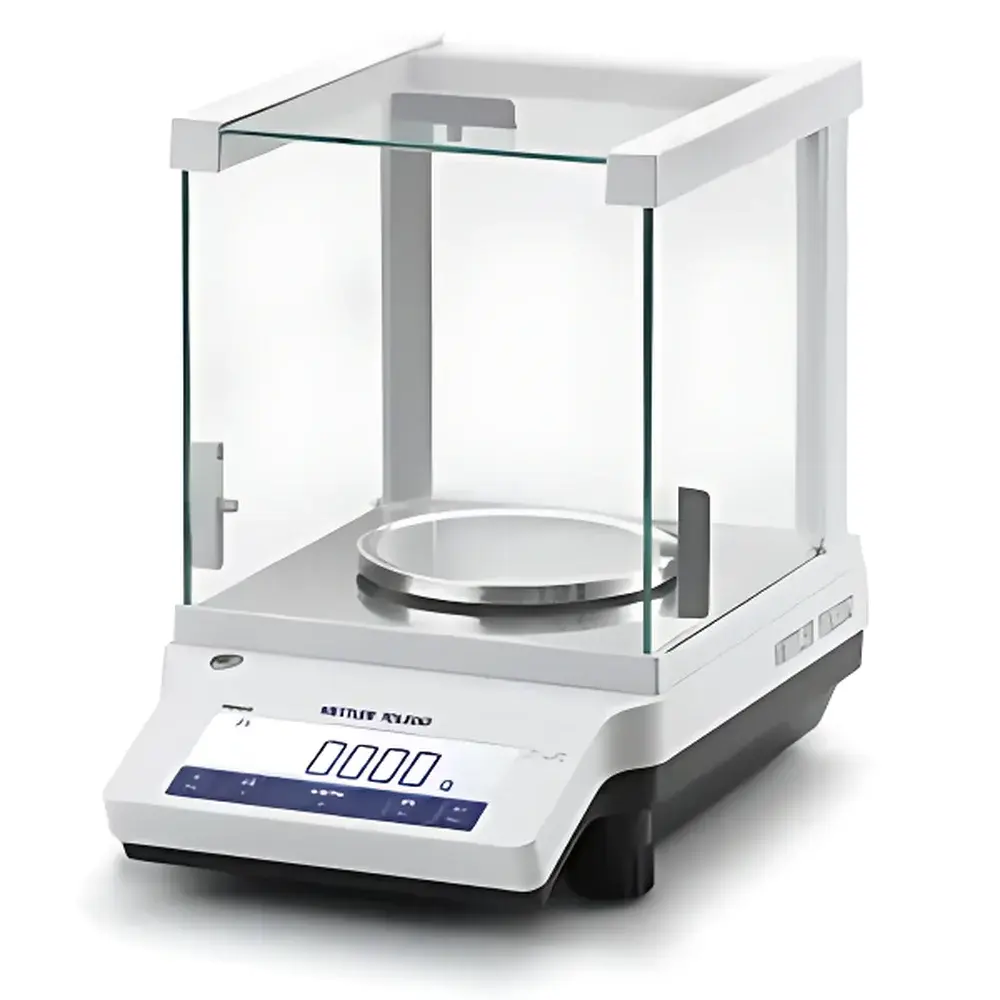
METTLER TOLEDO ME103E Precision Balance (0.001 g readability, 120 g capacity)
| Brand | METTLER TOLEDO |
|---|---|
| Origin | Shanghai, China |
| Model | ME103E /02 |
| Instrument Type | Precision Balance |
| Maximum Capacity | 120 g |
| Readability | 0.001 g |
| Repeatability (typical) | 0.7 mg |
| Minimum Weight (USP <0.1% RSD, k=2) | 1.4 g |
| Stabilization Time | 1.5 s |
| Calibration | External |
| Interface | RS232 (integrated), optional Bluetooth |
| Display | Backlit LCD |
| Pan Diameter | 120 mm |
| Dimensions (H×W×D) | 289 × 210 × 319 mm |
| Housing | Die-cast aluminum and ABS |
| Weighing Pan | Stainless steel |
| Overload Protection | Yes |
| Leveling | Adjustable feet |
Overview
The METTLER TOLEDO ME103E is a high-performance precision balance engineered for routine laboratory weighing tasks requiring consistent 1 mg readability and reliable traceability in non-regulated or lightly regulated environments. Based on METTLER TOLEDO’s proven electromagnetic force compensation (EMFC) transduction principle, the ME103E delivers stable, drift-resistant measurements through a temperature-compensated sensor architecture and internal thermal stabilization. Its 120 g maximum capacity and 0.001 g resolution meet the performance criteria for general analytical preparation, sample formulation, quality control checks, and educational applications where GLP-compliant audit trails are not mandated but reproducibility remains critical. The balance operates within standard ambient conditions (10–30 °C, ≤80 % RH non-condensing) and features automatic internal diagnostics to monitor sensor health, draft shield integrity, and leveling status—ensuring measurement confidence before each use.
Key Features
- Electromagnetic force compensation (EMFC) weighing mechanism with active temperature compensation for long-term stability and low drift.
- Dual-range leveling system with adjustable stainless-steel feet and integrated bubble level for rapid, repeatable setup on uneven surfaces.
- Robust mechanical construction: die-cast aluminum housing, 120 mm stainless-steel weighing pan, and integrated overload protection up to 150 % of nominal capacity.
- Backlit monochrome LCD display with high-contrast characters (18 mm digit height) optimized for readability under variable lab lighting.
- Integrated RS232 interface supporting ASCII-based data output to printers or PCs; optional Bluetooth module enables wireless data transfer to compatible devices.
- Preconfigured weighing applications including parts counting, percentage weighing, density determination (with optional kit), and checkweighing—accessible via intuitive soft-key navigation.
- Auto-rezero function with user-definable threshold and automatic zero-tracking during idle periods to maintain baseline accuracy.
Sample Compatibility & Compliance
The ME103E accommodates a broad range of solid and granular samples on its 120 mm diameter stainless-steel pan, with compatibility extending to containers up to 150 mm in height when used with optional draft shields (sold separately). While the ME103E does not include built-in 21 CFR Part 11 compliance features (e.g., electronic signatures, audit trail logging), it supports external documentation workflows compliant with ISO/IEC 17025 and ASTM E898-22 guidelines for balance verification and calibration management. Its repeatability of ≤0.7 mg (typical) and minimum weight of 1.4 g (per USP <0.1% RSD, k = 2) satisfy method suitability requirements for most pharmacopeial and industrial QC procedures involving intermediate-precision weighing. External calibration using certified weights (Class M2 or better) ensures traceability to national metrology institutes.
Software & Data Management
Data output follows standard ASCII protocol via RS232, enabling seamless integration with laboratory information systems (LIS), electronic lab notebooks (ELN), or spreadsheet-based reporting tools. Each transmitted record includes timestamp (if enabled externally), net weight, unit, and application identifier—facilitating manual traceability in non-GxP settings. Optional METTLER TOLEDO LabX Lite software provides basic configuration, report generation, and export to CSV or PDF formats; full LabX connectivity requires upgrade to higher-tier models. All firmware updates are delivered via USB memory stick—no internet connection required—maintaining network isolation in secure lab environments.
Applications
- Raw material and intermediate batch verification in pharmaceutical and chemical manufacturing.
- Formulation of standards, reference materials, and calibration solutions in environmental and food testing labs.
- Student experiments and faculty demonstrations in university chemistry and biology teaching laboratories.
- In-process quality checks during packaging line setup and validation (e.g., fill weight sampling).
- Weighing of catalysts, reagents, and fine powders in R&D synthesis workflows where sub-milligram variability is acceptable.
- Inventory management and component counting in electronics and precision machining facilities.
FAQ
What is the recommended calibration frequency for the ME103E?
Calibration should be performed before first use, after relocation, following significant ambient temperature shifts (>5 °C), and at least once per shift in high-usage environments. External calibration with traceable weights is mandatory per ISO 9001 and ISO/IEC 17025 requirements.
Does the ME103E support internal calibration?
No—the ME103E relies exclusively on external calibration using certified weights. Internal motorized calibration is available only on higher-tier ME-T and Advanced series models.
Can the ME103E be connected to a networked LIMS?
Yes—via RS232-to-Ethernet gateways or serial servers, provided the LIMS accepts ASCII-formatted weight data streams without requiring authentication or encrypted handshake protocols.
Is the weighing pan removable for cleaning?
Yes—the stainless-steel pan is tool-free detachable and autoclavable up to 121 °C for microbiological applications.
What is the typical warm-up time to achieve full specification performance?
The balance reaches thermal equilibrium and meets all published specifications within 30 minutes of power-on under stable ambient conditions.