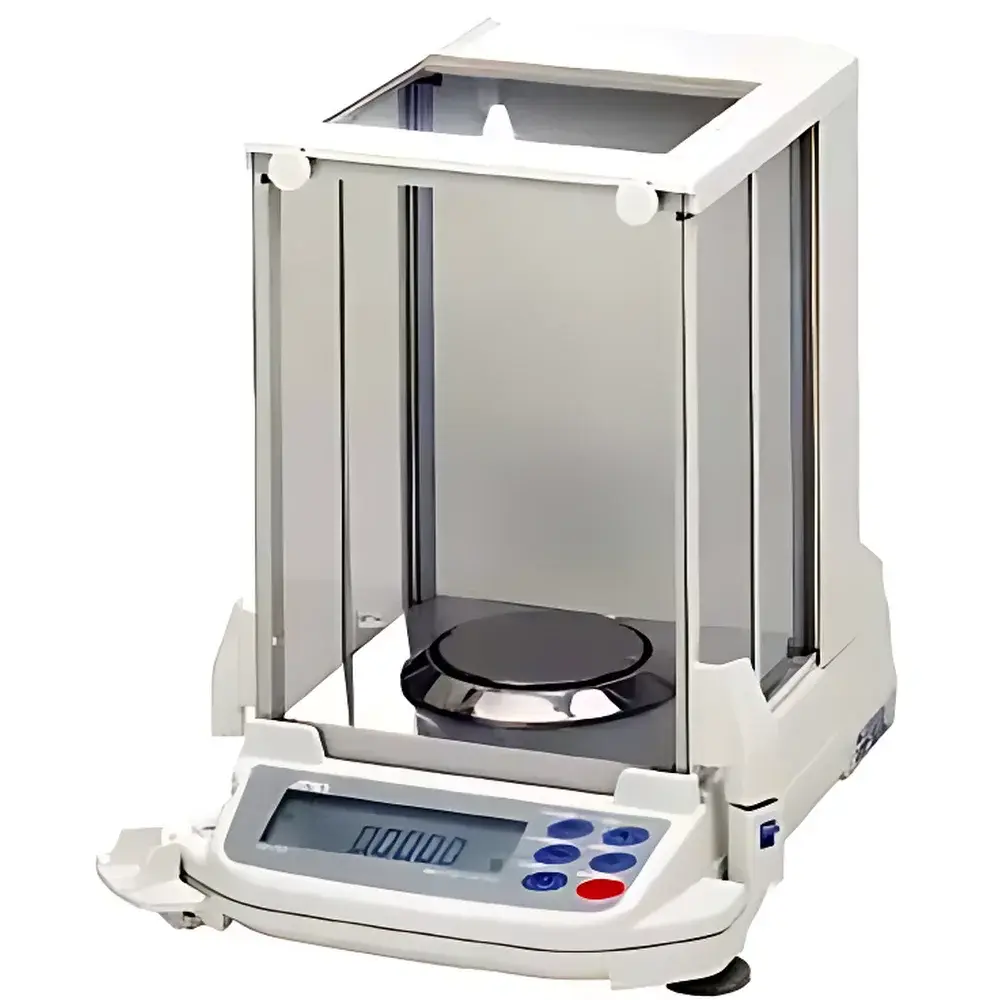
A&D GR-202 Dual-Range Analytical Balance (0.01 mg / 0.1 mg)
| Brand | A&D |
|---|---|
| Origin | Japan |
| Model | GR-202 |
| Type | Analytical Balance |
| Maximum Capacity | 42 g / 210 g |
| Readability | 0.01 mg / 0.1 mg |
| Repeatability | ±0.03 mg / ±0.2 mg |
| Calibration | Internal motorized calibration with built-in reference weights |
| Compliance | GLP, GMP, ISO 9001, ISO/IEC 17025 applicable |
| Interface | RS-232C serial port |
| Software | Win-CT (included) for data export to Excel, Word, and statistical analysis |
| Optional Accessory | AD-1653 Density Determination Kit |
Overview
The A&D GR-202 is a high-precision dual-range analytical balance engineered for laboratories requiring trace-level mass measurement across two distinct sensitivity domains: ultra-high resolution at 0.01 mg (10 µg) for critical micro-weighing tasks up to 42 g, and robust 0.1 mg readability for routine analyses up to 210 g. Its design adheres to the fundamental metrological principles of electromagnetic force compensation (EMFC), where sample mass is determined by the current required to restore the weighing pan to its null position after load application. This architecture ensures exceptional stability, low drift, and high reproducibility—essential attributes for method validation, reference standard preparation, and regulatory-compliant quality control workflows. The GR-202 is manufactured in Japan under A&D’s stringent ISO 9001-certified production system and meets the mechanical and performance criteria referenced in ASTM E898, USP , and OIML R76 for Class I analytical balances.
Key Features
- Motorized internal calibration: Integrated high-stability reference weights enable one-touch automatic calibration and periodic self-adjustment triggered by ambient temperature or humidity shifts—eliminating manual intervention and reducing calibration-induced variability.
- Adaptive sensitivity control: Real-time vibration and air current detection dynamically adjusts damping parameters and filtering algorithms to maintain measurement integrity in non-ideal lab environments (e.g., near fume hoods or HVAC vents).
- Ergonomic front-access draft shield: Patented fold-down glass door system provides unobstructed access while maintaining ISO 17025-required environmental isolation; compact footprint (249 × 330 × 328 mm) optimizes bench space without compromising chamber volume.
- Multi-unit and functional versatility: Supports 13 selectable mass units (g, mg, oz, ct, etc.), piece counting, percent weighing, and net/gross/tare operations—all configurable via intuitive membrane keypad with tactile feedback.
- GLP/GMP-ready data governance: Timestamped audit trail includes balance ID, operator code, calibration history, environmental logs, and measurement metadata—fully compliant with FDA 21 CFR Part 11 requirements when used with Win-CT software and validated IT infrastructure.
Sample Compatibility & Compliance
The GR-202 accommodates standard laboratory sample containers—including weighing boats, vials, crucibles, and filter papers—within its 85 mm diameter stainless-steel pan. Its dual-range architecture enables seamless transition between high-sensitivity pharmaceutical API assays (e.g., 1–10 mg active ingredient quantification) and broader QC applications such as excipient blending verification or dissolution tablet weight checks. All operational parameters satisfy ISO/IEC 17025 clause 5.5.2 for equipment suitability, and the balance’s traceable calibration certificate (NIST-traceable reference standards) supports accreditation audits. Optional AD-1653 density kit extends functionality to solid density determination per ASTM D792 and ISO 1183-1, delivering direct digital readout without manual calculation.
Software & Data Management
Bundled Win-CT software provides bidirectional RS-232C communication for automated data capture, real-time display, and structured export to CSV, Excel, or Word formats. It supports user-defined templates for SOP-driven reporting, statistical process control (SPC) charting (X-bar/R, Cp/Cpk), and trend analysis across batches. Data integrity safeguards include electronic signatures, role-based access control, and immutable audit logs with SHA-256 hashing—enabling full compliance with ALCOA+ principles (Attributable, Legible, Contemporaneous, Original, Accurate, Complete, Consistent, Enduring, Available). Raw measurement files retain full metadata (timestamp, environmental conditions, calibration status) for forensic traceability during regulatory inspections.
Applications
- Pharmaceutical development: Formulation R&D, reference standard dilution, residual solvent gravimetric analysis.
- Materials science: Catalyst loading precision, nanomaterial dispersion mass verification, thin-film deposition monitoring.
- Environmental testing: Filter weight gain analysis for PM2.5/PM10 particulate matter quantification (EPA Method IO-4.2).
- Food & beverage QA: Nutrient fortification accuracy checks, allergen cross-contamination threshold validation.
- Academic research: Isotope ratio sample preparation, electrochemical electrode mass calibration, polymer synthesis yield determination.
FAQ
What does “dual-range” mean for the GR-202?
It operates two independent measurement ranges: 0–42 g at 0.01 mg resolution and 0–210 g at 0.1 mg resolution—automatically selected based on load magnitude to maximize both sensitivity and capacity.
Is external calibration required?
No. Internal motorized calibration with certified reference masses satisfies routine verification; external calibration is only needed for periodic metrological verification or after relocation.
Can the GR-202 interface with LIMS systems?
Yes—via RS-232C and Win-CT’s configurable ASCII output protocol, enabling integration with major LIMS platforms using standard HL7 or ASTM E1384 message structures.
How is temperature drift compensated?
The balance continuously monitors internal sensor temperature and applies real-time correction coefficients derived from factory thermal characterization data, minimizing zero-point drift to ≤0.5 µg/°C.
Does it support density measurement out of the box?
Density functionality requires optional AD-1653 kit (includes sinker, thermometer, and density calculation firmware); no third-party hardware or software modifications are necessary.