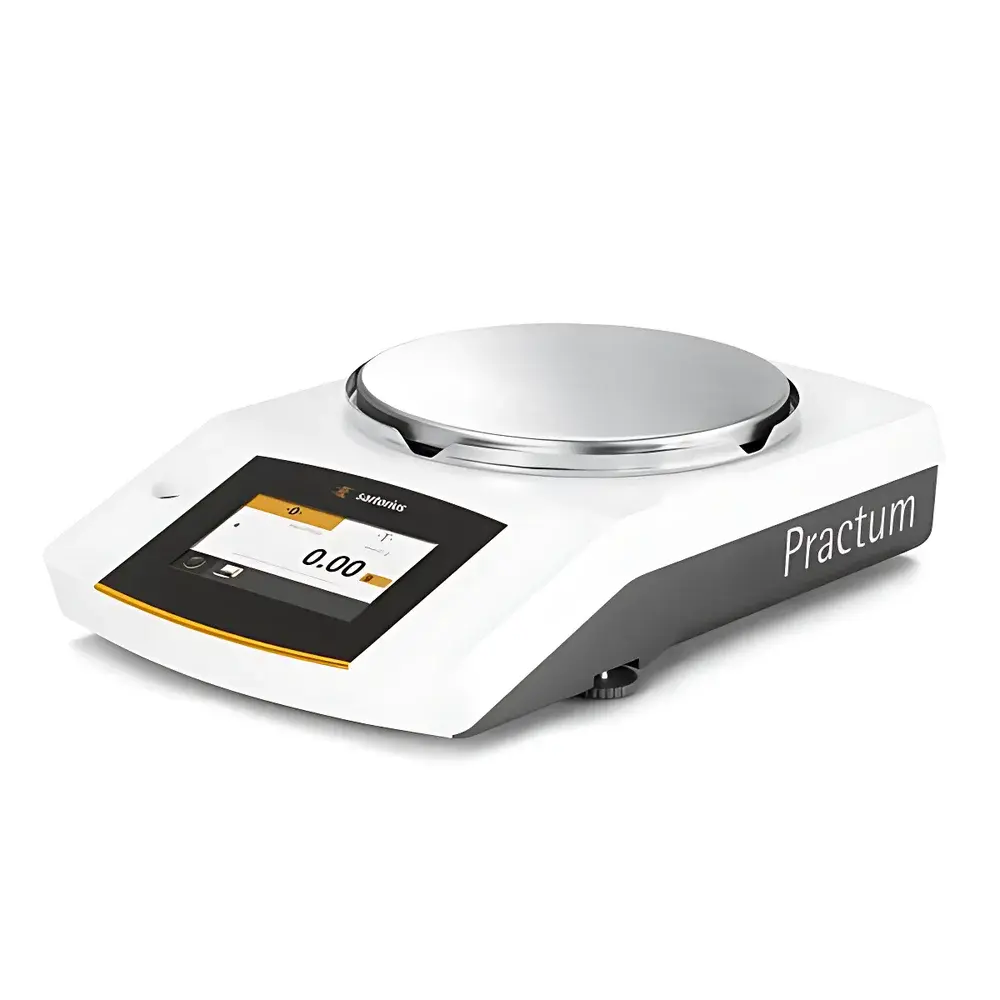
Sartorius Practum3102-1CN Precision Balance
| Brand | Sartorius |
|---|---|
| Origin | Shanghai, China |
| Manufacturer Type | Authorized Distributor |
| Product Category | Domestic |
| Model | Practum3102-1CN |
| Instrument Type | Precision Balance |
| Maximum Capacity | 3100 g |
| Readability | 0.01 g |
| Linearity | ±20 mg |
| Repeatability | 10 mg |
| Calibration Method | External |
| Pan Diameter | 180 mm |
| Dimensions (W × D × H) | 218 × 360 × 94 mm |
| Connectivity | USB interface for data export to Excel |
Overview
The Sartorius Practum3102-1CN is a high-reliability precision balance engineered for routine laboratory weighing tasks requiring consistent accuracy, robust mechanical stability, and intuitive operation. Based on electromagnetic force compensation (EMFC) technology, it delivers stable and traceable mass measurements across its full 3100 g capacity range with 0.01 g readability. Designed for environments where reproducibility and ease of use are critical—including QC labs, educational institutions, pharmaceutical production support areas, and industrial R&D facilities—the Practum3102-1CN integrates a rigid monolithic sensor architecture and reinforced draft shield to minimize environmental interference from air currents and mechanical vibration. Its compact footprint (218 × 360 × 94 mm) and low-profile housing optimize bench space without compromising structural integrity or thermal stability.
Key Features
- Electromagnetic force compensation (EMFC) transducer ensures long-term drift resistance and high repeatability (≤10 mg standard deviation under controlled conditions).
- Integrated draft shield with dual sliding doors provides Class II environmental protection per OIML R76, supporting stable weighing of powders, granules, and volatile liquids.
- Large 180 mm diameter stainless steel weighing pan accommodates oversized containers and facilitates bottom-hook density determination when used with optional density kit (Sartorius Densito accessory).
- USB 2.0 interface enables direct data transmission to Microsoft Excel® or LIMS systems—no proprietary software required; supports CSV and tab-delimited output formats.
- Dynamic weighing mode with peak-hold function captures transient values during unstable conditions (e.g., live animal weighing, vibrating platforms, or non-rigid sample placement).
- Regulatory-ready features include user-level access control (Supervisor Lock), time-stamped audit trail logging (when connected to compliant PC-based software), and configurable print intervals for GLP-compliant record generation.
- Front-mounted bubble level and oversized leveling feet simplify horizontal alignment—critical for maintaining metrological validity per ISO/IEC 17025 requirements.
Sample Compatibility & Compliance
The Practum3102-1CN supports diverse sample types: solid masses up to 3100 g, bulk powders in open vessels, viscous suspensions, and small-volume liquids in beakers or flasks. Its bottom-hook capability enables density determination of irregular solids (ASTM D792, ISO 1183-1) and suspended solids analysis. The balance complies with international metrological standards including OIML R76-1 (2021 edition), EN 45501, and meets essential requirements for CE marking under the EU Measuring Instruments Directive (MID 2014/32/EU). For regulated environments, it supports 21 CFR Part 11–compliant electronic records when integrated with validated third-party data acquisition software and appropriate access controls.
Software & Data Management
No proprietary software installation is required for basic operation. Raw weight data streams directly via USB HID protocol into spreadsheet applications. Optional Sartorius LabX Lite (freely downloadable) adds advanced functions: customizable report templates, statistical process control (SPC) charts, automated pass/fail evaluation against tolerance limits (e.g., checkweighing per ISO 2854), and encrypted local database storage. All exported files retain timestamps, operator ID (if configured), and instrument serial number—enabling full traceability in GMP/GLP audits. Audit trails include calibration events, parameter changes, and user logins when LabX Lite is deployed in networked mode.
Applications
- Quality Control & Manufacturing: Checkweighing of packaged goods (e.g., blister packs, vials, pouches) against upper/lower tolerance bands; batch uniformity testing per USP & Ph. Eur. general chapters.
- Pharmaceutical Labs: Formulation ingredient dispensing, excipient blending verification, and dissolution sample preparation where 0.01 g resolution satisfies typical SOP requirements.
- Educational Use: Student laboratories benefit from Supervisor Lock functionality to restrict menu navigation while preserving core weighing modes (net/gross/tare, counting, % deviation, density).
- Materials Testing: Density determination of metals, polymers, and ceramics using Archimedes’ principle; moisture content estimation via loss-on-drying workflows.
- Food & Agriculture: Portion control validation, feed additive dosing, and raw material acceptance testing aligned with ISO 7587 and AOAC guidelines.
FAQ
What calibration method does the Practum3102-1CN support?
It requires external calibration using certified weights traceable to national standards (e.g., NIST, PTB). Internal calibration is not available on this model.
Is the balance suitable for use in a fume hood?
Yes—its sealed electronics and draft shield design allow safe operation in ventilated enclosures, provided airflow velocity remains below 0.2 m/s at the pan surface (per ISO 9001 Annex A.7 guidance).
Can it perform piece counting without manual input of unit weight?
No—counting mode requires initial sampling of ≥10 identical items to calculate average piece weight; auto-learning of unit mass is not implemented.
Does it meet FDA 21 CFR Part 11 requirements out-of-the-box?
The hardware itself does not enforce electronic signature or audit trail generation; compliance is achieved only when paired with validated software (e.g., LabX) and documented procedural controls.
What is the warm-up time before achieving specified repeatability?
Minimum 30 minutes at stable ambient temperature (20–25 °C, ≤50 % RH); performance stabilizes fully after 60 minutes per Sartorius technical documentation.