
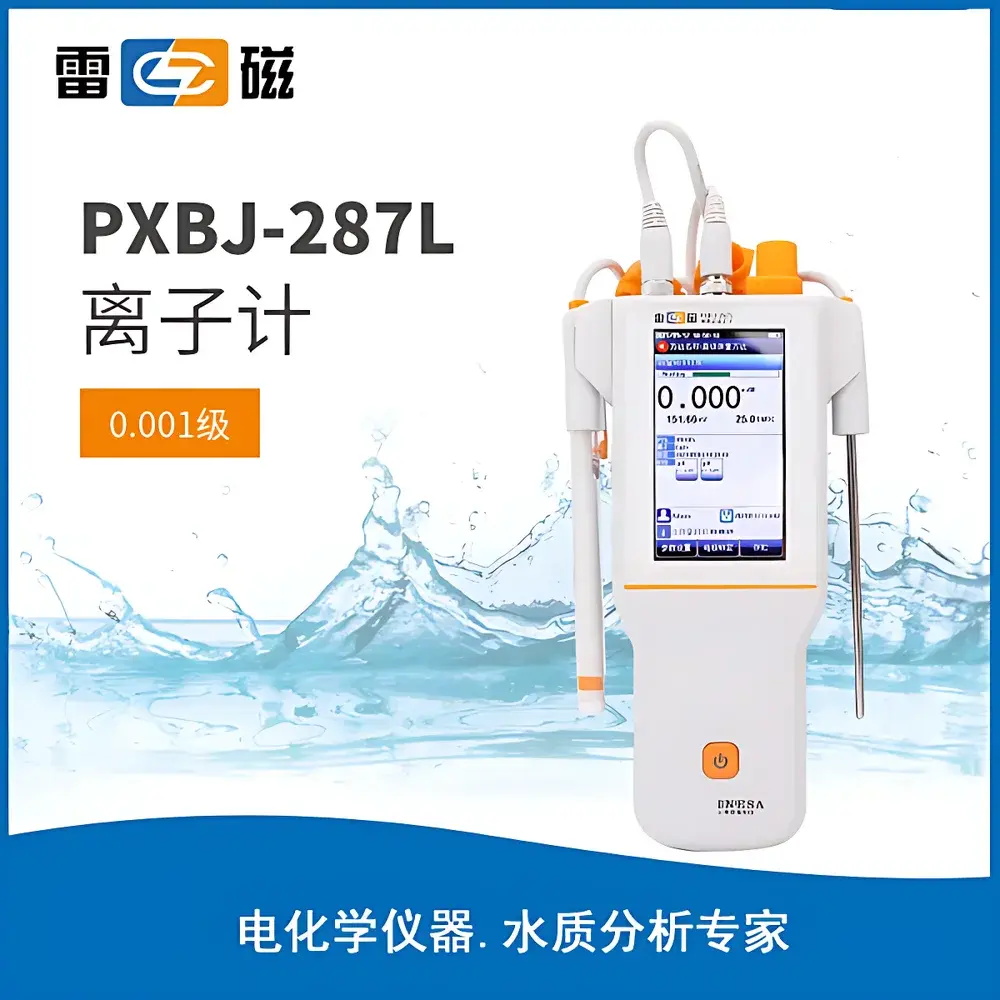
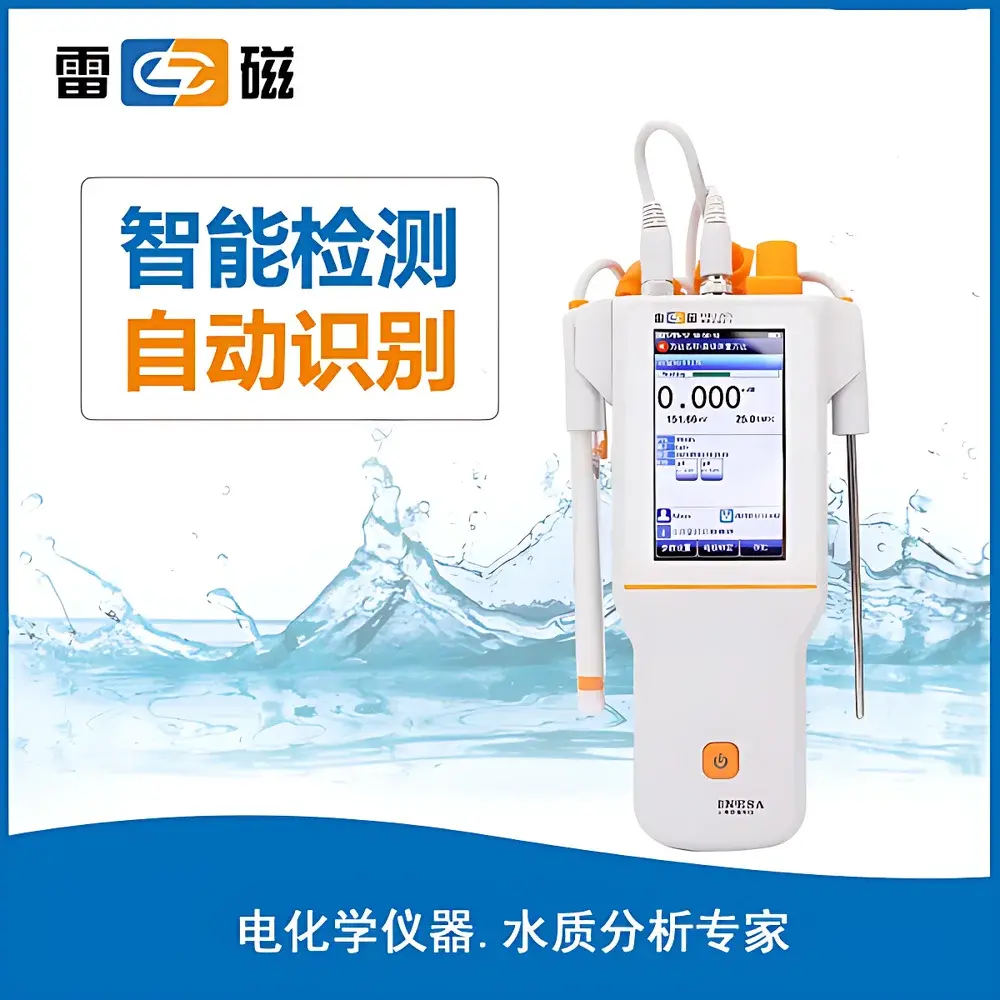
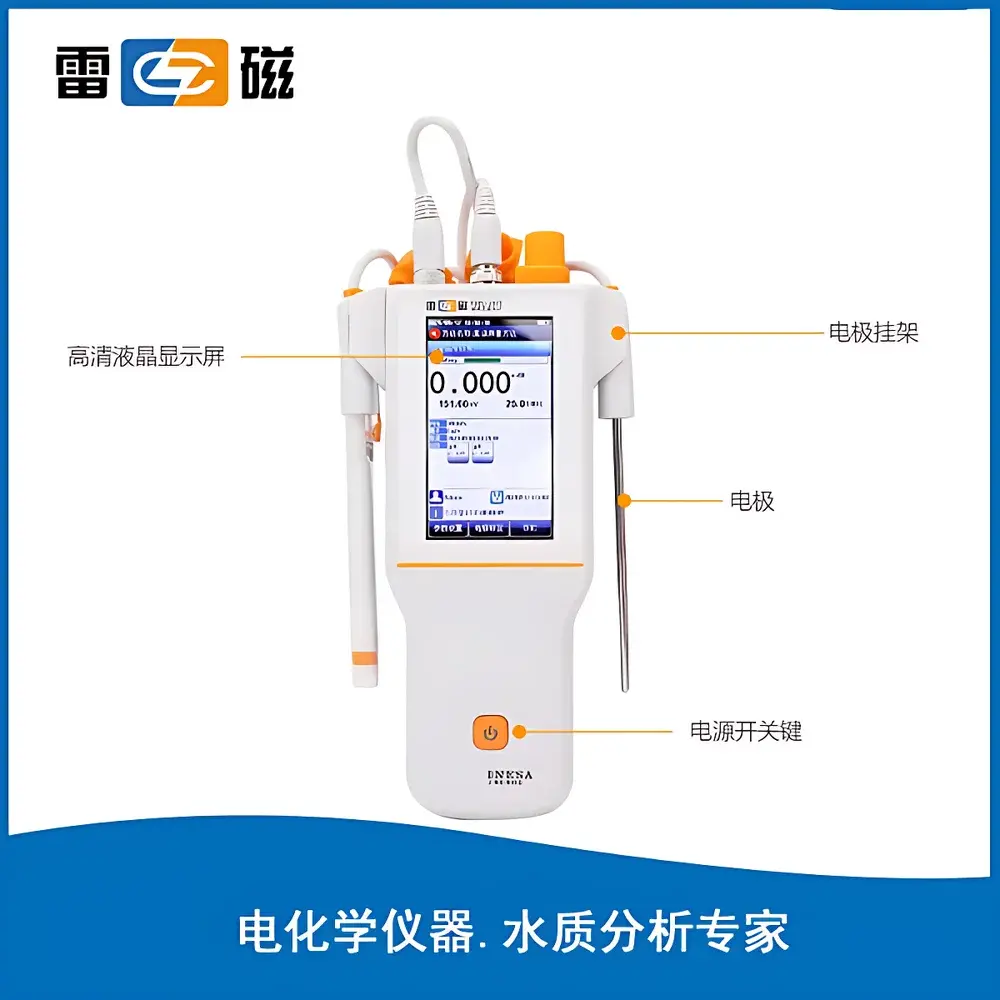
Leici PXBJ-287L Portable Ion Meter
| Brand | Leici |
|---|---|
| Origin | Shanghai, China |
| Manufacturer Type | Authorized Distributor |
| Product Category | Domestic |
| Model | PXBJ-287L |
| Instrument Type | Fluoride Ion Meter |
| Detection Range | 1–19990 (unit-dependent) |
| Detection Limit | 1 µg/L (typical for F⁻ with optimized electrode & TISAB) |
| Response Time | ≤2 min (to 95% of final value, 25°C, optimal conditions) |
| Measurement Accuracy | ±0.002 pX / ±0.03% of reading (ion concentration) |
| Temperature Range | −10.0 to 135.0 °C |
| Resolution | 0.001 pX, 0.01 mV, 0.1 °C/°F |
| IP Rating | IP65 |
| Battery Life | Up to 100 hours (typical usage, ambient temperature) |
Overview
The Leici PXBJ-287L Portable Ion Meter is a high-precision, field-deployable electrochemical analyzer engineered for quantitative determination of fluoride (F⁻) and other monovalent anions/cations—including Cl⁻, NO₃⁻, Br⁻, I⁻, CN⁻, NH₄⁺, K⁺, Na⁺—in aqueous environmental, industrial, and regulatory-compliant water samples. It operates on the principle of potentiometric ion-selective electrode (ISE) measurement, where the membrane potential of a solid-state or crystalline ion-selective electrode responds logarithmically to the activity of target ions in solution, per the Nernst equation. Designed for compliance with ISO 10304-1 (determination of anions by ion chromatography), ASTM D6919 (standard test method for determination of fluoride in water by ISE), and EPA Method 300.0 (determination of anions by ion chromatography), the PXBJ-287L delivers trace-level detection capability with robust thermal compensation and intelligent endpoint recognition—making it suitable for on-site monitoring of drinking water, wastewater effluent, groundwater, and surface water per WHO and national regulatory thresholds.
Key Features
- High-resolution 5.0-inch color TFT touchscreen with intuitive graphical UI supporting both English and Chinese language interfaces
- Multi-level user authentication with role-based access control (administrator, operator, viewer) and password-protected configuration changes
- IP65-rated enclosure ensuring dust-tight operation and protection against low-pressure water jets—enabling reliable use in humid field environments, rain, or splash-prone laboratories
- Integrated Bluetooth 5.0 and USB-C interface for real-time wireless data streaming or secure wired transfer to PCs; supports U-disk mass storage and barcode scanner integration
- Intelligent electrode diagnostics including automatic recognition of Leici F⁻-selective electrodes (e.g., PFB-101), built-in calibration status tracking, and electrode aging alerts
- Four standardized measurement modes: direct concentration reading, standard addition, sample addition, and Gran plot analysis—each configurable with user-defined titration volumes and dilution factors
- Eight-point pX/pH calibration capability with auto-buffer recognition across six international standard sets (NIST, DIN, GB, JIS, MERK, USA) and support for custom buffer definition
- Onboard rechargeable lithium-ion battery (≥100 h standby, ≥30 h continuous operation); compatible with universal AC adapters (100–240 VAC input) and portable power banks
Sample Compatibility & Compliance
The PXBJ-287L is validated for use with natural waters, treated drinking water, municipal wastewater, leachates, and process streams containing total dissolved solids (TDS) up to 5000 mg/L. For fluoride analysis, it requires use of Leici’s PFB-101 fluoride ion-selective electrode paired with TISAB II (Total Ionic Strength Adjustment Buffer) to mask interference from OH⁻, Al³⁺, Fe³⁺, and SiO₂. The instrument complies with GLP data integrity requirements: all measurements are timestamped, user-logged, and stored with full audit trail—including electrode ID, calibration history, temperature logs, and manual override records. Data export formats include CSV and XML, facilitating import into LIMS systems compliant with FDA 21 CFR Part 11 and ISO/IEC 17025 accreditation frameworks.
Software & Data Management
Equipped with embedded firmware v3.2+, the PXBJ-287L supports over-the-air (OTA) updates via USB or cloud-connected PC software (Leici LabLink Pro). Internal memory stores up to 1,000 complete measurement records—including raw mV values, calculated concentrations, calibration curves, and metadata (operator ID, location tag, sample ID). Statistical functions include mean, SD, RSD, linear regression (R²), and outlier detection (Grubbs’ test). Data synchronization preserves chain-of-custody: each record contains digital signatures verifying immutability upon export. USB host mode enables direct printing to compatible thermal printers or archival to encrypted USB drives meeting NIST SP 800-111 standards.
Applications
- Regulatory monitoring of fluoride in public water supplies (WHO guideline: 1.5 mg/L; US EPA MCL: 4.0 mg/L)
- Industrial hygiene assessment in aluminum smelting, semiconductor etching, and phosphate fertilizer production facilities
- Environmental site assessment of fluoride-contaminated soils and groundwater plumes
- Quality control of bottled water, infant formula reconstitution water, and dental rinse formulations
- Educational laboratories for teaching potentiometric analysis, Nernstian behavior, and ISE selectivity coefficients
FAQ
What ion-selective electrodes are compatible with the PXBJ-287L?
Leici PFB-101 (fluoride), PCL-101 (chloride), PK-101 (potassium), PNA-101 (sodium), and third-party electrodes conforming to BNC connector standards and ±2000 mV output range.
Does the instrument support automatic temperature compensation during field measurements?
Yes—integrated Pt1000 thermistor provides real-time ATC (Automatic Temperature Compensation) across −10.0 to 135.0 °C; manual offset adjustment is also available.
Can calibration data be exported separately from sample measurements?
Yes—calibration reports (including slope, intercept, R², and electrode response time) are stored as discrete files and exportable via USB or Bluetooth.
Is the PXBJ-287L suitable for GLP/GMP-regulated laboratories?
Yes—full electronic audit trail, user authentication, data encryption at rest, and 21 CFR Part 11–compliant signature options are enabled via firmware configuration.
How is electrode performance validated before field deployment?
The unit performs automated diagnostic checks at startup—including open-circuit voltage verification, reference junction resistance, and membrane impedance screening—flagging deviations beyond ±5% of baseline.







