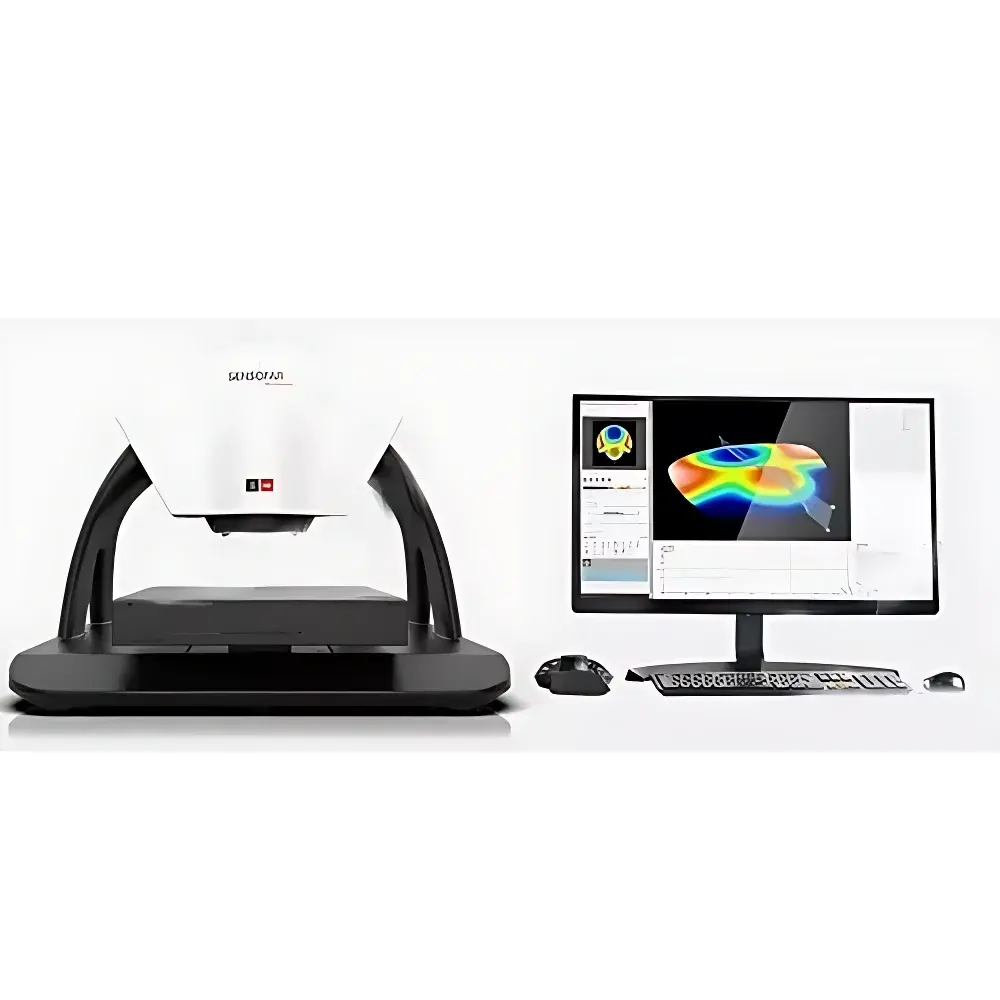
Sensofar S wide 3D Optical Profilometer
| Brand | Sensofar |
|---|---|
| Origin | Spain |
| Product Type | Non-contact 3D Profilometer / Surface Roughness Analyzer |
| Working Principle | White-light Interferometry & Fringe Projection Profilometry |
| Maximum Sample Area | 300 × 300 mm² |
| Maximum Sample Height | 350 mm |
| Working Distance | 80 mm |
| Camera Resolution | 5 MP color sensor with digital zoom |
| Single-shot 3D Capture Volume | 35 × 29 × 40 mm (40.6 mm³) |
| Height Repeatability | Sub-micrometer across full field |
| Calibration Traceability | ISO 25178-7 compliant (Z magnification, XY lateral scale, flatness error, eccentricity) |
Overview
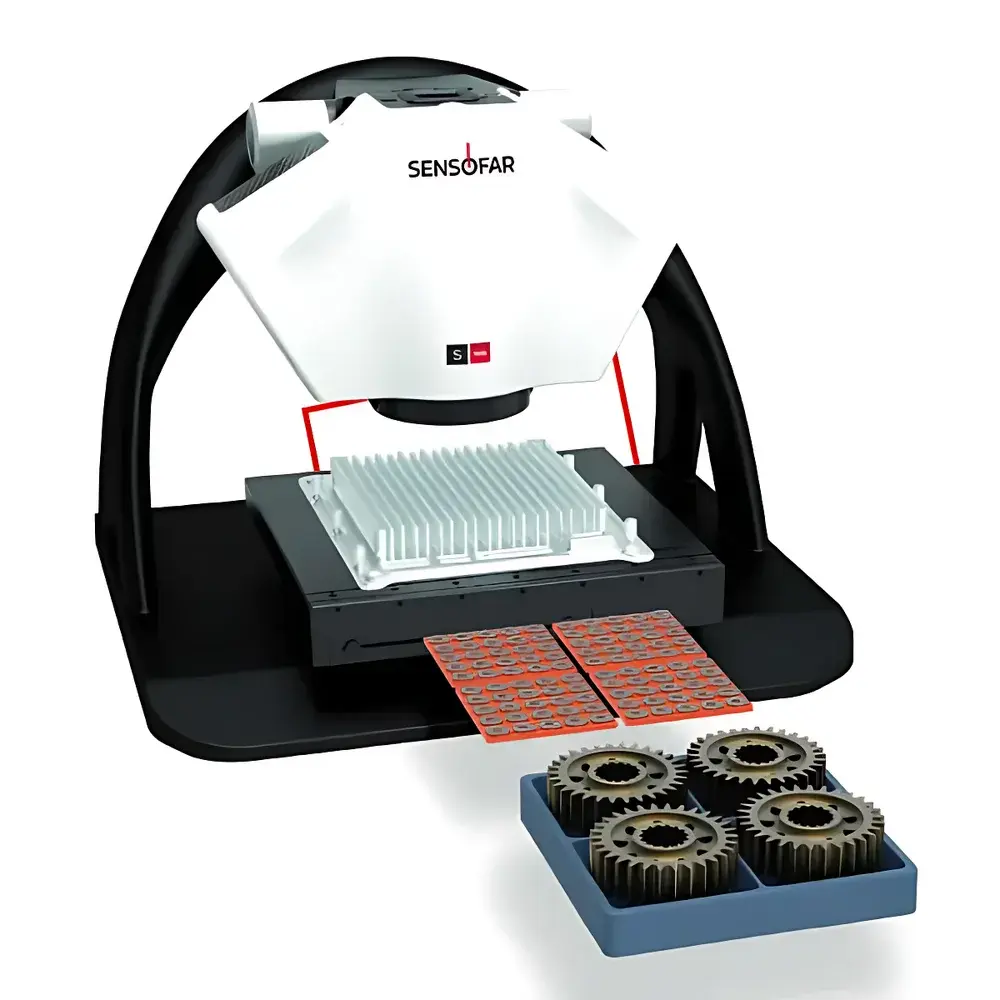
The Sensofar S wide 3D Optical Profilometer is a high-performance, non-contact surface metrology system engineered for precision geometric characterization of large-area components in industrial QA/QC, R&D, and process monitoring environments. Unlike contact stylus profilometers or confocal laser scanners, the S wide employs dual optical measurement principles—white-light interferometry (WLI) for nanoscale topography and sub-nanometer vertical resolution on smooth to moderately rough surfaces, and fringe projection profilometry (FPP) for rapid, high-fidelity 3D reconstruction of complex geometries, freeform surfaces, and textured features. Its hybrid optical architecture enables deterministic, traceable measurements without mechanical interaction—eliminating tip wear, surface deformation, or scanning artifacts. The system’s 80 mm working distance, passive vibration resistance, and absence of Z-axis motorized translation ensure operational robustness in factory-floor settings, cleanrooms, and shared lab spaces where environmental stability cannot be guaranteed.
Key Features
- Large-format measurement capability: 300 × 300 mm² XY stage with optional height extension up to 350 mm—enabling full-field inspection of wafers, PCBs, molded plastic parts, metal castings, and biomedical implants.
- Single-shot 3D acquisition: Captures a volumetric region of 35 × 29 × 40 mm (40.6 mm³) in one exposure—no Z-scan required—reducing measurement cycle time to under 1 second per field.
- Dual-lens far-corrected optics: Twin telecentric lenses minimize field curvature and distortion (<0.02% lateral error), ensuring metrological-grade XY fidelity across the entire FOV—critical for GD&T validation and CAD-to-part deviation analysis.
- 5 MP color imaging sensor with real-time digital zoom: Supports simultaneous topographic mapping and visual documentation; enables pixel-level correlation between texture appearance and quantitative roughness parameters.
- Adaptive fringe projection algorithms: Multiple projection modes (phase-shift, binary, sinusoidal) dynamically selected based on surface reflectivity, slope, and noise profile—optimizing signal-to-noise ratio and measurement confidence.
- Sub-micrometer height repeatability: Achieved through proprietary edge-based fringe analysis and thermal-stabilized optical path design—validated per ISO 25178-6 and certified for use in GLP/GMP-regulated workflows.
Sample Compatibility & Compliance
The S wide accommodates diverse sample types—including reflective metals, matte ceramics, translucent polymers, anodized aluminum, and structured micro-optics—without coating, vacuum, or surface preparation. Its non-destructive operation complies with ASTM E2923 (Standard Guide for Measuring Surface Texture Using Optical Profilometers) and ISO 25178 series (Geometrical Product Specifications — Surface Texture). System calibration is performed against NIST-traceable step-height standards and verified per ISO 25178-7 requirements for Z magnification accuracy, XY lateral scaling, flatness error, and lens eccentricity. Full audit trail functionality—including user login, parameter change logs, and timestamped raw data archives—supports compliance with FDA 21 CFR Part 11 and EU Annex 11 for regulated manufacturing environments.
Software & Data Management
Sensofar’s MountainsMap® S wide software provides an integrated metrology platform with automated workflow scripting, batch processing, and customizable reporting templates. It supports ISO 4287/4288, ISO 25178-2 (Sa, Sq, Sz, Sdr, etc.), ASME B46.1, and custom parameter definitions. GD&T modules enable direct evaluation of flatness, parallelism, cylindricity, and position tolerances against imported STEP or IGES CAD models. Measurement data exports natively to CSV, TXT, HDF5, and .STL formats; API integration (COM/Python) allows synchronization with MES, QMS, and PLM systems. Role-based user management, electronic signatures, and encrypted database storage meet enterprise IT security policies and data sovereignty requirements.
Applications
- Automotive: Validation of injection-molded interior panels, brake rotor surface finish, and EV battery cell electrode topography.
- Semiconductor & MEMS: Wafer-level warpage, bump height uniformity, and TSV (through-silicon via) depth profiling.
- Medical Devices: Surface texture verification of orthopedic implants per ISO 10993-22, stent strut geometry, and dental CAD/CAM restoration fit assessment.
- Additive Manufacturing: As-built part porosity mapping, layer adhesion analysis, and dimensional conformance to AM-specific standards (e.g., ASTM F3122).
- Optics & Photonics: Mold insert inspection, diffractive optical element (DOE) grating fidelity, and lens mount flatness certification.
FAQ
Does the S wide require Z-axis scanning for height measurement?
No. Its fringe projection architecture enables full 3D reconstruction within a 40 mm depth-of-field in a single capture—eliminating mechanical Z-motion and associated drift or hysteresis errors.
Can it measure highly reflective or transparent surfaces?
Yes. Adaptive illumination control, polarization filtering, and multi-frequency phase unwrapping allow stable acquisition on mirrors, polished stainless steel, glass substrates, and silicon wafers.
Is calibration traceable to international standards?
Yes. Each system ships with a certificate of calibration traceable to NIST and accredited per ISO/IEC 17025, covering Z-scale, lateral magnification, flatness, and lens alignment per ISO 25178-7.
How is data integrity ensured in regulated environments?
MountainsMap® S wide implements full 21 CFR Part 11 compliance: electronic signatures, immutable audit trails, role-based access control, and encrypted raw data archiving.
What level of technical support is available globally?
Sensofar provides factory-certified application engineering, on-site installation qualification (IQ), operational qualification (OQ), and preventive maintenance contracts aligned with ISO 9001 service delivery standards.