
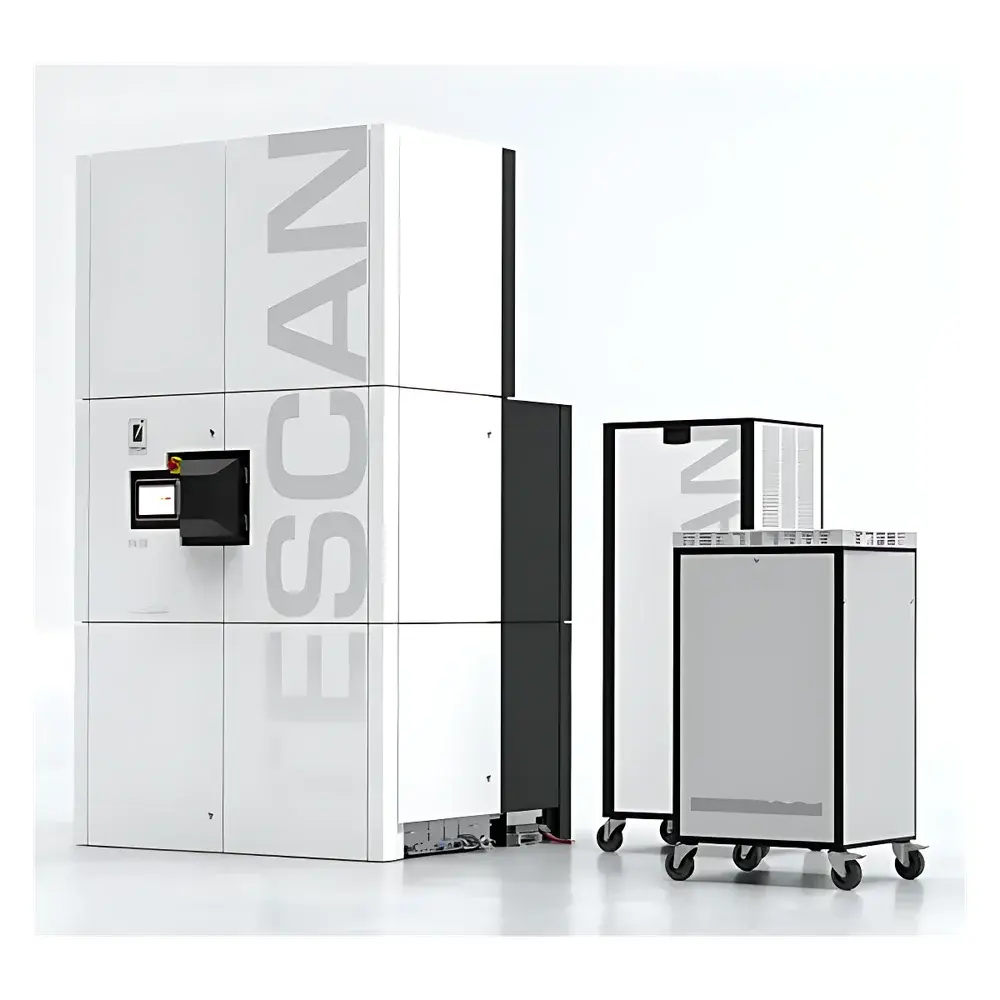
TESCAN TENSOR 4D Scanning Transmission Electron Microscope
| Brand | TESCAN |
|---|---|
| Origin | Czech Republic |
| Model | TENSOR |
| Acceleration Voltage | Medium-voltage (e.g., 80–200 kV) |
| Vacuum Level | Near-UHV (10⁻⁶ Pa in specimen chamber) |
| Detector Configuration | Dual large-solid-angle windowless EDS detectors |
| Precession Frequency | Up to 72 kHz |
| Camera | Hybrid-pixel direct electron diffraction camera |
| Software Platform | TESCAN Explore (real-time 4D-STEM processing) |
| Beam Control | Integrated electrostatic beam blanker |
| Emission Source | Schottky field-emission gun (FEG) |
| Compatibility | API support for HyperSpy, LiberTEM, Py4DSTEM |
Overview
The TESCAN TENSOR 4D Scanning Transmission Electron Microscope (4D-STEM) is a purpose-built, medium-acceleration-voltage analytical platform engineered for comprehensive nanoscale multimodal characterization of functional materials, thin films, nanoparticles—both natural and synthetic—and crystalline or amorphous systems. Unlike conventional STEM instruments, the TENSOR implements true 4D-STEM acquisition: at every probe position on the scanned raster, it simultaneously records a full 2D electron diffraction pattern *and* an energy-dispersive X-ray spectrum (EDS). This dual-signal acquisition captures the complete interaction between the focused electron beam and the specimen—enabling correlative extraction of structural (crystallographic orientation, strain, phase distribution), compositional (elemental mapping, stoichiometry), and morphological information from a single dataset. Its near-ultra-high vacuum environment (10⁻⁶ Pa in the specimen chamber), combined with a high-brightness Schottky field-emission electron source, ensures exceptional beam stability and signal-to-noise ratio across extended acquisition times.
Key Features
- Integrated precession-enabled 4D-STEM: Real-time beam precession up to 72 kHz eliminates dynamical diffraction artifacts and enhances quantitative diffraction contrast for reliable crystallographic analysis.
- Dual large-solid-angle windowless EDS detectors: Enable rapid, high-count-rate elemental mapping synchronized with diffraction acquisition—critical for correlative structure–composition studies.
- Hybrid-pixel direct electron diffraction camera: Provides high dynamic range, low noise, and nanosecond temporal resolution for accurate diffraction pattern capture at each probe position.
- Electrostatic beam blanker: Ensures precise dwell-time control and eliminates beam-induced damage during sensitive measurements.
- Modular high-voltage architecture: Supports stable operation at 80–200 kV, balancing penetration depth, spatial resolution, and radiation sensitivity for diverse material classes.
- Real-time data processing engine: Embedded “Explore” software enables on-the-fly indexing, virtual imaging, strain mapping, and phase identification without requiring prior expertise in diffraction physics or Python-based data science.
Sample Compatibility & Compliance
The TENSOR accommodates standard 3 mm TEM grids, lift-out lamellae (FIB-prepared), and bulk cross-sections mounted on specialized holders. It supports cryo-capabilities via optional stages for beam-sensitive biological or soft-matter specimens. From a regulatory standpoint, its digital workflow—including timestamped metadata logging, user-access controls, and audit-trail-enabled parameter recording—aligns with GLP and GMP documentation requirements. While not inherently FDA 21 CFR Part 11-certified out-of-the-box, the system’s deterministic data export (HDF5, TIFF, MRC) and API-driven automation facilitate integration into validated environments where traceability and electronic signature compliance are mandated.
Software & Data Management
TESCAN Explore serves as the unified interface for acquisition, visualization, and quantitative analysis of 4D-STEM datasets. It provides intuitive tools for virtual BF/ADF/HAADF imaging, orientation mapping (using ASTAR-like algorithms), strain tensor calculation, and EDS–diffraction correlation overlays. All raw and processed data adhere to FAIR principles (Findable, Accessible, Interoperable, Reusable): datasets are stored in open HDF5 format with embedded metadata compliant with the EMDB/EMPIAR schema. For advanced users, native Python API access allows custom pipeline development. Export modules support interoperability with open-source platforms including HyperSpy, LiberTEM, and Py4DSTEM—enabling offline reconstruction, machine learning–assisted segmentation, or deep-learning–based denoising workflows.
Applications
- Crystallographic phase identification and grain boundary characterization in polycrystalline battery cathodes and catalyst supports.
- Nanoscale strain mapping in semiconductor heterostructures (e.g., SiGe-on-Si, GaN HEMTs) to correlate lattice distortion with device performance degradation.
- Correlative chemical–structural tomography of core–shell nanoparticles, where EDS quantification and diffraction-based phase assignment are performed voxel-by-voxel.
- Defect analysis in 2D materials (e.g., MoS₂, h-BN), combining atomic-resolution HAADF imaging with local symmetry analysis via ptychographic reconstruction.
- In situ and operando studies—when coupled with compatible environmental or heating holders—to monitor dynamic structural evolution under thermal or electrical bias.
FAQ
What vacuum level does the TENSOR achieve in the specimen chamber?
The specimen chamber operates at a base pressure of ≤10⁻⁶ Pa under near-ultra-high vacuum (UHV) conditions, ensuring minimal hydrocarbon contamination and optimal electron beam coherence.
Can TENSOR acquire both diffraction and EDS data simultaneously at every probe position?
Yes—each pixel in the STEM scan acquires a full 2D diffraction pattern and a corresponding EDS spectrum in lockstep, enabling true 4D data cubes (x, y, diffraction qx, qy) with elemental metadata.
Is TESCAN Explore compatible with third-party analysis libraries?
Absolutely—the system exports natively to HDF5 and supports direct API calls to Python environments; integration with HyperSpy, LiberTEM, and Py4DSTEM is fully documented and maintained.
Does the TENSOR support automated crystallographic phase mapping?
Yes—via Explore’s built-in indexing engine, which performs real-time template matching against user-defined or ICDD PDF databases to generate orientation and phase maps without offline post-processing.
What is the maximum precession frequency supported?
The electrostatic precession system delivers stable, jitter-free beam rocking up to 72 kHz, optimized for artifact suppression while preserving probe current and spatial resolution.





