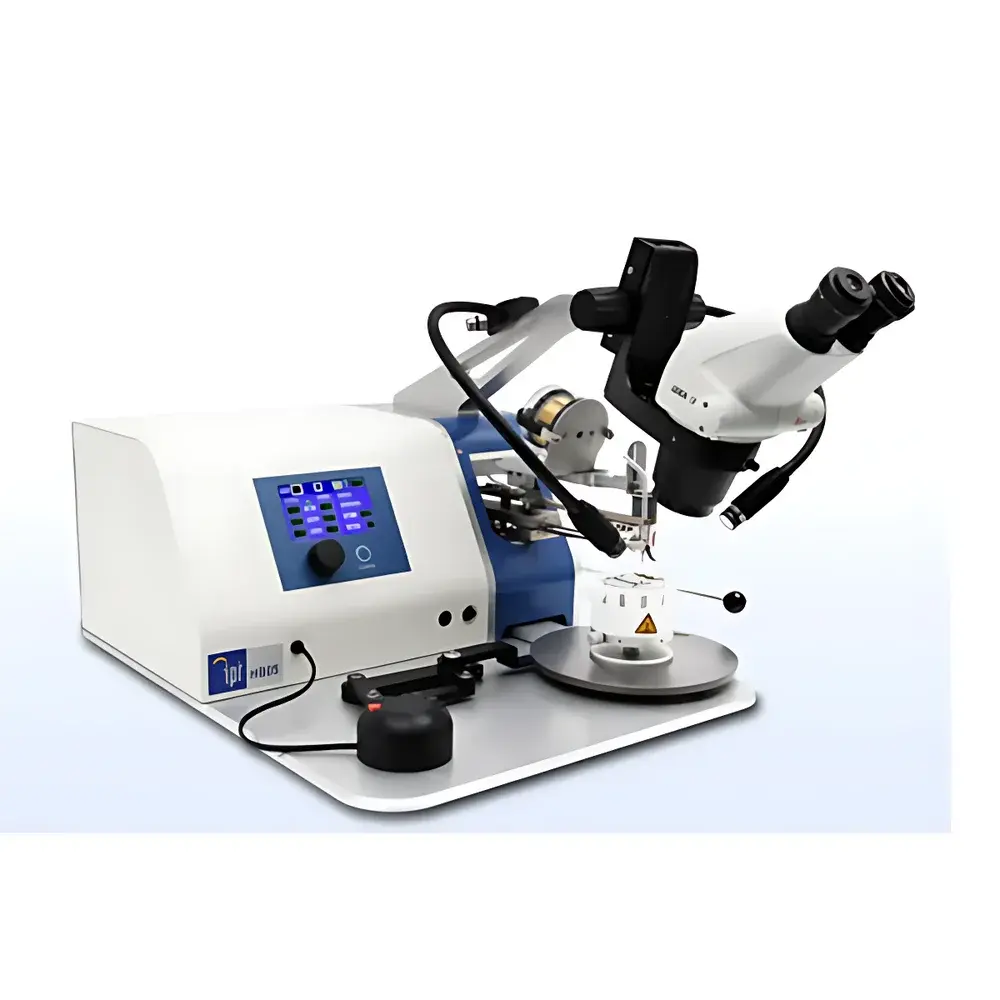
TPT HB05 Manual Thermosonic Wire Bonder
| Brand | TPT |
|---|---|
| Origin | Germany |
| Model | TPT-HB05 |
| Bonding Methods | Wedge-Wedge, Ball-Wedge, Ribbon & Bump Bonding |
| Wire Diameter | 17–75 µm (Au/Al) |
| Ribbon Size | Up to 25 × 250 µm |
| Ultrasonic Frequency | 62 kHz, PLL-Controlled |
| Ultrasonic Power Output | 0–5 W |
| Bond Time | 0–1 s |
| Bond Force | 5–130 cNm |
| Capillary | Ø1.58 mm, L=19 mm |
| Spool Diameter | 50.8 mm (2") |
| Cut-off Mechanism | Bond Head Integrated |
| Wire Feed Angle | 90° |
| Clamp Vertical Travel | Motor-Driven |
| Ball Size Control | Electronic |
| Stitch Depth | 165 mm |
| Fine-Stage Travel | 10 mm (6:1 Reduction Ratio) |
| Heating Stage | Up to 250 °C ±1 °C |
| Power Supply | 100–240 V ±10%, 50/60 Hz, Max 10 A |
| Dimensions (W×D×H) | 550 × 450 × 250 mm |
| Net Weight | 25 kg |
Overview
The TPT HB05 Manual Thermosonic Wire Bonder is a precision-engineered, benchtop bonding system designed for R&D laboratories, process development centers, and low-volume pilot production environments in semiconductor packaging and microelectronics assembly. It operates on the thermosonic bonding principle—combining controlled thermal energy (heated substrate), ultrasonic vibration (62 kHz, PLL-synchronized), and precisely regulated mechanical force to form reliable metallurgical interconnections between wire or ribbon and bond pads. Unlike fully automated systems, the HB05 retains full manual operator control over all critical bonding parameters—including force, time, ultrasonic power, temperature, and stitch positioning—enabling rapid iterative process optimization and failure root-cause analysis. Its modular head architecture supports seamless transition between ball bonding (using standard capillaries) and wedge bonding (with dedicated wedge tools), as well as ribbon and bump bonding configurations, without mechanical reconfiguration.
Key Features
- Multi-mode bonding capability: native support for ball-wedge, wedge-wedge, ribbon, and bump bonding within a single platform
- High-resolution motorized wire feed and clamp actuation, enabling repeatable tail control and consistent loop formation
- 4.3-inch LCD interface with intuitive menu navigation and direct parameter entry—no software installation required
- Deep-cavity bonding head with 16 mm vertical clearance, accommodating high-profile packages and stacked-die assemblies
- Motor-driven Z-axis clamp travel for precise contact pressure modulation across heterogeneous pad topographies
- Electronic ball size regulation and stitch depth control (165 mm maximum), ensuring reproducible first and second bond geometry
- Thermal stage with ±1 °C stability up to 250 °C, compliant with JEDEC J-STD-020 moisture sensitivity level (MSL) preconditioning requirements
- Integrated wire cut-off mechanism at the bonding head, eliminating post-bond trimming steps and reducing contamination risk
- 20-user-programmable recipes stored onboard, each with independent settings for ultrasonic power ramping, force profiling, and thermal soak timing
Sample Compatibility & Compliance
The HB05 accommodates a broad range of substrate geometries and material systems common in advanced packaging, including silicon die, ceramic substrates (Al₂O₃, AlN), organic laminates (BT, ABF), and flexible polyimide carriers. It bonds gold (17–75 µm), aluminum (17–75 µm), and copper wires, as well as flat ribbons up to 25 × 250 µm—suitable for high-current interconnects and RF applications. The system meets mechanical and electrical safety requirements per IEC 61000-6-2 (immunity) and IEC 61000-6-4 (emission), and its thermal and ultrasonic subsystems are calibrated traceable to national standards (DIN EN ISO/IEC 17025). While not certified for GMP manufacturing, its parameter logging, recipe consistency, and thermal stability support GLP-compliant documentation for qualification studies aligned with IPC-7095C and MIL-STD-883 Method 2011.
Software & Data Management
The HB05 operates via embedded firmware with no external PC dependency. All operational parameters—including bond force profiles, ultrasonic envelope settings, temperature ramps, and stitch coordinates—are stored locally in non-volatile memory. Each of the 20 programmable recipes includes timestamped versioning and user-accessible audit logs for parameter changes. Though the unit lacks network connectivity or FDA 21 CFR Part 11-compliant electronic signatures, its deterministic behavior, repeatable calibration intervals, and mechanical lockout of unauthorized parameter ranges make it suitable for IQ/OQ validation protocols in regulated development labs. Optional RS-232 output enables integration with lab-wide data acquisition systems for long-term process trend monitoring.
Applications
- Process development for Cu wire bonding in automotive and industrial ICs
- Failure analysis of intermetallic compound (IMC) growth kinetics under varied thermosonic conditions
- Ribbon bonding feasibility testing for GaN HEMT modules and SiC power devices
- Low-volume prototyping of stacked-die memory packages requiring deep-cavity access
- Qualification of new die attach materials where wire bond integrity must be assessed under thermal stress
- Teaching and training platforms in university microfabrication and packaging courses
FAQ
Is the HB05 compatible with copper wire bonding?
Yes—the HB05 supports gold, aluminum, and copper wires in the 17–75 µm diameter range, provided appropriate capillary/wedge tooling and inert atmosphere handling (e.g., N₂ purge) are implemented externally.
Can the bonding head be upgraded to support automatic vision alignment?
No—the HB05 is a manually operated platform with fixed optical path and no integrated camera or motion feedback loop; vision-assisted alignment requires retrofitting with third-party stereo microscopes and external XY stages.
What calibration services are available for the ultrasonic transducer?
TPT provides annual factory recalibration using reference load cells and laser Doppler vibrometry, traceable to PTB (Physikalisch-Technische Bundesanstalt) standards.
Does the system include vacuum or nitrogen purging capability?
No—purge functionality is not built-in but can be added via external gas manifold interfacing with the bond chamber enclosure (user-supplied).
How is thermal uniformity verified across the heating stage?
Each unit undergoes thermal mapping at three load points (center, corners) using calibrated Pt100 sensors prior to shipment; a certificate of thermal uniformity (±1.5 °C over 10 × 10 mm area at 250 °C) is included.