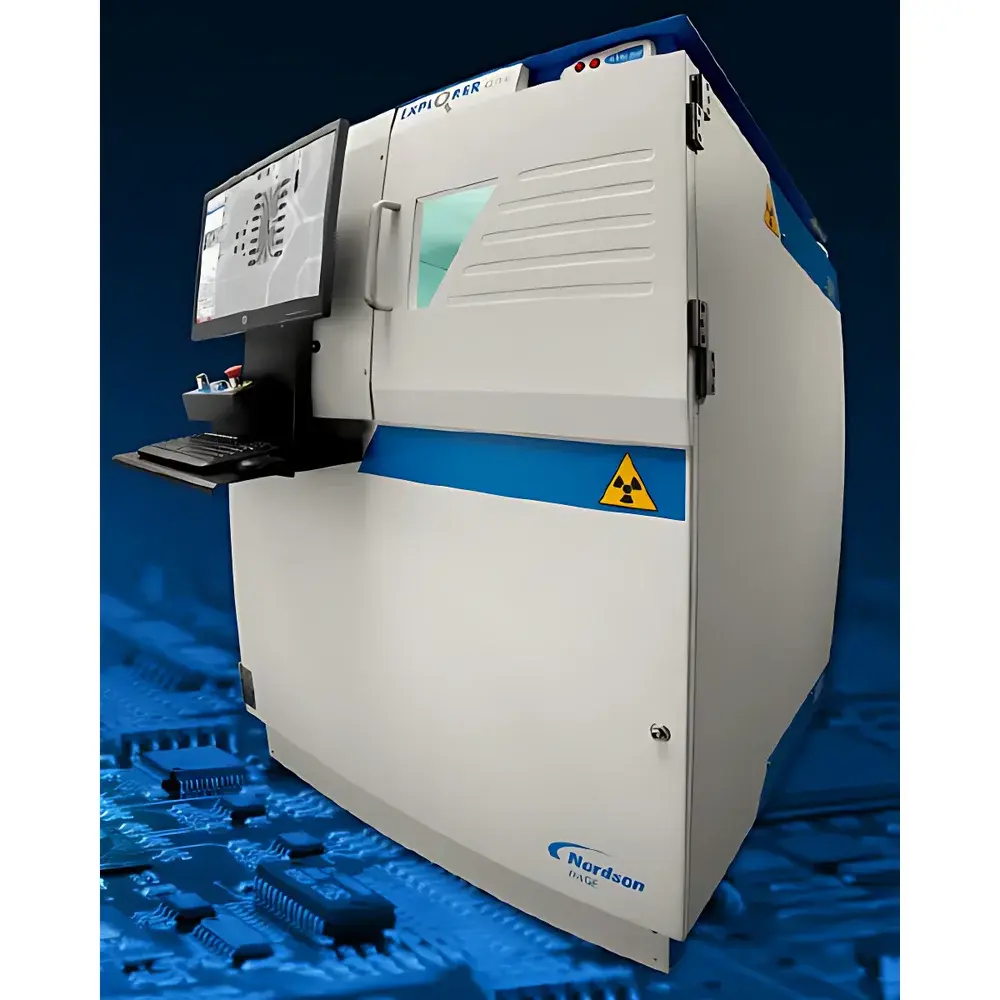
Nordson DAGE Explorer One X-ray Inspection System
| Brand | Nordson Dage |
|---|---|
| Origin | United Kingdom |
| Model | Explorer One |
| X-ray Tube | QuadraNT® transmission tube with filament-free operation |
| Feature Resolution | 2 µm |
| Output Power | 10 W |
| Operating Voltage | 30–90 kV |
| Detector | AspireFP™ flat-panel detector |
| Detector Resolution | 1.4 MP |
| Frame Rate | 10 fps |
| Digital Image Processing | 16-bit |
| Oblique View Capability | ±60° (dual-axis, no sample rotation required) |
| Inspection Area | 300 × 300 mm (12″ × 12″) |
| Maximum Magnification | 400× |
| Display | 22″ widescreen WXGA (1920 × 1080) |
| Measurement Capabilities | Dimensional metrology, void analysis, plating thickness assessment, pad inspection, BGA/QFN solder joint evaluation |
| Automation | Recipe-driven automated inspection, optional barcode reader for traceability |
| Safety Compliance | <1 µSv/h ambient dose rate, collision avoidance system, low-dose X-ray mode |
| Platform | Windows® 10 |
| Dimensions (W×D×H) | 1.05 × 1.30 × 1.38 m (41.3″ × 51.2″ × 54.3″) |
| Weight | 750 kg (1650 lb) |
| Power Supply | Single-phase 220–230 VAC, 50/60 Hz, 16 A |
| Pneumatic Requirements | None |
Overview
The Nordson DAGE Explorer One X-ray Inspection System is a high-resolution, benchtop microfocus X-ray imaging platform engineered specifically for non-destructive quality assurance in electronics manufacturing and semiconductor packaging. It operates on the principle of transmission radiography, utilizing a filament-free QuadraNT® microfocus X-ray source to generate high-contrast, low-noise images of internal structures—enabling sub-micron feature visibility without physical sectioning. Designed for production floor integration, the system delivers consistent, repeatable imaging performance across heterogeneous PCB assemblies, wire-bonded packages, flip-chip interconnects, and advanced substrates such as fan-out wafer-level packages (FOWLP) and silicon interposers. Its 2 µm geometric resolution—achieved through optimized source-to-detector geometry and proprietary AspireFP™ detector calibration—supports defect detection at the critical interconnect level, including micro-voids in solder joints, wire bond lift, die attach delamination, and underfill anomalies. Unlike macro-scale industrial CT systems, the Explorer One prioritizes rapid throughput and operator accessibility while maintaining metrological traceability suitable for ISO 9001-certified production environments.
Key Features
- QuadraNT® filament-free transmission X-ray tube delivering stable output over extended operational life, eliminating scheduled filament replacement downtime.
- AspireFP™ flat-panel detector with 1.4 MP native resolution and real-time 16-bit image processing, optimized for electron density contrast in low-Z materials (e.g., solder, copper traces, epoxy molding compounds).
- Dual-axis oblique imaging (±60° tilt) enabling stereoscopic visualization of stacked die, embedded passives, and multi-layer interposer structures—without mechanical sample rotation or repositioning.
- Intuitive mouse-and-click navigation interface with live navigation map, multi-region comparison windows, and 360° orbital feature tracking for systematic defect localization.
- Integrated metrology suite supporting calibrated dimensional measurement (ISO 10360-compliant), void area quantification (per IPC-A-610 Class 3 criteria), solder volume estimation, and BGA/QFN coplanarity analysis.
- Low-dose X-ray mode and active collision-sensing gantry ensure compliance with IEC 61000-6-4 EMC standards and local radiation safety regulations (e.g., UK Ionising Radiations Regulations 2017, US NRC 10 CFR Part 20).
Sample Compatibility & Compliance
The Explorer One accommodates a broad spectrum of electronic components—from 01005 passives and fine-pitch QFNs (0.3 mm pitch) to large-format HDI PCBs (up to 300 × 300 mm). Its open-frame design supports manual loading of trays, carriers, and custom fixtures, while the absence of pneumatic requirements simplifies facility integration. The system meets key industry compliance benchmarks: image data integrity aligns with FDA 21 CFR Part 11 requirements when paired with validated software configuration; measurement uncertainty budgets are documented per ISO/IEC 17025 guidelines; and routine performance verification follows ASTM E2737-21 (Standard Practice for Radiographic Examination of Electronic Components). All safety interlocks, dose monitoring, and emergency stop functions conform to EN 62471 (Photobiological Safety) and EN 61000-6-2 (Immunity).
Software & Data Management
Powered by DAGE’s proprietary Aspire™ software suite, the Explorer One provides audit-trail-enabled workflow management with timestamped user actions, parameter change logs, and encrypted image metadata storage. Automated inspection recipes support batch-mode execution across mixed-product lines, with optional barcode/RFID integration enabling full component traceability from incoming inspection to final test. Image archives are stored in DICOM-compliant format, facilitating interoperability with enterprise MES and PLM platforms (e.g., Siemens Opcenter, Rockwell FactoryTalk). Software updates are delivered via secure HTTPS channels with SHA-256 signature validation, and all system configurations undergo annual GLP/GMP validation support per customer-defined SOPs.
Applications
- Solder joint integrity verification in automotive ADAS modules and aerospace-grade avionics PCBs.
- Wire bond pull-test correlation and failure root cause analysis in power module packaging.
- Underfill uniformity and void content assessment in MEMS sensor encapsulation.
- Die attach coverage and silver sinter porosity evaluation in SiC MOSFET modules.
- Post-reflow inspection of micro-BGA and chip-scale package (CSP) interconnects.
- Failure analysis lab support for cross-sectional correlation and non-destructive fault isolation.
FAQ
What is the minimum detectable feature size under standard operating conditions?
The system achieves a verified geometric resolution of 2 µm at optimal magnification and source-detector distance—validated using certified line-pair test objects per ISO 16508-2.
Does the Explorer One support automated defect classification?
Yes—when configured with optional AI-assisted analysis modules, it performs supervised classification of common defects (e.g., bridging, insufficient solder, missing bond) using convolutional neural networks trained on customer-specific ground-truth datasets.
Can the system be integrated into a factory-wide SPC framework?
Absolutely—the Aspire™ software exports measurement data in CSV/Excel format with full metadata, enabling direct ingestion into Minitab, JMP, or custom SPC dashboards compliant with ISO/IEC 13053 (DMAIC methodology).
Is remote diagnostics and software update capability available?
Yes—via Nordson’s secure Remote Support Portal (RSP), which operates under TLS 1.3 encryption and requires dual-factor authentication for technician access.
What regulatory documentation is provided upon installation?
Customers receive a comprehensive compliance dossier including CE Declaration of Conformity, UKCA Marking Certificate, Radiation Safety Test Report (per IEC 62495), and Factory Acceptance Test (FAT) protocol signed by a UKAS-accredited metrologist.