
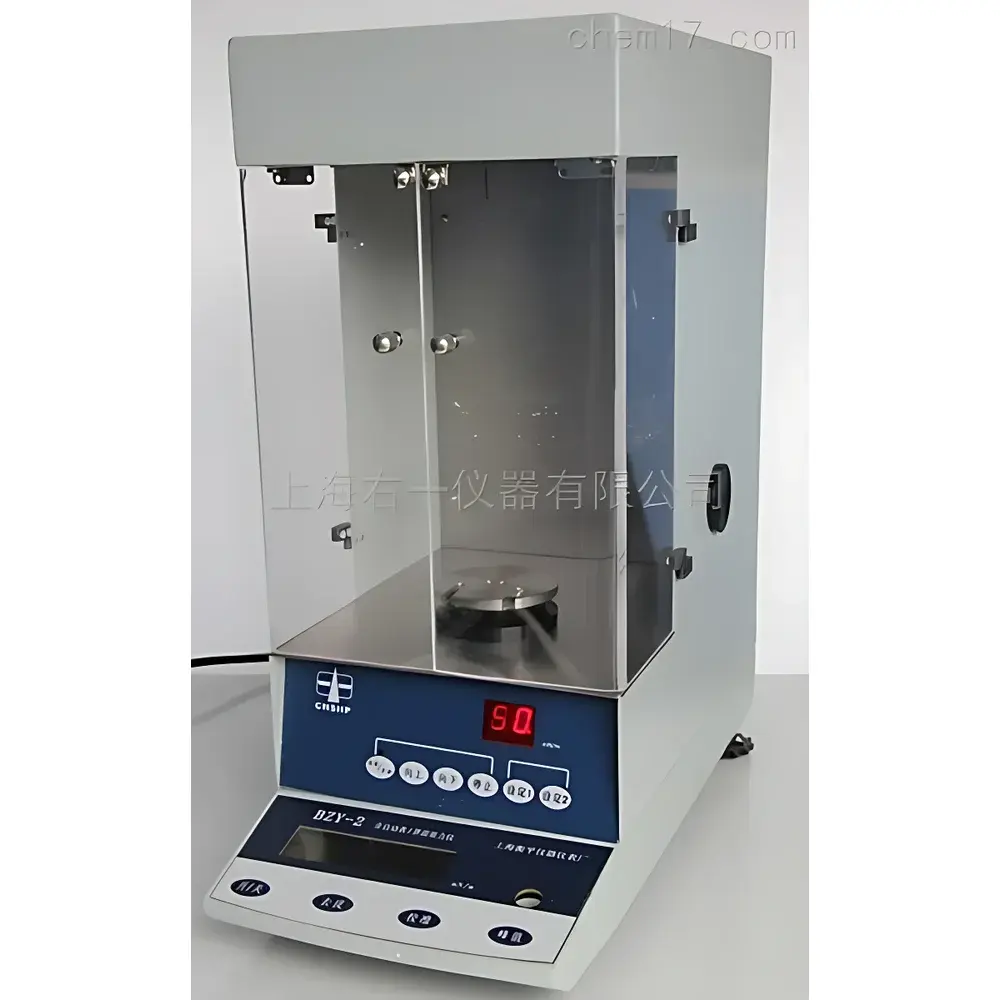
Hengping BZY-2 Automated Surface & Interfacial Tensiometer
| Brand | Hengping |
|---|---|
| Origin | Shanghai, China |
| Model | BZY-2 |
| Measurement Range | 0–200 mN/m |
| Resolution | 0.01 mN/m |
| Accuracy | ±0.02 mN/m |
| Temperature Display Range | 0–100 °C |
| Measurement Method | Wilhelmy Plate Method (optional Du Noüy Ring Method) |
| Compliance | JB/T 9388-2002, GB/T 6541-1986, ISO 1409:1995, GB/T 22237-2008, GB 11278-1989, GB/T 18396-2001, SH/T 1156-1999 |
Overview
The Hengping BZY-2 Automated Surface & Interfacial Tensiometer is a precision laboratory instrument engineered for the gravimetric determination of surface tension (liquid–air) and interfacial tension (liquid–liquid) using the Wilhelmy plate principle. Based on electromagnetic force compensation and closed-loop transduction, it delivers high-fidelity tensiometric measurements without external computer dependency. The system operates by vertically immersing a calibrated platinum plate into the test liquid and measuring the force required to maintain equilibrium at the liquid–air or liquid–liquid interface. This method adheres strictly to ASTM D971, ISO 1409, and GB/T 6541 standards for interfacial tension measurement and is inherently suitable for dynamic surface tension profiling—particularly in systems containing surfactants, polymers, or high-viscosity fluids where equilibrium tension develops over time. Designed for routine QC labs and R&D environments, the BZY-2 integrates microprocessor-based control, automatic zeroing and calibration routines, and real-time force monitoring to ensure traceable, repeatable results under ambient or controlled thermal conditions.
Key Features
- Electromagnetic force compensation sensor with ±0.02 mN/m accuracy and 0.01 mN/m resolution—optimized for low-noise, high-stability signal acquisition.
- Automated sample stage with programmable vertical travel (60 mm range), enabling precise immersion depth control and reproducible meniscus contact.
- Dual-method capability: Wilhelmy plate (standard) and optional Du Noüy ring configuration—both compliant with ISO 1409 and GB/T 6541 for cross-standard validation.
- Onboard LED display with real-time force readout and auto-detection of equilibrium tension—eliminates subjective endpoint judgment.
- One-touch tare (0–400 mN range) and rapid calibration using supplied certified weights—reducing operator-induced variability and supporting GLP-aligned workflows.
- Integrated RS232C interface for data export and optional synchronization with third-party curve analysis software; supports timestamped CSV logging.
- Modular thermal compatibility: Accepts standard and high/low-temperature恒温 cups (–5 °C to 110 °C) coupled with PT100 temperature probes (0.1 °C resolution) for ISO/IEC 17025-compliant thermal control.
Sample Compatibility & Compliance
The BZY-2 is validated for use across diverse liquid systems—including aqueous surfactant solutions, hydrocarbon–water interfaces, polymer melts, pharmaceutical emulsions, and ink formulations. Its Wilhelmy plate geometry (standard 19 mm × 10 mm Pt plate, 0.1 mm thickness) ensures minimal buoyancy error and consistent wetting behavior per ISO 1409 Annex A. For interfacial applications involving immiscible phases (e.g., crude oil–brine, silicone oil–water), the instrument maintains linearity across the full 0–200 mN/m range. Regulatory alignment includes compliance with Chinese national standards JB/T 9388-2002 (tensiometer specifications), GB/T 22237-2008 (surfactant surface tension testing), and GB 11278-1989 (CMC determination). While not FDA 21 CFR Part 11–certified out-of-the-box, audit trails generated via RS232 export meet basic ALCOA+ data integrity criteria for non-GMP laboratories.
Software & Data Management
The BZY-2 ships with standalone real-time curve acquisition software compatible with Windows OS. This application captures force vs. time profiles at user-defined sampling intervals (10–100 Hz), overlays multiple runs for comparative kinetics analysis, and calculates equilibrium surface tension using slope convergence algorithms. Export formats include .csv and .txt for downstream processing in MATLAB, OriginLab, or Excel. All measurements retain embedded metadata: date/time stamp, operator ID (manually entered), temperature reading (if probe connected), and calibration status. No cloud connectivity or proprietary firmware lock-in is implemented—ensuring long-term data sovereignty and instrument interoperability.
Applications
- Petroleum: Oil–water interfacial tension monitoring for enhanced oil recovery (EOR) formulation screening and transformer oil aging assessment per IEC 60429.
- Pharmaceuticals: Surfactant selection for nanoemulsion stability, wetting efficiency of API suspensions, and CMC quantification during excipient development.
- Coatings & Inks: Evaluation of pigment dispersion stability, substrate wettability (contact angle proxy), and rheo-tensiometric response during drying.
- Agrochemicals: Optimization of adjuvant performance through dynamic surface tension reduction kinetics and spray droplet formation analysis.
- Food Science: Interfacial activity of natural emulsifiers (e.g., lecithin, whey protein), foam stability in dairy products, and packaging film compatibility testing.
- Academic Research: Fundamental studies of adsorption isotherms, Gibbs elasticity, and Marangoni flow effects in Langmuir monolayers.
FAQ
What measurement principle does the BZY-2 employ?
It uses the Wilhelmy plate method based on force balance at the solid–liquid–gas interface, conforming to ISO 1409 and GB/T 6541.
Can the BZY-2 measure interfacial tension between two liquids?
Yes—provided the liquids are immiscible and the denser phase serves as the subphase; typical applications include hydrocarbon–aqueous systems.
Is temperature control integrated or external?
Temperature sensing (PT100) is built-in; thermal regulation requires optional external circulation baths—compatible with standard lab-grade thermostats.
Does the instrument support GMP/GLP documentation requirements?
While not pre-validated for 21 CFR Part 11, its RS232 output enables secure, time-stamped data capture suitable for internal QA protocols and ISO/IEC 17025 audits.
How often must calibration be performed?
Daily verification with the supplied 500 mg standard weight is recommended; full recalibration is advised after mechanical shock, sensor replacement, or biannual usage per ISO/IEC 17025 guidance.
Related Products



