
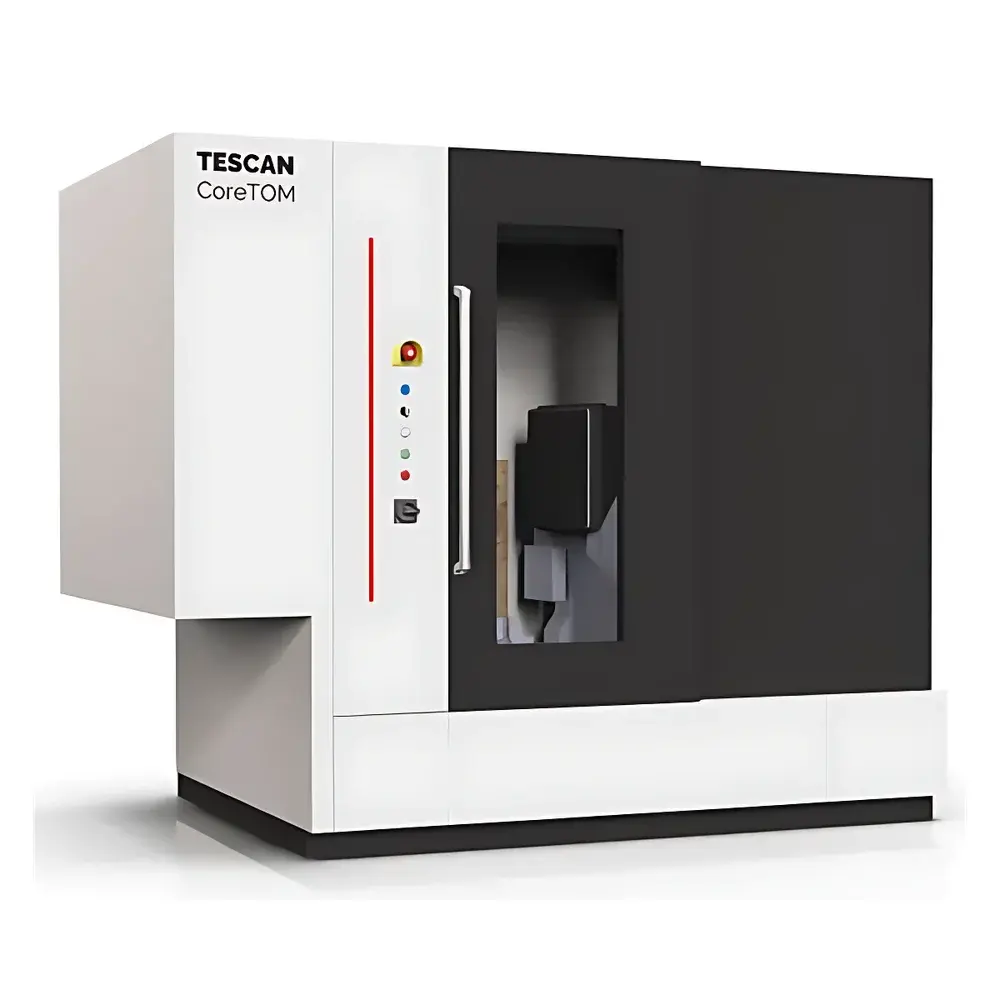
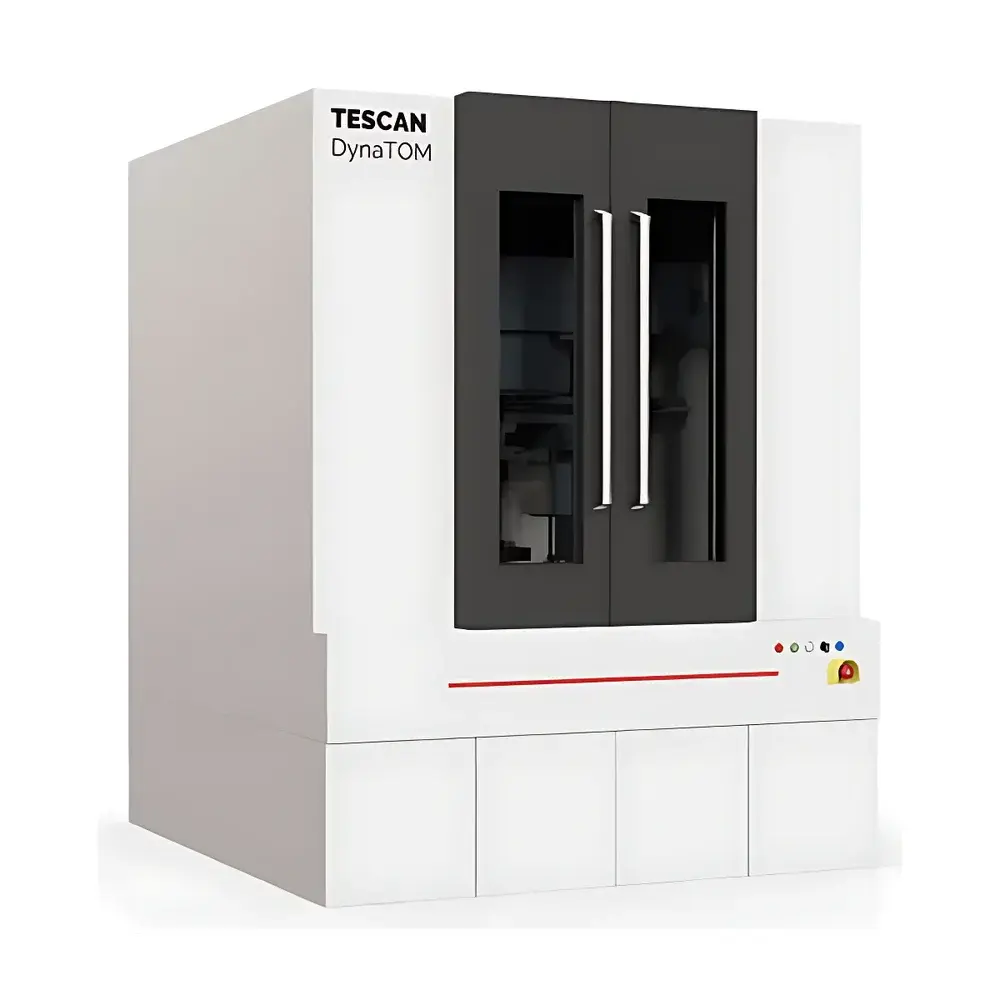
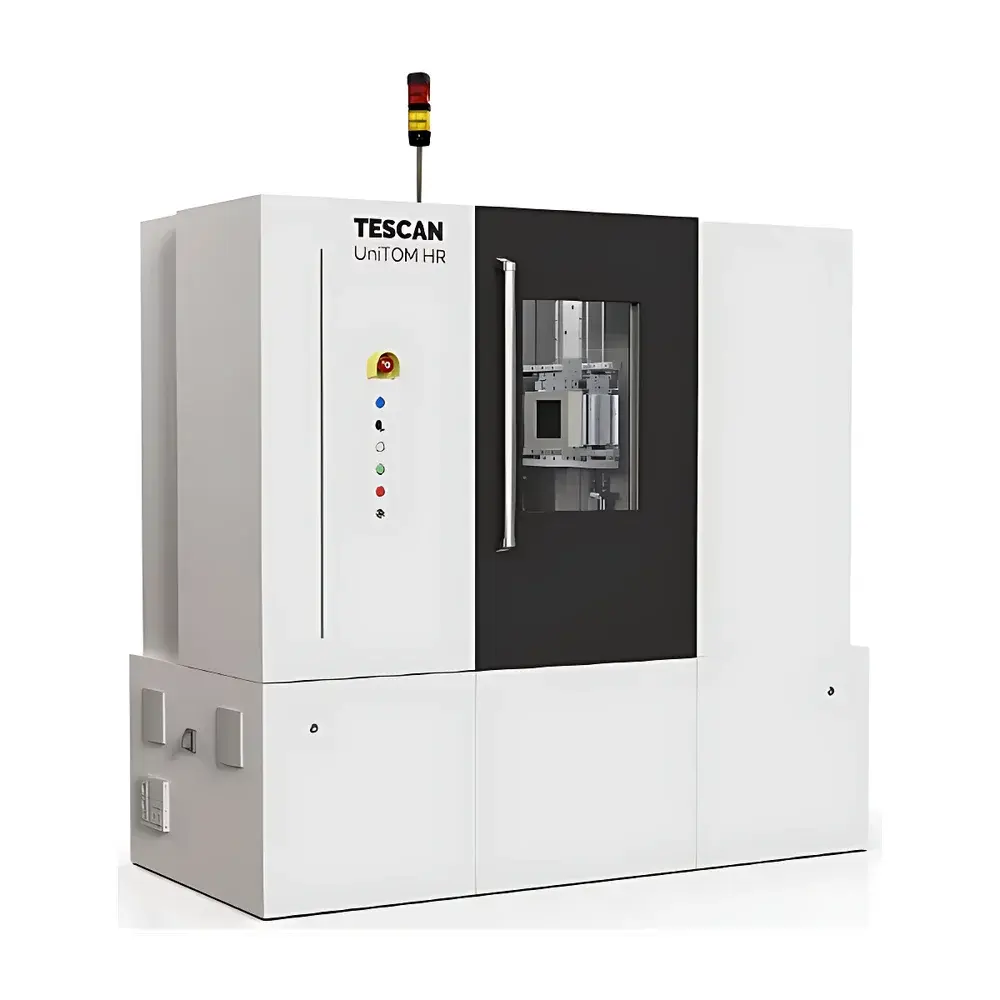
TESCAN CoreTOM / DynaTOM / UniTOM HR 4D Dynamic X-ray Micro-CT System
| Brand | TESCAN |
|---|---|
| Origin | Czech Republic |
| Model Series | CoreTOM, DynaTOM, UniTOM HR |
| Maximum Sample Diameter | 30 cm |
| Maximum Sample Height | 50 cm |
| Spatial Resolution (UniTOM HR) | ≤ 0.6 µm |
| Spatial Resolution (CoreTOM & DynaTOM) | ≤ 3 µm (JIMA mode) |
| Scan Time (DynaTOM, full tomogram) | ~seconds |
| In-situ/4D Capability | Yes |
| System Architecture | Fixed-sample (DynaTOM), Variable-sample (CoreTOM, UniTOM HR) |
Overview
The TESCAN CoreTOM, DynaTOM, and UniTOM HR series constitute a family of laboratory-based 4D dynamic X-ray micro-computed tomography (micro-CT) systems engineered for high-fidelity, non-destructive volumetric imaging across time and space. These systems operate on the principle of cone-beam X-ray computed tomography: a microfocus X-ray source emits polychromatic radiation through a sample onto a high-efficiency flat-panel detector; hundreds to thousands of projection images are acquired over 360° rotation (or, in the case of DynaTOM, via source–detector gantry rotation around a stationary specimen); and iterative or filtered back-projection algorithms reconstruct quantitative 3D volume datasets with isotropic voxel resolution. Unlike synchrotron-based approaches, TESCAN’s benchtop platforms deliver synchrotron-like temporal resolution and spatial fidelity without requiring beamline access—enabling routine 4D (3D + time) experimentation under controlled environmental conditions (e.g., temperature, pressure, fluid flow, mechanical loading). Each model addresses distinct experimental priorities: CoreTOM emphasizes multi-scale imaging of large-volume geological and industrial specimens; DynaTOM prioritizes ultra-fast, continuous tomographic acquisition for real-time process monitoring; and UniTOM HR delivers sub-micron structural resolution with modular extensibility for advanced correlative workflows.
Key Features
- Three purpose-built platform variants: CoreTOM (multi-resolution, large-field-of-view), DynaTOM (high-temporal-resolution, fixed-sample geometry), and UniTOM HR (sub-600 nm resolution, modular architecture)
- DynaTOM’s unique rotating-source-and-detector design eliminates sample motion, enabling seamless integration with in-situ rigs—including hydraulic cells, triaxial pressure vessels, heating stages, and electrochemical cells—without compromising mechanical stability or alignment integrity
- CoreTOM supports hierarchical imaging: rapid whole-core scanning (up to 1.15 m length) followed by region-of-interest (ROI) magnification without repositioning, preserving spatial context across scales from centimeter- to micrometer-level features
- UniTOM HR offers true sub-micron spatial resolution (≤ 0.6 µm) validated per ISO 17025-accredited protocols, with optional dual-source/dual-detector configurations for enhanced contrast-to-noise ratio and reduced beam-hardening artifacts
- All systems incorporate TESCAN’s proprietary NDT software suite with GPU-accelerated reconstruction, real-time preview, and automated drift correction—critical for long-duration 4D acquisitions
- Hardware modularity allows incremental upgrades: additional X-ray sources, detectors, or stage controllers can be integrated without system replacement, extending operational lifetime and ROI
Sample Compatibility & Compliance
The TESCAN 4D micro-CT platforms accommodate diverse specimen geometries and material classes—ranging from low-density polymer foams and biological tissues to high-Z metallic alloys and mineralogically complex rock cores. CoreTOM accepts samples up to 1 m in length and 30 cm in diameter; UniTOM HR handles specimens up to 30 cm in diameter and 50 cm in height; DynaTOM optimizes for smaller, dynamically constrained samples (typically ≤ 10 cm) where temporal fidelity outweighs maximum volume. All systems comply with IEC 61000-6-3 (EMC emissions), IEC 61000-6-4 (industrial immunity), and EU Directive 2013/59/Euratom for radiation safety. Data provenance and auditability meet GLP and GMP requirements through built-in metadata logging (acquisition parameters, calibration timestamps, user credentials) and optional 21 CFR Part 11–compliant electronic signature modules.
Software & Data Management
Acquisition, reconstruction, and analysis are unified within TESCAN’s NDT software environment—a validated, version-controlled platform supporting DICOM, TIFF, HDF5, and custom binary output formats. The software includes automated beam-hardening correction, ring artifact suppression, phase-retrieval algorithms for low-contrast materials, and quantitative morphometric tools (porosity, tortuosity, grain size distribution, phase segmentation via machine learning classifiers). Time-series data from 4D experiments are managed using hierarchical directory structures with embedded JSON metadata, enabling traceable linkage between raw projections, reconstructed volumes, and derived metrics. Integration with third-party platforms (Avizo, Dragonfly, MATLAB, Python via REST API) is supported for advanced simulation coupling (e.g., Lattice Boltzmann flow modeling, finite element stress analysis).
Applications
- Petroleum engineering: 4D pore-network evolution during core flooding, wettability alteration, and CO₂ sequestration studies
- Materials science: Real-time observation of crack propagation, dendritic solidification, battery electrode degradation, and additive manufacturing defect formation
- Geosciences: Multi-scale characterization of reservoir rock heterogeneity, fracture network connectivity, and diagenetic mineral redistribution
- Manufacturing QA/QC: Non-destructive validation of internal geometry, void content, and assembly integrity in castings, composites, and MEMS devices
- Life sciences: Longitudinal imaging of scaffold degradation, vascular perfusion dynamics, and bone–implant interface remodeling under mechanical stimulation
FAQ
What distinguishes DynaTOM’s fixed-sample geometry from conventional micro-CT systems?
DynaTOM rotates the X-ray source and detector around a stationary specimen—eliminating sample-stage motion that introduces vibration, misalignment, and thermal drift. This architecture is essential for stable, uninterrupted 4D acquisition when coupled with external stimuli (e.g., pressure, fluid injection, load frames).
Can CoreTOM perform true 4D imaging, or is it limited to static 3D?
CoreTOM supports time-resolved imaging via programmable sequential scans; however, its primary strength lies in multi-resolution 3D characterization. For sub-second temporal resolution, DynaTOM is the designated platform.
Is UniTOM HR capable of phase-contrast imaging?
Yes—when equipped with a high-coherence microfocus source and optimized detector geometry, UniTOM HR supports propagation-based phase-contrast enhancement, significantly improving soft-tissue and low-Z material visibility without contrast agents.
How is system calibration maintained across long-term deployments?
Each platform includes automated geometric calibration routines executed prior to every scan session, referencing embedded fiducial markers. Drift-compensation algorithms monitor and correct for thermal expansion effects in real time during extended acquisitions.
Does TESCAN provide application-specific workflow validation packages?
Yes—validated SOPs aligned with ASTM E1441 (standard guide for X-ray micro-CT), ISO 12795 (non-destructive testing—industrial CT), and USP (pharmaceutical packaging integrity) are available upon request for regulated environments.



