
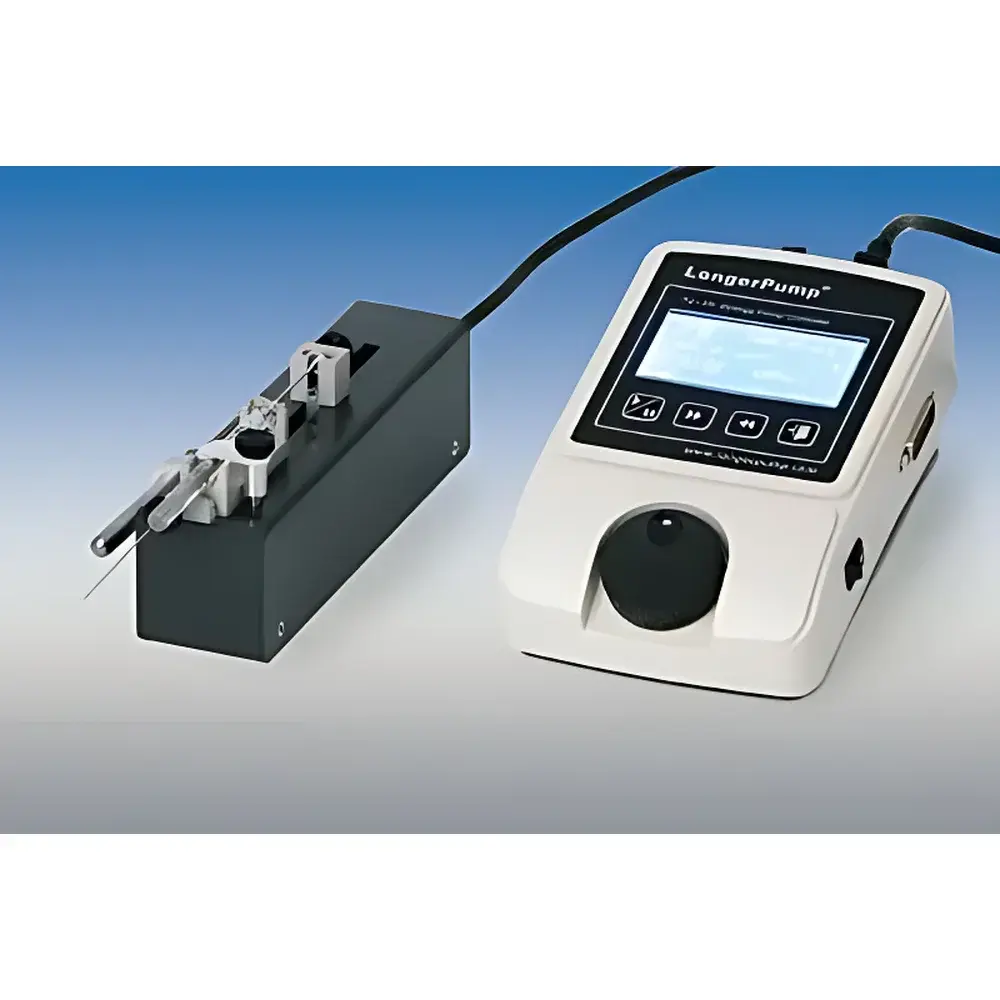
LongerPump TJ-2A / L0107-2A Single-Channel Micro-Syringe Pump
| Brand | LongerPump |
|---|---|
| Origin | Hebei, China |
| Manufacturer Type | OEM Manufacturer |
| Instrument Type | Micro-syringe Pump |
| Flow Rate Range | 0.764 nL/min – 1.325 mL/min |
| Accuracy | ≤ ±0.5% (when stroke ≥ 30% of max stroke) |
| Max Stroke | 70 mm |
| Stroke Resolution | 0.165 µm |
| Linear Speed Range | 7.94 µm/min – 79.4 mm/min |
| Linear Force Output | >20 N |
| Syringe Compatibility | Preloaded database + 4 user-defined syringe inner diameters |
| Control Interface | RS485 |
| Power Supply | AC 90–260 V, 10 W |
| Operating Temperature | 0–40 °C |
| Relative Humidity | <80% RH |
| Controller Dimensions | 170 × 108 × 65 mm |
| Controller Weight | 0.5 kg |
| Actuator Dimensions | 180 × 46 × 78 mm |
| Actuator Weight | 0.6 kg |
Overview
The LongerPump TJ-2A / L0107-2A is a single-channel, push-pull micro-syringe pump engineered for high-precision fluid delivery and withdrawal in life science laboratories. Based on closed-loop stepper motor actuation and calibrated linear displacement control, it delivers volumetric accuracy through direct mechanical translation of syringe plunger motion—eliminating reliance on indirect pressure or pressure-based flow estimation. Its core architecture separates the controller and actuator units, enabling flexible integration into confined experimental setups such as micromanipulation rigs, stereotaxic frames, patch-clamp stations, and microfluidic interfacing platforms. Designed for applications requiring nanoliter-to-milliliter scale dosing with sub-micrometer positional repeatability, the TJ-2A supports both discrete bolus delivery and continuous infusion protocols under programmable temporal sequencing.
Key Features
- Five operational modes: Infuse only, Withdraw only, Infuse-then-Withdraw, Withdraw-then-Infuse, and Continuous cycle—each configurable per channel with independent timing parameters.
- High-resolution linear actuation: 0.165 µm stroke resolution ensures reproducible positioning across the full 70 mm travel range, critical for low-volume precision dosing.
- Wide linear speed range (7.94 µm/min to 79.4 mm/min), corresponding to flow rates from 0.764 nL/min up to 1.325 mL/min when paired with standard glass or plastic syringes (e.g., 10 µL to 60 mL).
- Consistent mechanical force output (>20 N rated linear thrust) maintains stable plunger advancement even with high-viscosity media or high-backpressure conditions.
- Integrated syringe database covering major manufacturers (Hamilton, BD, Terumo, etc.) and common models; plus support for four user-defined syringe inner diameters for custom or nonstandard hardware.
- On-device flow calibration routine allows empirical correction of volumetric output based on gravimetric or timed-collected validation—essential for GLP-compliant method development.
- Dual open-collector status outputs (start/stop and direction) and three TTL-level control inputs (start/stop, fast-infuse, fast-withdraw) enable seamless synchronization with external equipment including electrophysiology amplifiers, imaging triggers, and environmental controllers.
Sample Compatibility & Compliance
The TJ-2A accommodates standard Luer-lock and Luer-slip syringes ranging from 10 µL microsyringes to 60 mL reservoirs. Its modular clamp design accepts syringes with barrel diameters from 4.5 mm to 35 mm, supporting both disposable plastic and reusable glass configurations. While not certified for IVD or clinical use, the device meets CE marking requirements for laboratory equipment (2014/30/EU EMC Directive and 2014/35/EU Low Voltage Directive). Its firmware implements non-volatile parameter retention (including run state, position, and timing settings), satisfying basic data integrity expectations under ISO/IEC 17025 Annex A.2.2 for instrument configuration traceability. The RS485 interface supports Modbus RTU protocol, facilitating integration into centralized lab automation systems compliant with ASTM E1384 or ISO/IEC 11179 metadata standards.
Software & Data Management
The TJ-2A operates autonomously via its front-panel keypad and LCD display, requiring no host PC for basic operation. For advanced protocol orchestration, optional PC software provides graphical workflow editing, multi-step sequence definition (including inter-step delays, repeat loops, and conditional branching), and real-time monitoring of position, flow rate, and elapsed time. All parameter changes—including syringe ID selection, flow calibration coefficients, and mode transitions—are timestamped and stored in internal memory. Audit trail functionality records operator-initiated actions (e.g., start, stop, fast-mode activation), supporting documentation needs in QA/QC environments operating under GLP or internal SOP frameworks. Exportable log files include CSV-formatted runtime data compatible with MATLAB, Python (pandas), and LabChart for downstream statistical analysis.
Applications
- Neuroscience: Precise intracerebral microinjection of tracers, viral vectors, or pharmacological agents during stereotactic surgery.
- Electrophysiology: Controlled drug application near recorded neurons in slice or in vivo preparations.
- Microfluidics: Priming, flushing, and reagent loading in PDMS-based chips and organ-on-chip platforms.
- Single-cell analysis: Nanoliter-scale dispensing for droplet generation, cell encapsulation, or on-chip lysis buffer delivery.
- Material science: Controlled deposition of functional nanomaterials or polymer precursors onto substrates in ambient or inert-gas gloveboxes.
- Method development labs: Validation of analytical sample introduction systems for HPLC, CE, or mass spectrometry interfaces.
FAQ
What syringe sizes are supported?
Standard syringes from 10 µL to 60 mL are supported via preloaded profiles; custom inner diameters (4.5–35 mm) can be entered and saved for up to four user-defined syringes.
Is the pump compatible with third-party control systems?
Yes—the RS485 interface supports Modbus RTU communication, allowing integration with PLCs, DAQ systems, or custom LabVIEW/Python scripts.
How is volumetric accuracy ensured across different syringes?
Accuracy relies on precise linear displacement measurement and user-performed flow calibration using gravimetric or timed-collection verification against known standards.
Does the device retain settings after power loss?
Yes—non-volatile memory preserves all configuration parameters and optionally resumes the last active run state upon power restoration.
Can multiple TJ-2A units be synchronized?
While each unit operates independently, external TTL triggering and RS485 command coordination enable tightly timed multi-pump sequences across distributed setups.



