
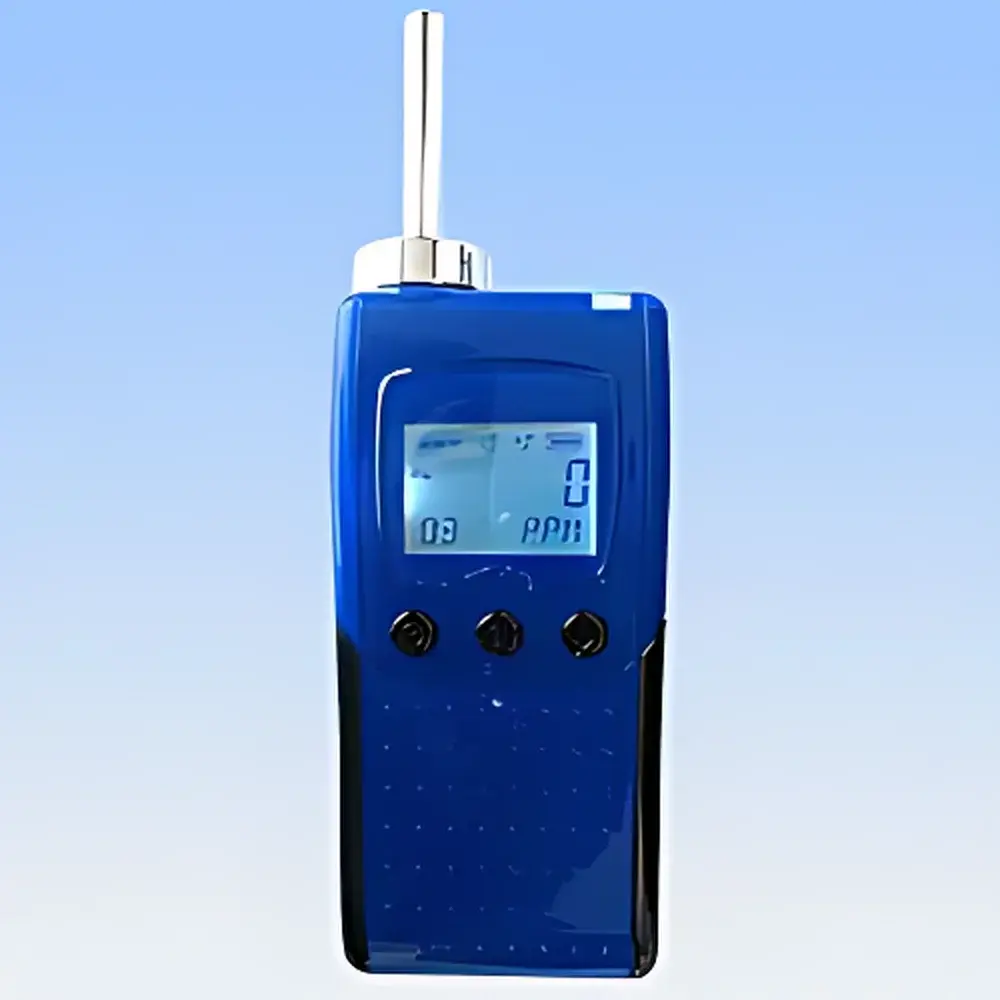
HengaoDe HRX-HK90-NH₃ Portable Ammonia Gas Detector
| Brand | HengaoDe |
|---|---|
| Origin | Beijing, China |
| Manufacturer Type | General Distributor |
| Country of Origin | China |
| Model | HRX-HK90-NH₃ |
| Price | USD 42.50 (based on ¥298 at 1 USD ≈ ¥7) |
| Measurement Range | 0–10 / 0–50 / 0–100 / 0–500 / 0–1000 / 0–2000 / 0–5000 ppm |
| Resolution | 0.01 ppm (≤100 ppm), 0.1 ppm (≤1000 ppm), 1 ppm (>1000 ppm) |
| Detection Method | Pump-aspiration |
| Display | Backlit LCD |
| Accuracy | ≤±3% FS |
| Alarm Modes | Audible, visual, vibration, low-battery |
| Response Time | <30 s |
| Recovery Time | <40 s |
| Power Supply | 3.6 VDC, 1800 mAh Li-ion (with charging protection) |
| Sensor Life | 3 years |
| Operating Temperature | −20 °C to +70 °C |
| Relative Humidity | ≤95% RH (non-condensing) |
| Explosion Protection | Intrinsic safety Exia II CT6 |
| IP Rating | IP65 |
| Dimensions | 125 × 52 × 30 mm (L×W×H) |
| Weight | 200 g |
Overview
The HengaoDe HRX-HK90-NH₃ Portable Ammonia Gas Detector is a compact, intrinsically safe instrument engineered for real-time quantitative detection of ammonia (NH₃) in ambient air across industrial hygiene, laboratory safety, wastewater treatment, agricultural storage, and cold-chain logistics environments. It operates on electrochemical sensing principles—specifically, a three-electrode amperometric cell optimized for selective NH₃ oxidation at low concentrations. The sensor exhibits minimal cross-sensitivity to common interferents including CO, H₂S, NO₂, and VOCs, enabling reliable measurements even in complex gas matrices. Its pump-aspiration sampling system ensures consistent flow control and representative sample delivery, critical for achieving repeatable results under variable environmental conditions. Designed for field deployment, the unit complies with IEC 60079-0 and IEC 60079-11 for explosive atmospheres and meets electromagnetic compatibility requirements per IEC 61000-4 series standards.
Key Features
- Compact ergonomic form factor (125 × 52 × 30 mm; 200 g) optimized for belt-clip or handheld use during extended monitoring shifts.
- Intrinsically safe design certified to Exia II CT6, suitable for Zone 0/1 hazardous locations where flammable gas accumulation is possible.
- Multi-range configurable measurement capability—from trace-level 0–10 ppm up to high-concentration 0–5000 ppm—with auto-ranging resolution scaling (0.01 ppm at low end, 1 ppm at high end).
- Robust IP65-rated enclosure providing full protection against dust ingress and water jets, ensuring operational integrity in outdoor or wet-process environments.
- Integrated dual-stage alarm system: visual (LED flash), audible (≥75 dB at 30 cm), and tactile (vibration), plus programmable low-battery warning.
- Real-time data logging with timestamped event capture—including alarm triggers, calibration events, and sensor fault codes—for traceability and audit readiness.
Sample Compatibility & Compliance
The HRX-HK90-NH₃ is validated for continuous monitoring of gaseous NH₃ in ambient air, stack emissions, and confined-space breathing zones. It is not intended for liquid-phase or dissolved ammonia analysis. The electrochemical sensor demonstrates stable performance across relative humidity levels up to 95% RH (non-condensing) and temperature extremes from −20 °C to +70 °C—making it suitable for unheated outdoor installations and refrigerated facilities. Device firmware and hardware architecture support GLP-aligned usage: all calibration entries are time-stamped and non-erasable; sensor zero/span verification logs are retained onboard. While not FDA 21 CFR Part 11 compliant out-of-the-box (lacking electronic signature and audit trail modules), the instrument’s data export function (via optional USB interface) facilitates integration into validated LIMS or EDC systems when paired with appropriate metadata tagging protocols.
Software & Data Management
The detector operates autonomously without external software dependency. All configuration—including alarm thresholds, sampling interval, backlight timeout, and units (ppm or mg/m³)—is managed via intuitive button navigation and on-device LCD prompts. Calibration is performed using certified NH₃ span gas (e.g., 50 ppm in N₂); the device stores up to three historical calibration records with date/time stamps, sensor ID, and pass/fail status. Raw concentration values and alarm events are stored in non-volatile memory (capacity: ≥10,000 readings). Optional PC connectivity via USB enables bulk export of CSV-formatted datasets—including timestamps, measured values, battery voltage, and ambient temperature—for trend analysis, regulatory reporting (e.g., OSHA PEL compliance documentation), or integration with facility-wide gas monitoring dashboards.
Applications
- Occupational health surveillance in fertilizer plants, poultry farms, and dairy processing facilities where NH₃ exposure exceeds 25 ppm TWA (OSHA) or 35 ppm STEL (ACGIH).
- Leak detection during ammonia refrigeration system maintenance, including pipe joints, valve stems, and heat exchanger manifolds.
- Verification of ventilation effectiveness in livestock housing and manure storage pits prior to worker entry.
- Environmental compliance monitoring near wastewater treatment plant headworks, digesters, and dewatering centrifuges.
- Educational use in university chemistry and environmental engineering labs for gas diffusion kinetics and Henry’s law demonstrations.
FAQ
What is the recommended calibration frequency?
Calibration is advised before each day’s use if deployed in critical safety applications; otherwise, biweekly bump testing and quarterly full calibration with traceable NH₃ standard gas are recommended per ISO 17025 guidelines.
Can the sensor be exposed to high-humidity or condensing environments?
The unit is rated IP65 and tolerates up to 95% RH non-condensing. Direct exposure to condensate or immersion will damage the electrochemical cell and void warranty.
Does the device support data export for regulatory reporting?
Yes—via USB interface, users can extract time-synchronized measurement logs compatible with Excel, LabVIEW, or enterprise EHS platforms for OSHA 300 log generation or EPA RMP submissions.
Is sensor replacement user-serviceable?
Sensor modules are field-replaceable by trained personnel using manufacturer-supplied tools; replacement requires post-installation zero and span calibration.
What certifications does the instrument hold?
It carries CE marking (EMC Directive 2014/30/EU, Low Voltage Directive 2014/35/EU), intrinsic safety certification Exia II CT6 per GB 3836.4-2010 (equivalent to IEC 60079-11), and RoHS 2011/65/EU compliance.





