
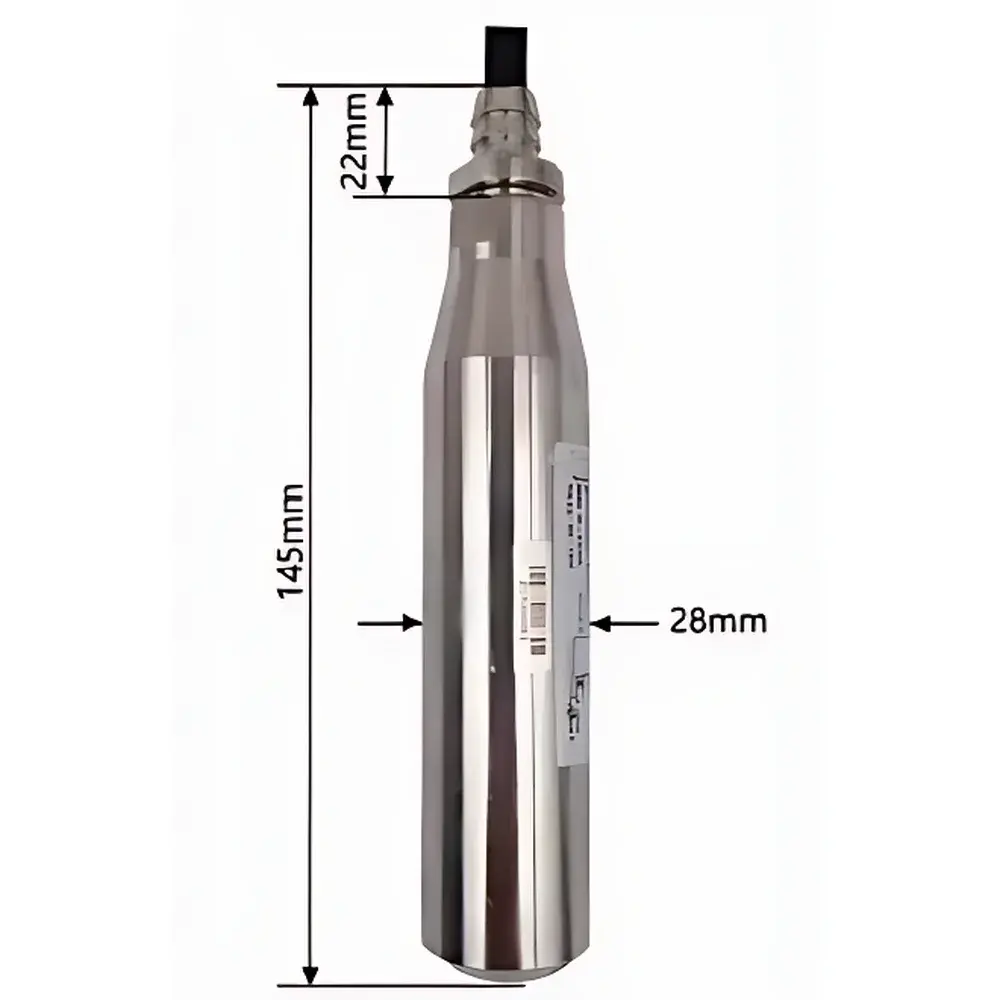
HengaoDe HAD-YW5 Smart Digital Level Electrode Sensor with RS485 Communication
| Brand | HengaoDe |
|---|---|
| Origin | Beijing, China |
| Model | HAD-YW5 |
| Measurement Range | 0.1–100 m |
| Media Compatibility | Water, oil, and other non-corrosive liquids |
| Pressure Type | Gauge (default) or absolute |
| Operating Voltage | DC 12 V / DC 24 V |
| Output Interface | RS485 (Modbus RTU protocol) |
| Housing Material | Stainless Steel 316 |
| Process Connection | Submersible type with optional threads — G1/2, G1/4, or M20×1.5 |
| Cable Length | Standard 5 m (customizable) |
| Ingress Protection | IP68 |
| Accuracy Class | 0.1 |
| Diaphragm Material | 316S stainless steel |
| Process Fitting Material | 1Cr18Ni9Ti |
| Electrical Connection | Direct lead wires, Harting connector, or aviation plug |
Overview
The HengaoDe HAD-YW5 Smart Digital Level Electrode Sensor is an industrial-grade submersible level measurement device engineered for precision, long-term stability, and robust environmental resilience. It operates on the principle of hydrostatic pressure sensing: the sensor detects the pressure exerted by a column of liquid above the diaphragm, which is linearly proportional to liquid height when fluid density is known and constant. This gauge-pressure-based transduction method ensures reliable, drift-free measurements in static or slow-moving liquid applications—ideal for water reservoirs, chemical storage tanks, oil sumps, and wastewater monitoring systems. The integrated digital signal processing unit converts analog pressure signals into calibrated level data, transmitted via RS485 Modbus RTU for seamless integration into SCADA, PLC, and building management systems. Designed for continuous operation in harsh industrial environments, the HAD-YW5 complies with electromagnetic compatibility (EMC) requirements per IEC 61326-1 and meets functional safety considerations aligned with IEC 61508 SIL 2 for basic level monitoring tasks.
Key Features
- High-accuracy 0.1-class pressure transduction with temperature-compensated silicon piezoresistive sensing element
- Full stainless steel 316 wetted parts—including diaphragm (316S) and process fitting (1Cr18Ni9Ti)—for corrosion resistance in aqueous and mildly aggressive media
- IP68-rated hermetic housing certified for permanent submersion up to 100 m depth
- RS485 serial interface supporting Modbus RTU protocol at standard baud rates (9.6 kbps to 115.2 kbps), enabling multi-drop network configuration with up to 32 nodes
- Flexible mechanical mounting options: G1/2, G1/4, or M20×1.5 threaded connections; compatible with standard tank penetrations and float chamber interfaces
- Wide operating voltage range (DC 12–24 V) with reverse-polarity and surge protection (IEC 61000-4-5 Level 3)
- Digital zero/span adjustment via Modbus registers—no physical potentiometers required
- Internal diagnostics including sensor health status, overpressure detection, and cable continuity monitoring
Sample Compatibility & Compliance
The HAD-YW5 is validated for use with clean or mildly suspended liquids including potable water, demineralized water, diesel, lubricating oils, glycol solutions, and non-foaming process fluids. It is not recommended for highly viscous, abrasive, or crystallizing media without protective stilling wells or flush-mounted isolation diaphragms. The sensor conforms to RoHS Directive 2011/65/EU and REACH Regulation (EC) No. 1907/2006. Its construction materials meet ASTM A240/A240M for 316 stainless steel and GB/T 1220–2007 for Chinese-grade 1Cr18Ni9Ti. While not intrinsically safe certified, it may be deployed in Zone 2/22 hazardous areas when installed with appropriate barrier systems compliant with IEC 60079-11.
Software & Data Management
Configuration, calibration, and real-time monitoring are supported through standard Modbus-compatible software tools—including open-source Modbus Poll, commercial SCADA platforms (e.g., Ignition, WinCC, FactoryTalk), and custom Python-based data loggers using pymodbus. All operational parameters—including damping time (0–32 s), measurement update interval (1–10 s), and linearization coefficients—are programmable via Modbus function codes 03 (read holding registers) and 06/16 (write single/multiple registers). The device supports timestamped data logging when paired with a Modbus-to-Ethernet gateway with local SD card or cloud upload capability. Audit trails, change logs, and firmware version reporting are accessible through reserved diagnostic registers—supporting GLP-aligned documentation requirements for regulated water treatment and environmental monitoring applications.
Applications
- Level monitoring in municipal water supply tanks and elevated reservoirs
- Interface level detection between immiscible liquids (e.g., oil/water separators) when combined with density correction algorithms
- Process control feedback in chemical dosing systems and pH neutralization tanks
- Remote telemetry for rural wastewater lift stations using low-bandwidth cellular RTUs
- Integration into ISO 55001-compliant asset management systems for predictive maintenance of pumping infrastructure
- Calibration reference for ultrasonic or radar level transmitters in validation protocols per ISO/IEC 17025
FAQ
Is the HAD-YW5 suitable for seawater applications?
Yes—its 316 stainless steel construction provides excellent resistance to chloride-induced pitting and crevice corrosion in seawater up to 35 ppt salinity, provided flow velocity remains below 1.5 m/s and biofouling is periodically managed.
Can the output be configured for 4–20 mA analog signal instead of RS485?
No—the HAD-YW5 is exclusively a digital RS485 Modbus device. For analog output, consider the HAD-YW5A variant (not covered in this datasheet), which shares identical mechanical specifications but includes isolated 4–20 mA current loop output.
What is the maximum cable length supported for RS485 communication?
Up to 1,200 meters at 9.6 kbps with proper twisted-pair shielded cable (AWG22, 120 Ω characteristic impedance) and termination resistors installed at both ends of the bus.
Does the sensor require field recalibration after installation?
No—factory calibration is traceable to CNAS-accredited standards (certificate available upon request). Zero-point verification can be performed in situ using dry-air reference or known datum level; span verification requires full immersion at known depth.
How is temperature compensation implemented?
An integrated PT1000 RTD measures diaphragm temperature in real time; compensation coefficients are applied dynamically using a 3rd-order polynomial algorithm stored in non-volatile memory—ensuring ±0.05 %FS thermal error contribution across 0–50 °C ambient range.





