
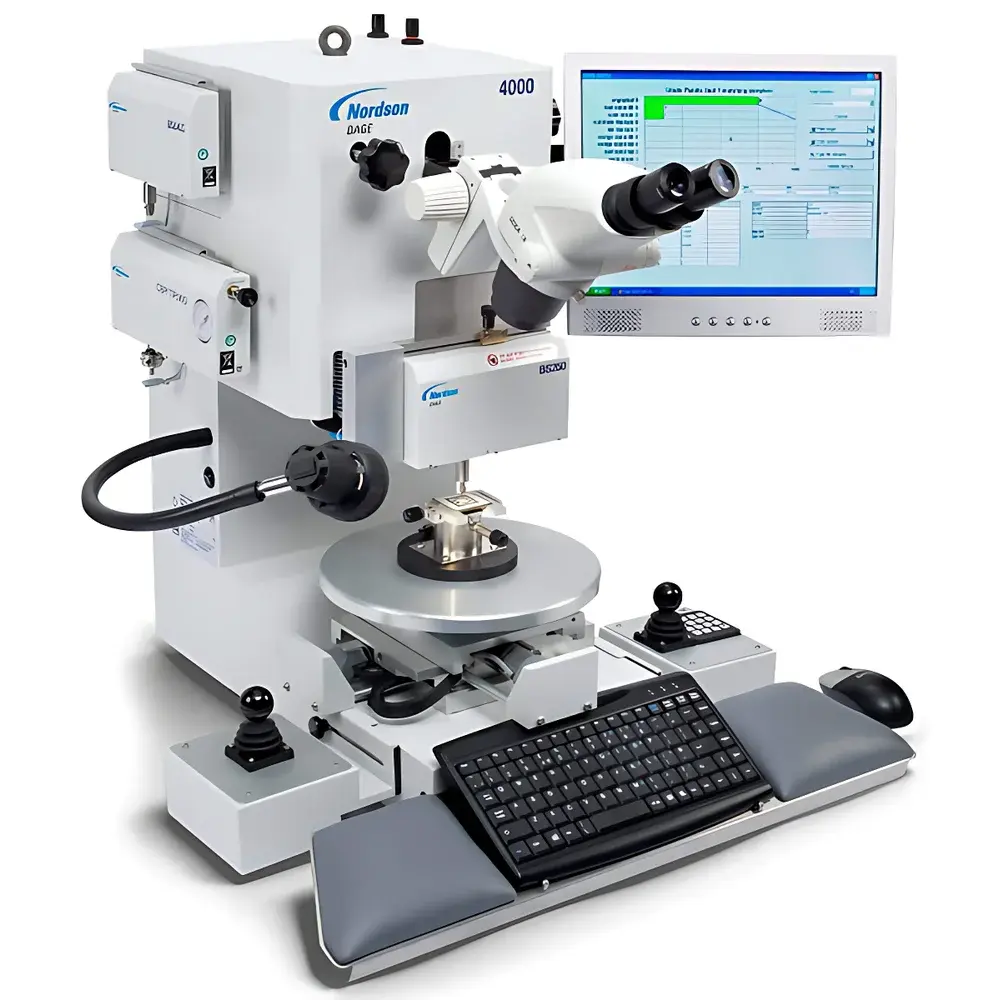
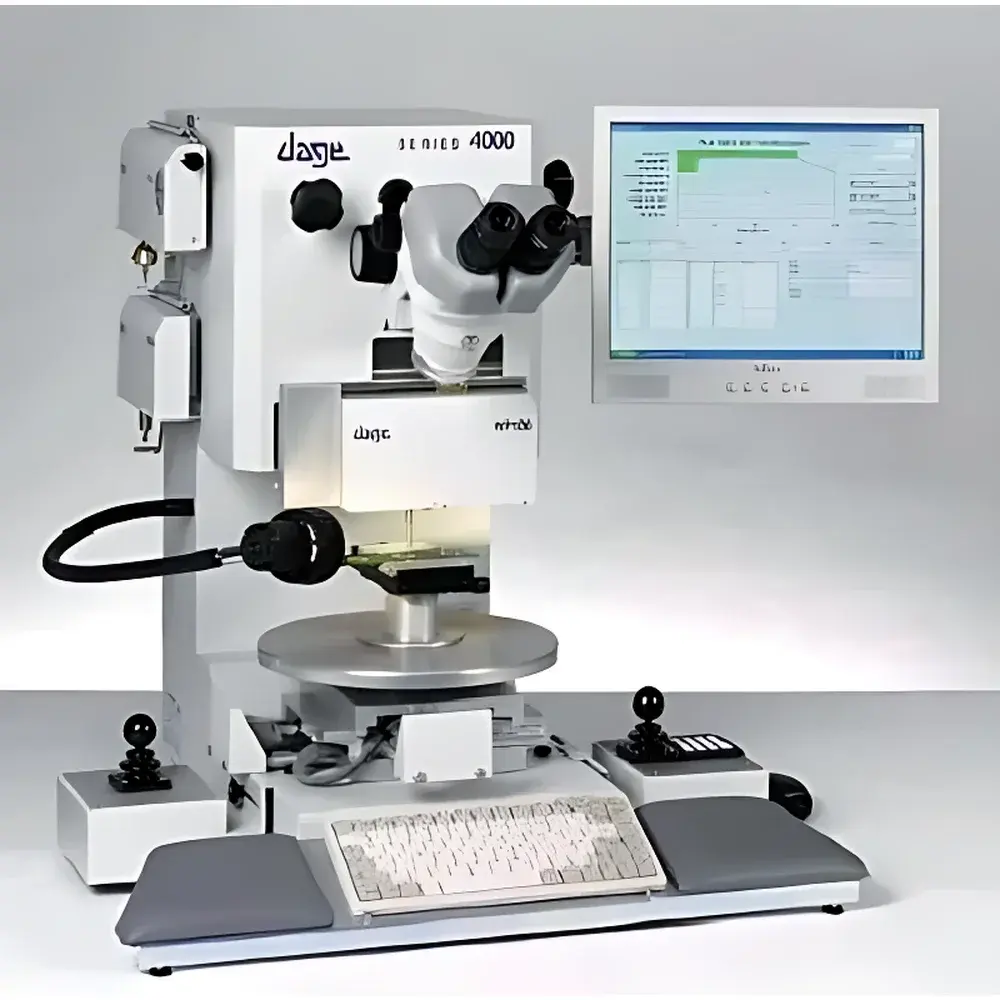
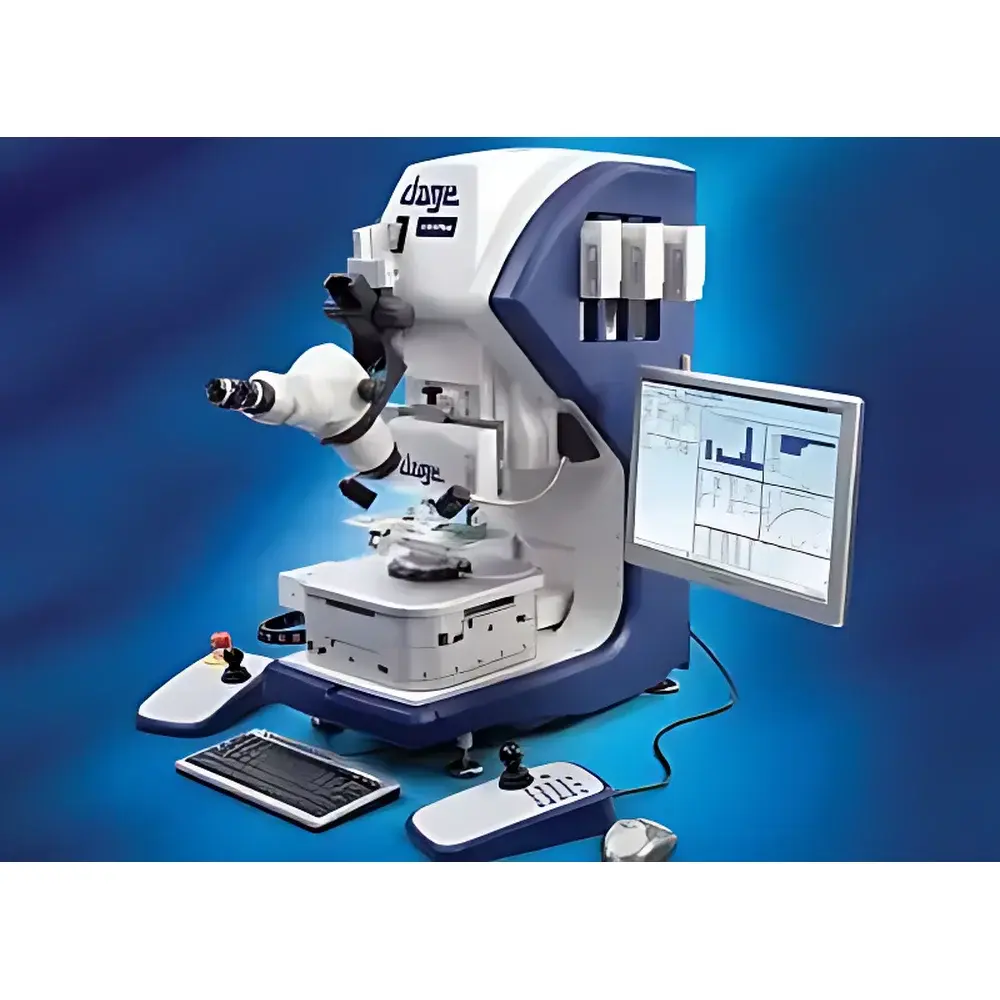
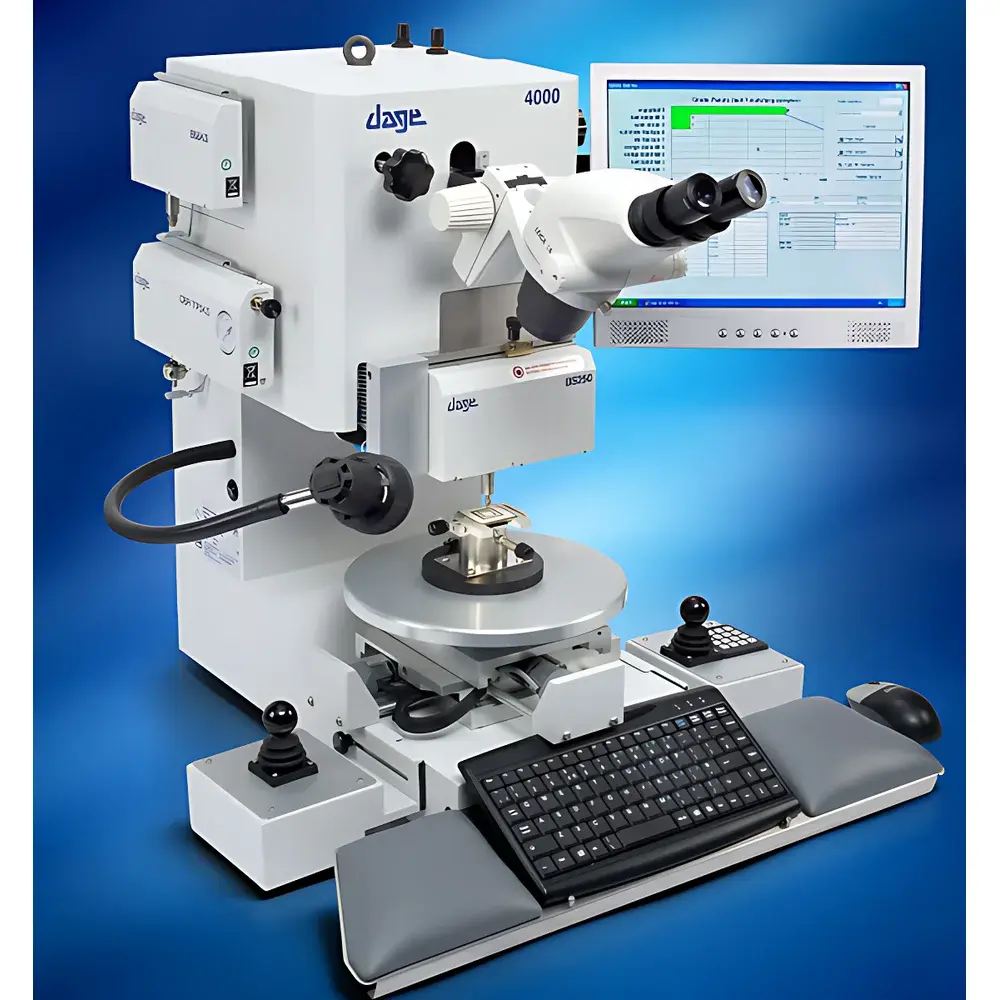
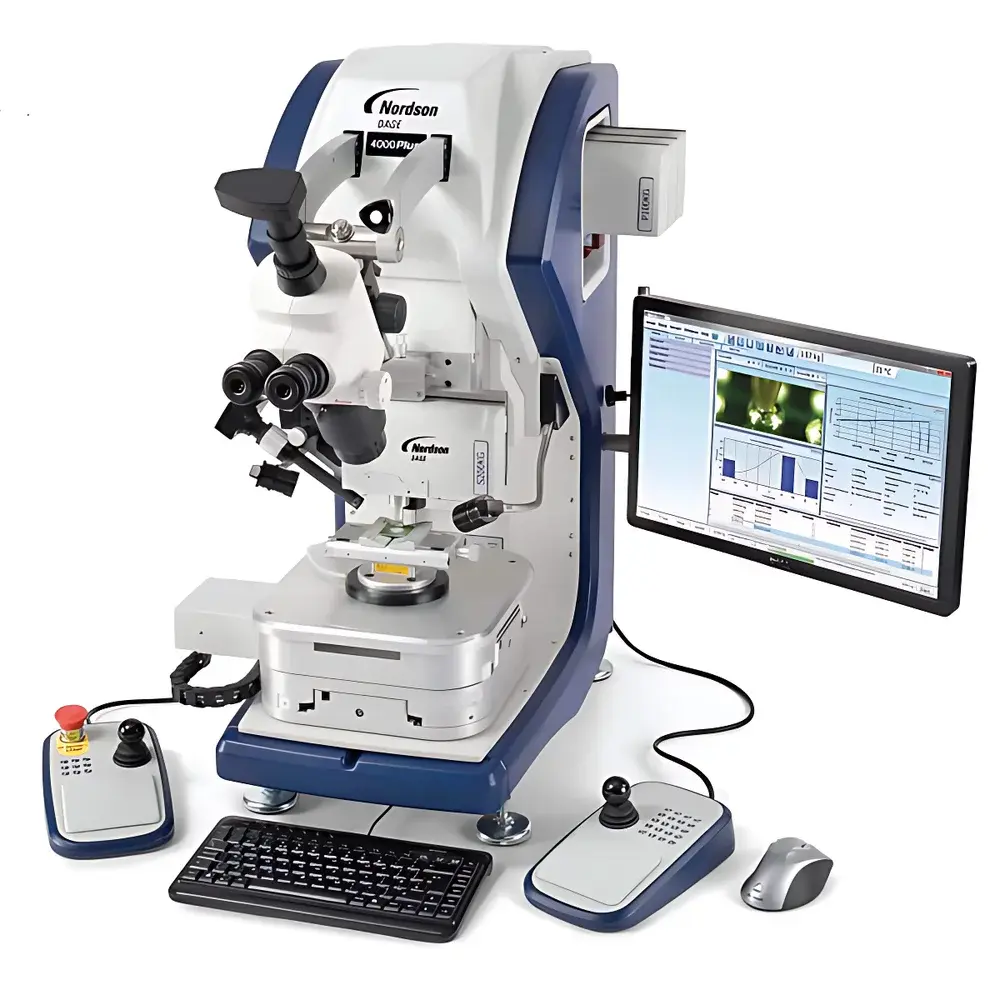
Nordson DAGE 4000 Bond Tester
| Brand | Nordson Dage |
|---|---|
| Origin | United Kingdom |
| Model | DAGE 4000 |
| Test Force Range (Tensile) | 0–100 g, 0–1 kg, 0–10 kg |
| Test Force Range (Shear/Thrust) | 250 g, 5 kg, 0–100 kg, 0–200 kg |
| Test Force Range (Tweezer Pull) | 100 g, 5 kg |
| Test Force Range (BGA Ball Pull) | 0–100 g, 0–5 kg |
| Dimensions (L×W×H) | 730 × 425 × 670 mm |
| Weight | 45 kg |
| Power Supply | 100–240 V AC, 50/60 Hz |
| Compliance | Designed for ISO/IEC 17025-compliant laboratories |
Overview
The Nordson DAGE 4000 Bond Tester is a precision-engineered micro-mechanical testing platform designed for quantitative mechanical evaluation of interconnect structures in semiconductor packaging, printed circuit board assembly (PCBA), and advanced electronic interposers. It operates on the principle of controlled force application—using calibrated load cells and high-resolution motion control—to measure bond strength via tensile, shear, thrust, tweezer pull, and vector pull methodologies. Unlike generic tensile testers, the DAGE 4000 employs a modular architecture with interchangeable test heads and tooling optimized for micron-scale geometries typical of wire bonds (Au, Cu, Al), solder bumps (SnPb, SAC, micro-bumps), die attach interfaces, and embedded passive elements. Its mechanical design prioritizes thermal stability, minimal frame deflection (<0.5 µm under full load), and sub-micron positioning repeatability—critical for correlating mechanical failure modes (e.g., pad cratering, intermetallic fracture, cohesive delamination) with process parameters.
Key Features
- Modular test head configuration supporting six distinct mechanical test modes: wire pull, ball shear, die shear, bump pull, tweezer pull, and vector pull—each with dedicated tooling and force calibration protocols.
- Multi-range load cell architecture enabling seamless switching between low-force regimes (0–100 g for fine-pitch Cu wire bonds) and high-force applications (up to 200 kg for large-area die attach shear validation).
- Integrated high-speed image acquisition system mounted directly adjacent to the test zone, delivering real-time optical feedback for precise tool alignment and post-test failure mode classification (ISO 8502-3 compliant imaging).
- Motorized XYZ stage with standard 160 mm travel range (X/Y) and 50 mm Z-axis stroke; optional extended-range stages available for multi-die or panel-level testing.
- Thermally isolated baseplate and vibration-damped granite construction to minimize environmental drift during long-duration fatigue or creep tests.
- Tool-free quick-change collet system for rapid transition between hook-type, blade-type, and custom shear tools—reducing setup time by >40% versus legacy platforms.
Sample Compatibility & Compliance
The DAGE 4000 accommodates substrates ranging from bare silicon wafers (2″, 4″, 6″, 8″) to populated PCBs up to 300 × 300 mm, including FR-4, polyimide, ceramic, and glass-reinforced laminates. It supports industry-standard test fixtures per JEDEC JESD22-B116 (ball shear), JESD22-B117 (wire pull), and IPC-9708 (micro-bump reliability). All force transducers are traceably calibrated to NIST standards, and system-level verification follows ASTM E4 and ISO 7500-1 protocols. When operated with DAGE’s certified software suite (v5.2+), the instrument meets data integrity requirements of FDA 21 CFR Part 11—including electronic signatures, audit trail logging, and role-based access control—making it suitable for regulated environments requiring GLP or GMP compliance.
Software & Data Management
The DAGE 4000 runs on proprietary Windows-based control software featuring scriptable test sequences, real-time force-displacement curve overlay, and automated pass/fail decision logic based on user-defined thresholds (e.g., minimum acceptable shear strength per IPC-A-610 Class 3 criteria). Raw data exports to CSV, XML, and PDF formats with embedded metadata (operator ID, timestamp, calibration certificate ID, environmental conditions). Optional integration with LIMS systems via OPC UA or RESTful API enables centralized data aggregation across multiple instruments. Fatigue testing modules support cyclic loading profiles (sinusoidal, trapezoidal, random) with cycle counting, crack initiation detection, and Weibull distribution fitting for reliability modeling.
Applications
- Qualification of thermosonic Au/Cu wire bonds in power modules and RF packages.
- Shear strength validation of SnAgCu solder bumps in flip-chip BGA and 2.5D interposers.
- Die attach integrity assessment for SiC MOSFETs subjected to thermal cycling stress.
- Vector pull testing of stacked-die configurations where conventional shear tools cannot access bond sites.
- Fatigue life characterization of micro-bumps under accelerated temperature-humidity bias (THB) conditions.
- Failure analysis root cause determination—correlating mechanical test results with SEM/EDS cross-sections and FIB tomography.
FAQ
What standards does the DAGE 4000 comply with for calibration and testing?
It adheres to ISO 7500-1 for load cell verification, ASTM E4 for force measurement systems, and JEDEC/IPC standards for specific bond test methodologies.
Can the DAGE 4000 perform automated sequential testing across multiple dies on a wafer?
Yes—when paired with optional wafer mapping software and motorized chuck stages, it supports fully automated die-by-die testing with coordinate referencing and defect flagging.
Is remote diagnostics and software update support available?
Nordson DAGE provides secure remote access via encrypted VPN channels for firmware updates, calibration assistance, and troubleshooting under valid service contracts.
How is traceability maintained for regulatory audits?
All test records include immutable timestamps, operator authentication, instrument ID, calibration status flags, and digital signatures—fully compliant with FDA 21 CFR Part 11 Annex 11 requirements.
What maintenance intervals are recommended for optimal force accuracy?
Annual recalibration of load cells and stage encoders is recommended; daily warm-up and zero-point verification are required prior to critical qualification runs.



