
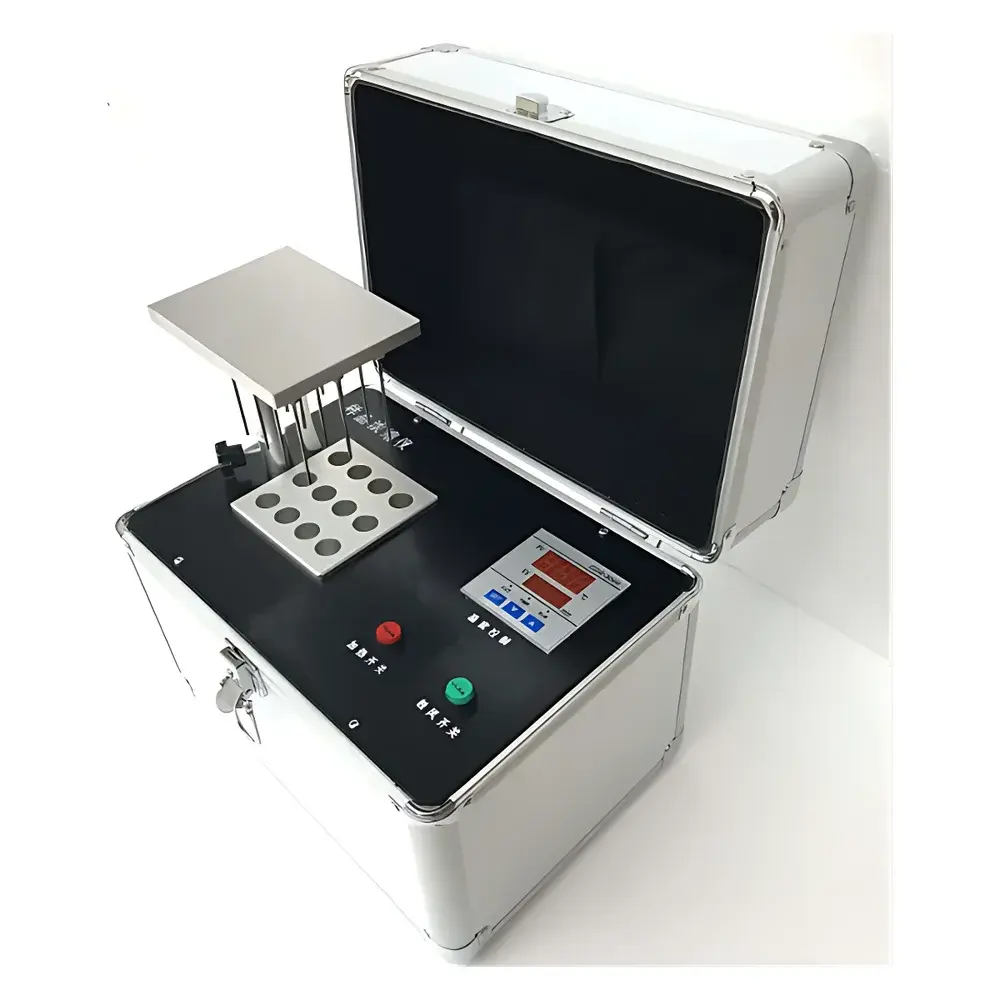
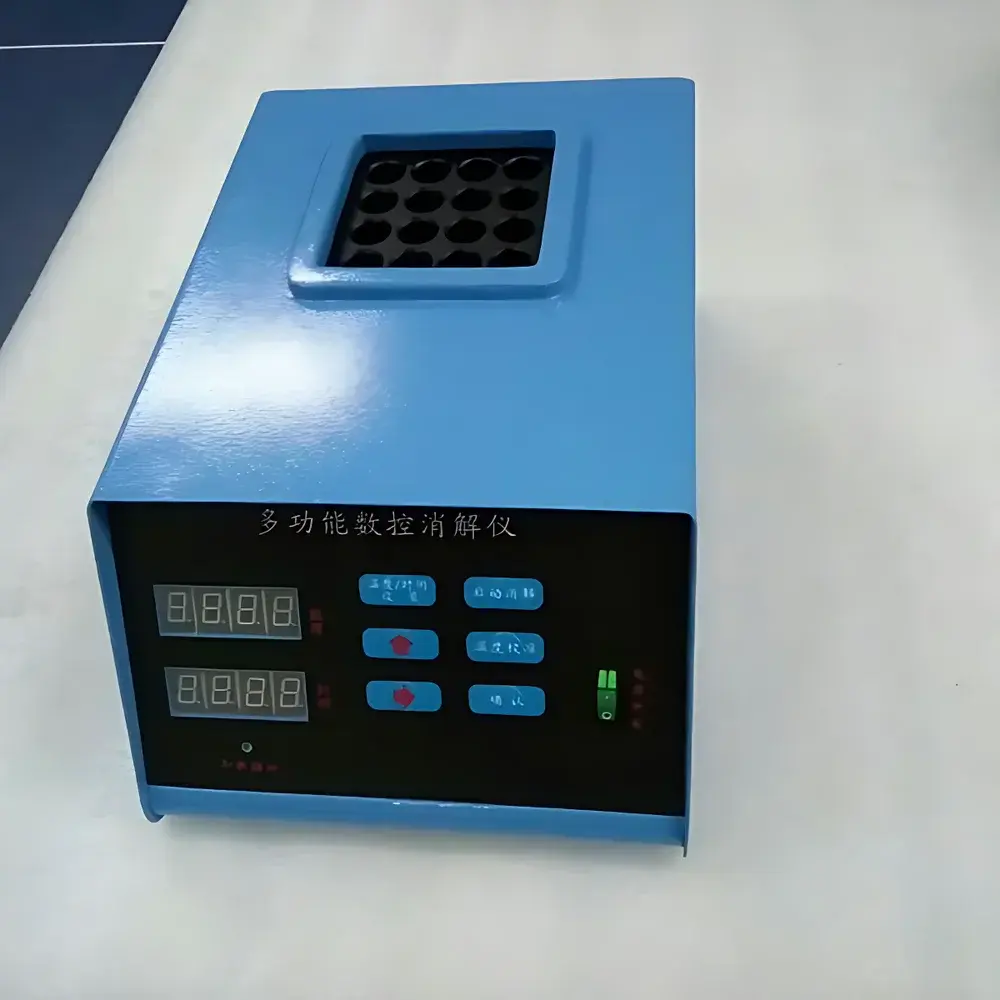
HengaoDe HAD-NSY12 Portable Air-Nitrogen Sample Concentrator with Integrated Air Compressor and Digital Temperature Control
| Brand | HengaoDe |
|---|---|
| Origin | Beijing, China |
| Model | HAD-NSY12 |
| Heating Range | Ambient to 100 °C |
| Temperature Accuracy | ≤ ±0.3 °C |
| Air Flow Rate | 0–36 L/min |
| Sample Capacity | 12 × 16.5 mm tubes |
| Tube Depth | 45 mm |
| Power Rating | 250 W |
| Dimensions (L×W×H) | 320 × 220 × 260 mm |
| Safety | Intrinsically safe for organic solvents |
Overview
The HengaoDe HAD-NSY12 is a compact, self-contained air-driven sample concentrator engineered for rapid solvent evaporation and gentle sample preparation in analytical laboratories. It operates on the principle of controlled dry-air or nitrogen gas flow directed tangentially across the surface of liquid samples in standard test tubes, accelerating solvent removal while minimizing thermal degradation and cross-contamination. Unlike water-bath or centrifugal concentrators, the HAD-NSY12 eliminates reliance on external gas sources—its integrated air compressor delivers consistent, oil-free airflow up to 36 L/min. Combined with precise digital PID temperature control (ambient to 100 °C, ±0.3 °C accuracy) and auxiliary resistive heating, the system supports reproducible concentration of volatile organic solvents—including acetone, methanol, ethyl acetate, and dichloromethane—under ambient or controlled environmental conditions. Its portable hand-carried enclosure (320 × 220 × 260 mm) enables deployment in field labs, QC rooms, or mobile testing units without infrastructure modifications.
Key Features
- Integrated oil-free air compressor eliminating dependency on external gas cylinders or central lab air networks
- Digital temperature controller with real-time display and ±0.3 °C stability across 0–100 °C range
- 12-position modular rack accommodating 16.5 mm OD tubes to 45 mm depth—compatible with common 13–16 mL conical and round-bottom vials
- Adjustable gas nozzle height (1 cm clearance above liquid surface) ensures uniform laminar flow and prevents splashing or foaming
- Intrinsically safe design certified for use with flammable and chlorinated solvents—no spark-generating components or heated surfaces exposed to vapor zones
- Low thermal mass aluminum block heater with rapid warm-up (<5 min to 60 °C) and minimal overshoot
- Front-panel keypad interface with SET button navigation, incremental up/down adjustment, and persistent parameter memory
Sample Compatibility & Compliance
The HAD-NSY12 accommodates aqueous, alcoholic, and low-boiling organic extracts commonly used in pharmaceutical residue analysis, environmental pesticide screening, food contaminant quantification (e.g., PAHs, PCBs), and clinical toxicology workflows. Its non-contact gas delivery architecture avoids immersion contamination and preserves analyte integrity during concentration. The instrument complies with general laboratory safety requirements per IEC 61010-1 for electrical equipment used in measurement, control, and laboratory use. While not individually certified to ISO/IEC 17025 or GLP Annex 15, its temperature accuracy (±0.3 °C), flow consistency, and repeatable endpoint detection support method validation under internal SOPs aligned with USP , ASTM D5845, and EPA Method 502.1. All wetted materials are chemically inert stainless steel and PTFE-coated components—resistant to corrosion from halogenated solvents and acidic digestates.
Software & Data Management
The HAD-NSY12 operates as a standalone benchtop device with no embedded software or connectivity. All operational parameters—including set temperature, run duration (via external timer), and airflow activation—are configured manually via tactile keypad and confirmed by LED indicators. This architecture ensures deterministic behavior, zero firmware vulnerabilities, and full auditability of user actions—critical for regulated environments where electronic records must comply with FDA 21 CFR Part 11. For laboratories requiring traceable data capture, integration with external logging systems (e.g., LabArchives, Empower, or custom Python-based DAQ) is supported via optional RS-232 or USB-to-serial adapters (not included). Temperature calibration certificates—traceable to NIST standards—can be generated using external thermistors and validated against the unit’s digital readout at three points (25 °C, 50 °C, 75 °C).
Applications
- Rapid pre-concentration of environmental water extracts prior to GC-MS or LC-MS/MS analysis (e.g., EPA 8270, 8330)
- Final volume reduction of derivatized amino acid or steroid standards in clinical chemistry assays
- Preparative cleanup of SPE eluates in food safety testing (e.g., mycotoxin or veterinary drug residue workflows)
- Parallel processing of 12 plasma or urine aliquots in pharmacokinetic studies requiring consistent evaporation kinetics
- On-site sample prep in mobile environmental monitoring vans where compressed gas infrastructure is unavailable
- Teaching laboratories demonstrating solvent removal kinetics, heat transfer principles, and mass transfer limitations in undergraduate analytical chemistry courses
FAQ
Does the HAD-NSY12 require an external air or nitrogen supply?
No—the unit includes a built-in oil-free diaphragm air compressor rated for continuous duty at up to 36 L/min. External gas lines are unnecessary.
Can the instrument be used with corrosive solvents such as hydrochloric acid digestates?
It is not recommended for direct exposure to strong mineral acids. Use only with organic solvents and neutral aqueous solutions. For acidic applications, install an inline PTFE condenser trap upstream.
What is the maximum safe operating temperature for polypropylene tubes?
Standard 15 mL PP tubes maintain structural integrity up to 95 °C for short durations; prolonged exposure above 85 °C may cause deformation. Glass or borosilicate tubes are advised for >90 °C protocols.
How is temperature uniformity verified across all 12 positions?
Users should perform a multi-point validation using calibrated micro-probe thermometers inserted into empty tubes at edge and center positions. Deviation should remain within ±0.5 °C at steady state.
Is the airflow rate adjustable per individual tube?
No—airflow is distributed uniformly across all 12 nozzles via a single regulator. Independent flow control requires retrofitting with aftermarket mass-flow modules (not supported by factory design).






