
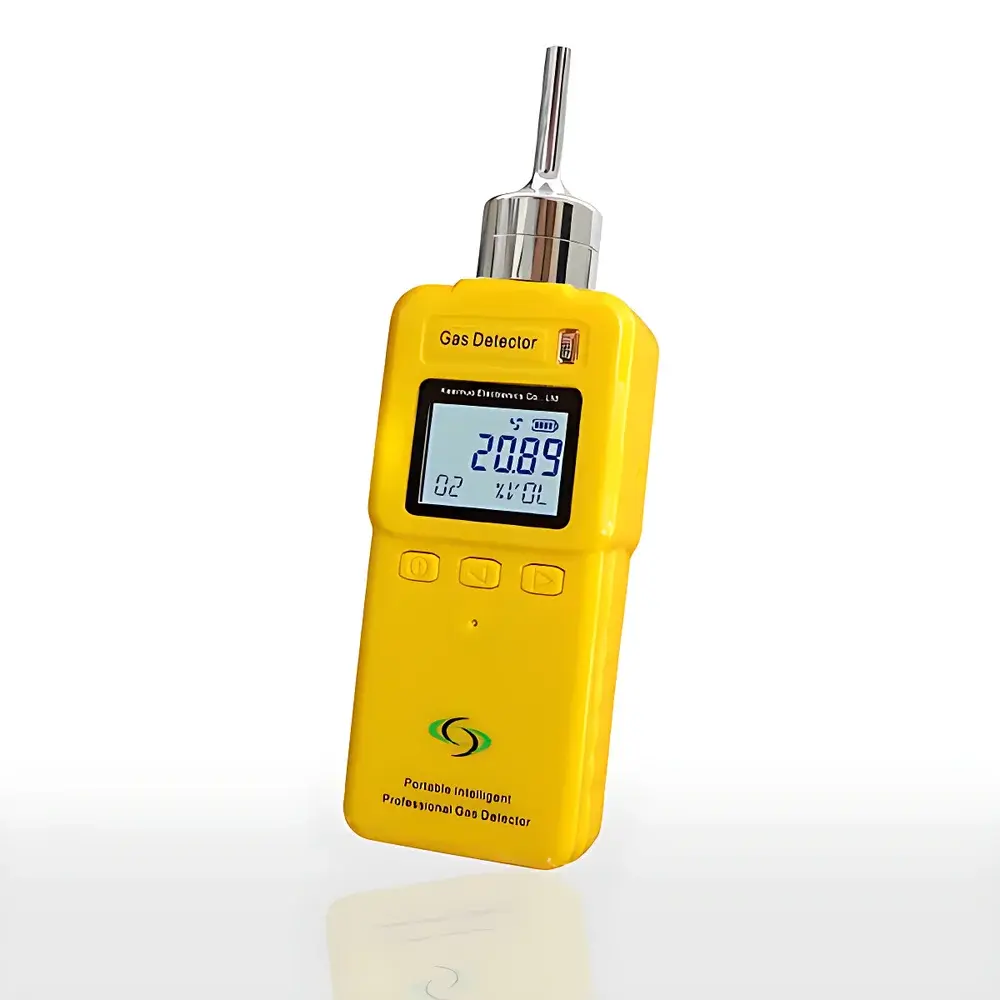
Hengao De HAD-GT901-O3 Portable Pump-Aspirated Ozone (O₃) Gas Detector
| Brand | Hengao De |
|---|---|
| Origin | Beijing, China |
| Manufacturer Type | Authorized Distributor |
| Country of Origin | China |
| Model | HAD-GT901-O3 |
| Price | USD 42.50 (based on ¥298 at 7.0 CNY/USD) |
| Detection Principle | Electrochemical Sensor |
| Target Gas | Ozone (O₃) |
| Range Options | 0–1 ppm, 5 ppm, 20 ppm, 50 ppm, 100 ppm, 200 ppm, 500 ppm, 1000 ppm, 5000 ppm, 30000 ppm |
| Resolution | 0.001 ppm (0–1 ppm), 0.01 ppm (0–100 ppm), 1 ppm (>1000 ppm) |
| Accuracy | ≤±3% FS (actual concentration) |
| Sensor Lifetime | 3 years |
| Alarm | Dual-stage visual & audible alarm |
| Power | Rechargeable Ni-MH battery |
| Display | Backlit digital LCD |
| Enclosure | High-strength ABS engineering plastic |
| Certifications | Compliant with GB/T 50480–2008 (Chinese standard for portable gas detectors) |
| Operating Environment | –10°C to +50°C, ≤95% RH non-condensing |
Overview
The Hengao De HAD-GT901-O3 is a portable, pump-aspirated ozone (O₃) gas detector engineered for continuous, real-time monitoring of ambient or process ozone concentrations in industrial, environmental, and laboratory settings. It operates on the electrochemical sensing principle: ozone molecules undergo oxidation-reduction reactions at the working electrode surface, generating a current proportional to gas concentration. This analog signal is digitized, temperature-compensated, and displayed with user-configurable alarm thresholds. Unlike diffusion-based instruments, the integrated micro-diaphragm sampling pump ensures consistent airflow across the sensor surface—critical for achieving rapid response (<30 s T90), high reproducibility, and minimal interference from ambient airflow or pressure fluctuations. Designed to meet operational requirements under variable field conditions, the unit features robust mechanical construction, low-power electronics, and compliance with Chinese national standards for portable toxic gas detection (GB/T 50480–2008), serving as a reference-grade tool for routine safety verification and process control where ozone is used in water treatment, semiconductor cleaning, pharmaceutical sterilization, or UV-ozone surface modification.
Key Features
- Integrated aspiration pump enabling active sampling at fixed flow rate—improves measurement accuracy and reduces cross-sensitivity to humidity and airflow turbulence
- Electrochemical O₃ sensor with 3-year nominal service life and factory calibration traceable to NIM (National Institute of Metrology, China)
- Multi-range configuration support: selectable full-scale ranges from 0–1 ppm to 0–30,000 ppm, optimized for applications ranging from indoor air quality (IAQ) to industrial ozone generation monitoring
- Dual-stage alarm system with independent visual (LED flash) and audible (≥85 dB at 30 cm) outputs, programmable per range segment
- Backlit LCD display with 4-digit resolution, auto-zero function, and real-time bar graph trend indicator
- IP65-rated enclosure using flame-retardant ABS housing; drop-tested to 1.2 m per IEC 61010-1
- Built-in data logging (500-event buffer) with timestamp, alarm status, and battery voltage tracking
- Rechargeable Ni-MH battery pack providing ≥12 hours continuous operation; USB-C charging interface with state-of-charge indicator
Sample Compatibility & Compliance
The HAD-GT901-O3 is validated for use in gaseous matrices containing ozone at ambient pressure and temperatures between –10°C and +50°C. It is not intended for direct immersion, high-humidity condensing environments (>95% RH), or corrosive atmospheres containing chlorine, nitrogen dioxide, or sulfur dioxide above 1 ppm—these may accelerate sensor drift or cause irreversible poisoning. The instrument complies with GB/T 50480–2008 for performance, environmental testing, and electromagnetic compatibility (EMC). While not certified to ATEX, IECEx, or UL 913 for hazardous locations, it is routinely deployed in classified Zone 2 areas when operated outside ignition sources and verified for zero spark emission per internal circuit analysis. For regulatory reporting in pharmaceutical cleanrooms or drinking water facilities, users must perform periodic bump tests and full calibration against NIST-traceable ozone standards (e.g., UV photometric reference analyzers per ISO 11843-3).
Software & Data Management
Data export is supported via USB-C interface using vendor-provided PC software (Windows 10/11 compatible), enabling CSV-formatted download of time-stamped concentration logs, alarm events, and calibration history. The software supports GLP-compliant audit trails—including operator ID input, calibration gas lot numbers, and pass/fail validation flags. No cloud connectivity or remote firmware updates are implemented; all configuration changes occur locally via intuitive menu navigation. Firmware versioning (v2.4.1+) includes CRC-32 checksums for integrity verification during update procedures. The device does not comply with FDA 21 CFR Part 11 electronic record requirements out-of-the-box; however, its deterministic logging architecture allows integration into validated LIMS environments when paired with controlled procedural documentation.
Applications
- Verification of residual ozone levels post-UV/O₃ disinfection in hospital HVAC ducts and pharmaceutical water-for-injection (WFI) distribution loops
- Real-time monitoring of ozone generator output stability in municipal wastewater tertiary treatment plants (per GB 18918–2002)
- Occupational exposure assessment in semiconductor fab cleanrooms during photoresist stripping processes
- Leak detection and area monitoring in ozone-based food processing equipment (e.g., cold storage decontamination units)
- Educational laboratories conducting atmospheric chemistry experiments involving corona discharge or UV lamp ozone generation
- Field validation of catalytic ozone destruct units prior to stack release in chemical manufacturing facilities
FAQ
What is the recommended calibration frequency?
Calibration is required before each day’s use if employed in safety-critical applications; otherwise, quarterly calibration with span gas (e.g., 0.5 ppm O₃ in N₂, certified to ±2% uncertainty) is advised per GB/T 50480–2008 Annex B.
Can the sensor be exposed to high humidity?
Continuous exposure above 95% RH may cause electrolyte dilution and baseline drift; use only with optional hydrophobic particulate filter (accessory HAD-FIL-01) in humid environments.
Is zero calibration possible without external gas?
Yes—the instrument supports automatic fresh-air zeroing in ozone-free ambient air; however, this requires stable temperature (±2°C) and confirmed background O₃ <0.01 ppm.
Does the pump require maintenance?
The diaphragm pump has no user-serviceable parts; lifetime exceeds 10,000 hours. Replace pump module only if flow rate drops below 300 mL/min (verified via built-in flow test mode).
How is sensor cross-sensitivity managed?
The electrochemical cell incorporates selective catalytic layers and electronic compensation algorithms for NO₂ and Cl₂ up to 0.5 ppm; higher interferents necessitate pre-sampling filtration (e.g., activated carbon scrubber).
Related Products






