
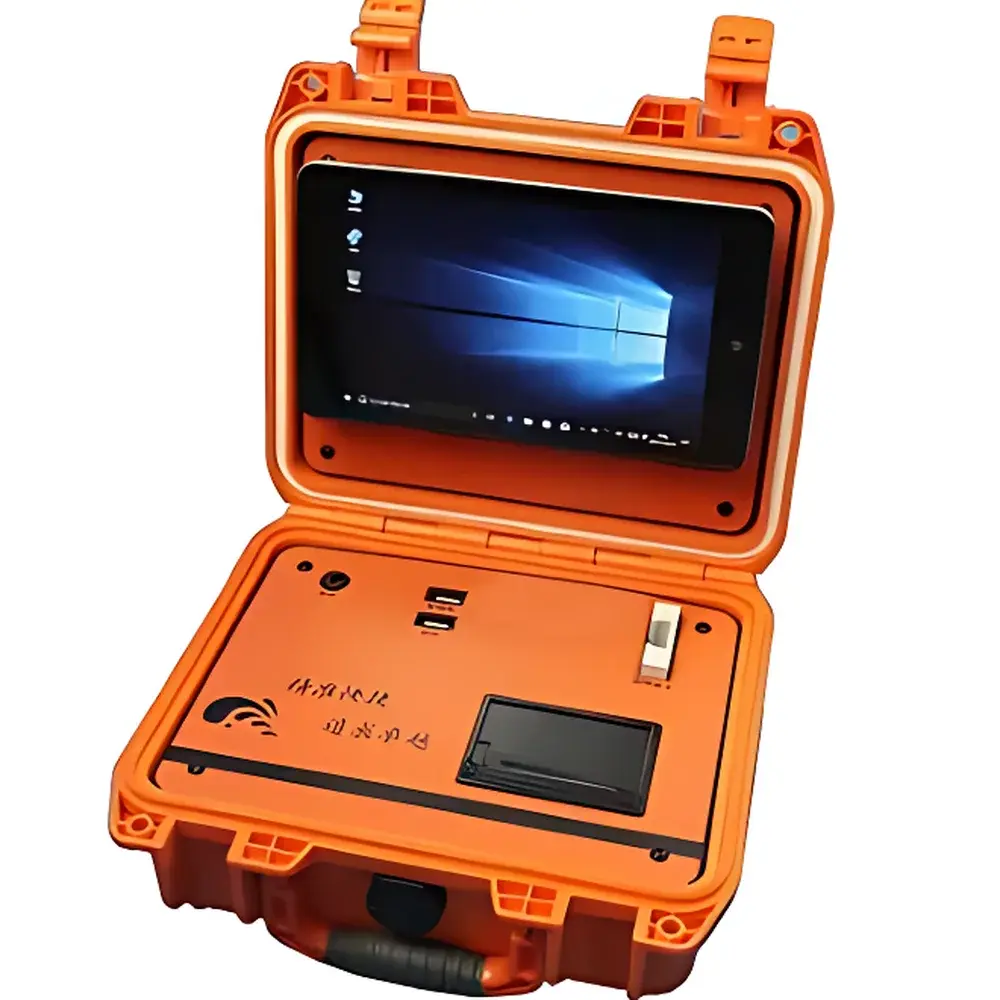
HengaoDe HAD-T102SJ Colloidal Gold-Based Melamine Quantitative Analyzer with 8-inch Touchscreen
| Brand | HengaoDe |
|---|---|
| Origin | Beijing, China |
| Manufacturer Type | Authorized Distributor |
| Product Origin | Domestic (China) |
| Model | HAD-T102SJ |
| Detection Limit | 1 ppm (melamine in milk matrix) |
| Display | 8-inch color TFT-LCD touchscreen (1280×800 resolution) |
| Processor | Intel-based CPU |
| Memory | 2 GB RAM |
| Storage | 32 GB internal flash |
| OS | Windows Embedded |
| Connectivity | Wi-Fi, Bluetooth, 3G/4G, USB 2.0 |
| Power | AC 220 V / 5 V DC / rechargeable Li-ion battery (6 h continuous, 72 h standby) |
| Max. Power Consumption | <10 W |
| Compliance | Designed for GLP-aligned field deployment and traceable digital immunoassay documentation |
Overview
The HengaoDe HAD-T102SJ Colloidal Gold-Based Melamine Quantitative Analyzer is a field-deployable, CE-compliant immunoassay reader engineered for rapid, objective quantification of melamine and selected antibiotic residues in liquid dairy matrices—including raw milk, reconstituted powder, and UHT-treated products. Unlike subjective visual interpretation of lateral flow test strips, the HAD-T102SJ employs high-resolution CCD imaging coupled with algorithm-driven optical density analysis to convert colloidal gold immunochromatographic signals into calibrated concentration values (ppm). Its measurement principle relies on reflectance photometry at 630 nm ± 15 nm, optimized for the spectral absorption peak of colloidal gold nanoparticles. The instrument complies with ISO 15239:2012 (immunoassay validation principles) and supports traceable data generation aligned with FDA 21 CFR Part 11 requirements for electronic records and signatures—enabling audit-ready reporting in quality control laboratories and on-farm testing environments.
Key Features
- High-fidelity CCD sensor with auto-focus and dynamic exposure control ensures consistent image capture across varying ambient lighting conditions.
- Intelligent card recognition engine automatically distinguishes valid test lines from invalid or expired strips, rejecting non-conforming assays prior to analysis.
- Integrated Windows Embedded OS enables secure local file management, keyboard/mouse input, handwriting recognition, and embedded video-based operator training modules.
- Dual-mode data storage: local retention of raw images (JPEG), quantitative results, timestamps, GPS coordinates (optional), and operator IDs—up to 100,000+ records on 32 GB flash memory.
- Real-time wireless transmission via Wi-Fi, Bluetooth, or cellular (3G/4G) to cloud-based LIMS platforms using TLS 1.2–encrypted HTTP(S) protocols.
- Open architecture firmware supports over-the-air (OTA) updates, custom assay calibration curve import (CSV format), and third-party software integration via RESTful API endpoints.
- On-device report generation with configurable templates; direct thermal printing or A4 output via USB-connected inkjet/laser printers.
Sample Compatibility & Compliance
The HAD-T102SJ is validated for use with commercially available colloidal gold lateral flow assays targeting melamine (e.g., R-Biopharm RIDASCREEN® Melamine, Neogen Reveal® 3D Melamine) and β-lactam antibiotics (e.g., penicillin G, ampicillin). It accepts standard 5-mm-wide nitrocellulose strip formats without mechanical alignment fixtures—enabling true “plug-and-read” operation. All hardware components meet IP54 ingress protection standards for dust and splash resistance. Electrical safety conforms to IEC 61010-1:2010 for laboratory equipment. Data integrity workflows support GLP and GMP environments through configurable user access levels, electronic audit trails, and tamper-evident result logging.
Software & Data Management
The embedded software suite includes a dual-interface design: a simplified touch-optimized UI for field operators and an advanced configuration mode accessible via password-protected administrator login. Calibration curves are stored as encrypted .CAL files with checksum verification. Each measurement record contains embedded metadata: device serial number, firmware version, assay lot ID, environmental temperature/humidity (via optional external sensor), and digital signature of the executing user. Cloud synchronization uses AES-256 encryption; uploaded datasets are structured in JSON-LD format compatible with ISO/IEC 11179 metadata registries. Local backup exports support CSV and PDF formats with embedded digital signatures for regulatory submission.
Applications
- Routine screening of raw milk at collection centers prior to tanker dispatch.
- Verification testing of infant formula and dairy-based nutritional supplements during batch release.
- On-site monitoring of feed ingredients suspected of melamine adulteration (e.g., wheat gluten, rice protein concentrate).
- Regulatory inspection support for national food safety authorities conducting unannounced audits.
- Research applications requiring longitudinal tracking of residue degradation kinetics under controlled storage conditions.
FAQ
Does the HAD-T102SJ require assay-specific calibration for each test strip brand?
Yes. While factory-default curves are provided for major commercial kits, users must perform initial calibration using certified reference standards per ISO/IEC 17025:2017 Clause 5.5.2 before routine use.
Can the instrument operate without network connectivity?
Yes. All core functions—including image acquisition, quantitative analysis, local storage, and thermal printing—are fully operational offline. Network connectivity is required only for cloud sync, remote diagnostics, and firmware updates.
Is the device suitable for ISO/IEC 17025-accredited laboratories?
It meets technical prerequisites for accreditation when deployed within a documented quality management system covering instrument qualification (IQ/OQ/PQ), analyst training records, and periodic performance verification using NIST-traceable melamine reference materials.
What is the expected service life of the CCD imaging module?
Rated for ≥50,000 actuations under normal operating conditions (25°C, 60% RH); no consumable parts require replacement during standard warranty period (24 months).





