
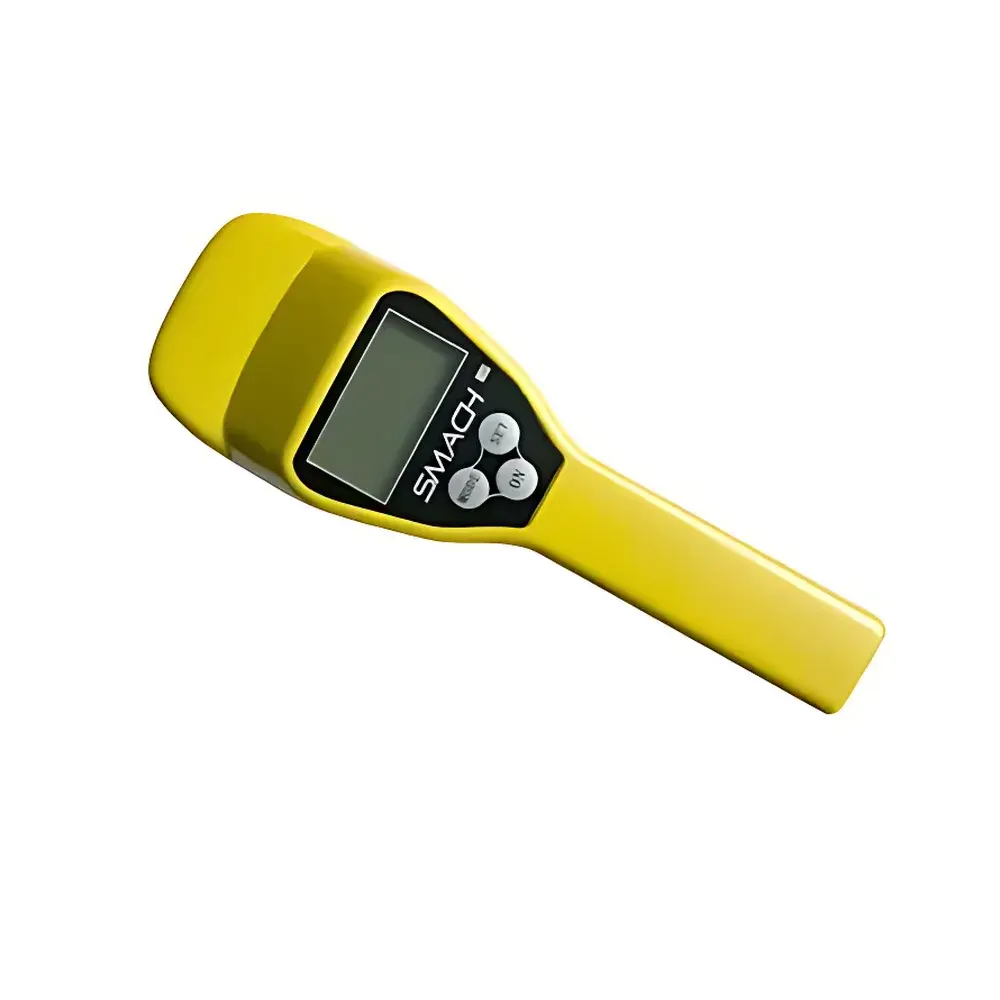
SMACH RS1050 Portable Multi-Radiation Survey Meter
| Brand | SMACH |
|---|---|
| Model | RS1050 |
| Type | Portable Dose Rate Meter |
| Detector | End-Window Mica Geiger-Müller Tube |
| Detection Radiation | Alpha, Beta, Gamma, and X-rays |
| Dose Rate Range | 0.01 µSv/h – 1 mSv/h (extendable to 150 mSv/h) |
| Dose Accumulation Range | 0.001 µSv – 999 Sv |
| Sensitivity | 5800 cpm/mR/h (for ⁶⁰Co) |
| Detector Active Area | 33 cm² (65 mm effective diameter) |
| Accuracy | ±15% (relative to ¹³⁷Cs) |
| Operating Temperature | −40 °C to +75 °C |
| Power | Two C-size alkaline batteries |
| Data Storage | 2000 manual/automatic entries + SD card logging |
| Display | Backlit color LCD with bar graph and simultaneous multi-parameter readout |
| Alarm Types | Dose rate threshold, accumulated dose threshold, pulse rate threshold, detector fault, low battery, over-range |
| Compliance | Designed for field use in accordance with IEC 60846-1:2014 (Radiation protection instrumentation — Ambient and/or directional dose equivalent (rate) meters and/or monitors for beta, X and gamma radiation) |
Overview
The SMACH RS1050 Portable Multi-Radiation Survey Meter is a field-deployable, high-sensitivity radiation detection instrument engineered for rapid, reliable assessment of ambient ionizing radiation fields. It operates on the principle of gas ionization within an end-window mica Geiger-Müller tube—optimized for efficient detection of alpha, beta, gamma, and X-ray photons across a broad energy spectrum. Its 33 cm² active detection area (65 mm effective diameter) provides enhanced geometric efficiency and statistical counting stability, enabling low-dose-rate measurements down to 0.01 µSv/h with high reproducibility. The instrument incorporates anti-saturation circuitry to maintain linearity under pulsed or high-intensity fields, and features a human-centered ergonomic design suitable for extended handheld operation in diverse environmental conditions—from arctic cold to desert heat (−40 °C to +75 °C). Calibration is performed remotely via built-in safety interlocks, eliminating operator exposure during routine maintenance—a critical requirement for ALARA-compliant field protocols.
Key Features
- Multi-radiation capability: Simultaneous detection of α, β, γ, and X-ray emissions; optional neutron probe interface available for modular expansion.
- High-efficiency detector: Imported end-window mica GM tube with 33 cm² active area ensures superior sensitivity—5800 cpm per mR/h for ⁶⁰Co—and low-energy response down to ~20 keV (X-ray) and 3–5 MeV (alpha).
- User-configurable correction factors: Enables application-specific energy compensation without hardware modification, supporting traceable field calibration against reference sources (e.g., ¹³⁷Cs, ²⁴¹Am).
- Adjustable averaging time: Configurable integration periods (1 s to 60 s) optimize signal-to-noise ratio for both rapid screening and long-term trend monitoring.
- Dual-mode data capture: Stores up to 2000 measurement records internally (timestamped, location-tagged if GPS-enabled), plus continuous logging to removable SD card with FAT32 formatting support.
- Intuitive visual interface: Full-color backlit LCD displays real-time dose rate (µSv/h, mR/h), accumulated dose (µSv–Sv), count rate (cps/cpm), and dynamic bar-graph trend—all simultaneously.
- Comprehensive alarm architecture: Programmable thresholds for dose rate, cumulative dose, and pulse rate; audible (85 dB @ 30 cm) and visual (flashing LED + screen alert) notifications for over-range, low battery, detector failure, and calibration timeout.
- Robust mechanical and electrical design: IP54-rated enclosure resists dust and water splashes; EMI-hardened analog front-end minimizes false triggers near RF transmitters or switching power supplies.
Sample Compatibility & Compliance
The RS1050 is validated for direct surface scanning of contaminated materials—including scrap metal, construction aggregates, soil samples, and medical equipment—and supports proximity measurements at distances from contact to 30 cm depending on source geometry and emission energy. It meets functional requirements outlined in IEC 60846-1:2014 for portable ambient dose equivalent (H*(10)) rate meters and complies with national regulatory frameworks governing radiation protection in occupational and public environments (e.g., NRC 10 CFR Part 20, EURATOM Directive 2013/59, GBZ 188-2014). While not certified to ISO/IEC 17025 for accredited laboratory use, its traceable calibration methodology aligns with GLP documentation standards for field survey reporting. Optional firmware updates support future alignment with ANSI N42.33-2022 (performance criteria for radionuclide identification devices).
Software & Data Management
Data export is supported via USB-C interface using vendor-provided PC software compatible with Windows 10/11. Export formats include CSV (for Excel/Python analysis), XML (for LIMS integration), and PDF report generation with embedded metadata (operator ID, instrument serial number, calibration date, GPS coordinates if enabled). Audit trail functionality logs all configuration changes, alarm events, and calibration actions with timestamps and user authentication—meeting baseline expectations for FDA 21 CFR Part 11–aligned recordkeeping in regulated sectors such as nuclear medicine or decommissioning projects. SD card files are timestamped and write-protected post-recording to prevent accidental overwrites.
Applications
The RS1050 serves mission-critical roles across civil and industrial domains: environmental radiological surveys following suspected contamination incidents; routine monitoring at nuclear power plant perimeters and waste storage facilities; border control and customs inspection for illicit radioactive material; occupational health assessments in radiology departments and industrial radiography sites; characterization of recycled metals in scrap yards; and residential radon progeny screening in building materials. Its portability, wide dynamic range, and alpha-beta discrimination capability make it particularly suited for first-response teams conducting triage-level radiation mapping during emergency scenarios—including lost-source recovery, transportation accidents, or post-event reconnaissance.
FAQ
What radiation types does the RS1050 detect?
It detects alpha, beta, gamma, and X-ray radiation using its end-window mica GM tube. Neutron detection requires an optional external probe.
Can the RS1050 measure radon gas directly?
No—it does not quantify gaseous radon (²²²Rn); however, it can detect alpha-emitting radon progeny deposited on surfaces when used in close-contact mode.
Is the instrument suitable for underwater or high-humidity environments?
It carries an IP54 rating—dust resistant and protected against water splashes—but is not submersible or rated for prolonged high-humidity exposure (>95% RH).
How often does the detector require recalibration?
Annual calibration is recommended per manufacturer guidelines and regulatory best practices; field verification using check sources (e.g., ¹³⁷Cs disc) should be performed before each shift.
Does the RS1050 support Bluetooth or Wi-Fi connectivity?
No—data transfer is via USB-C or SD card only; wireless modules are omitted to ensure electromagnetic immunity and battery longevity.
Related Products







