
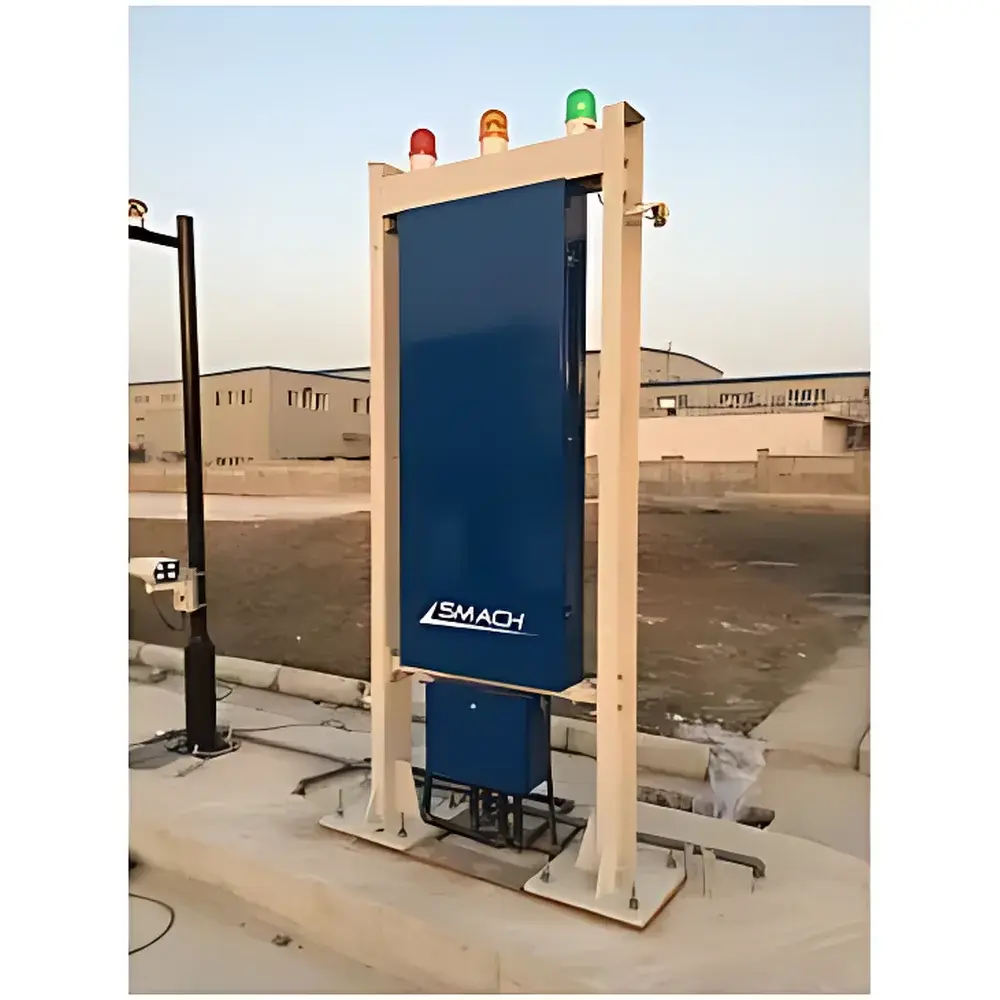
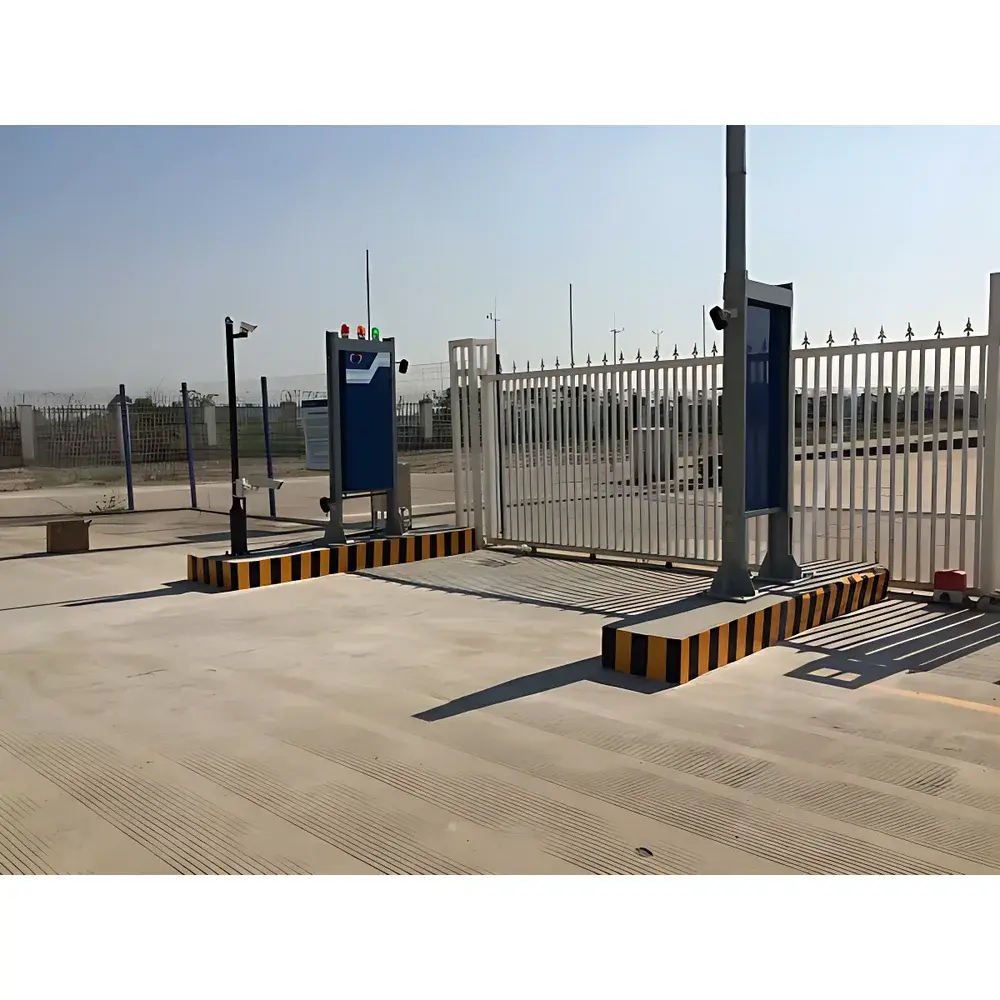
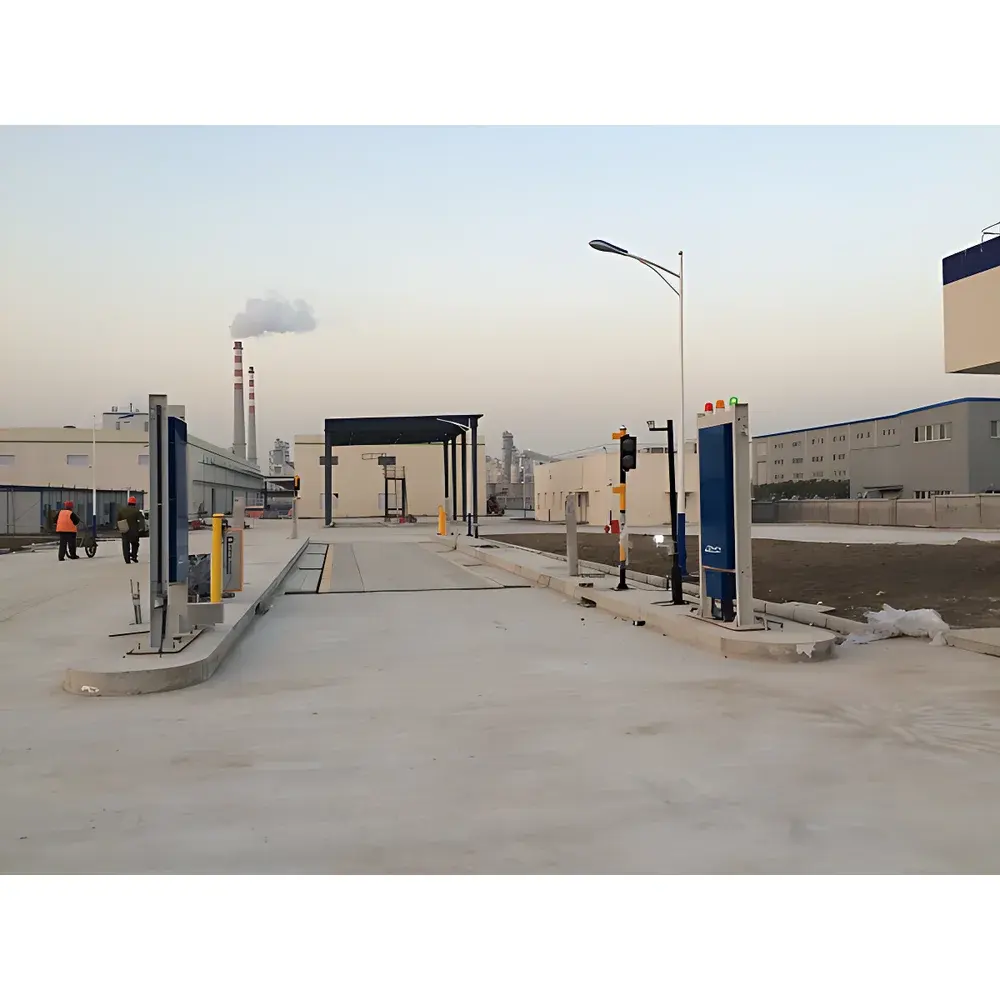
SMACH RC2025 Vehicle-Portal Radiation Monitoring System
| Brand | SMACH |
|---|---|
| Model | RC2025 |
| Origin | Fujian, China |
| Detector Type | Plastic Scintillator |
| Radiation Type | Gamma (γ) |
| Energy Response Range | 50 keV – 3 MeV |
| Gamma Sensitivity | >60,000 cps/μSv/h per detector unit |
| Dynamic Detection Capability | ≥5×10⁶ Bq ¹³⁷Cs |
| Neutron Sensitivity | Detectable ≥20,000 n/s neutron source |
| False Alarm Rate | ≤0.1% |
| Non-Detection Side Shielding | 5 mm lead-equivalent |
| Height Coverage | 0.1–3 m |
| Width Coverage | 5 m |
| Nuclear Isotope Discrimination | Artificial vs. Natural Radionuclides |
| System Architecture | Modular, Online, Real-Time |
| Compliance | Designed for IAEA RS-G-1.9, ANSI N42.34, and ISO 28000-aligned operational environments |
Overview
The SMACH RC2025 Vehicle-Portal Radiation Monitoring System is an industrial-grade, online gamma radiation detection platform engineered for continuous, non-intrusive screening of vehicles at high-throughput checkpoints. It operates on the principle of scintillation detection: incident gamma photons interact with large-volume plastic scintillator crystals (2 × 25 L modules), generating prompt light pulses proportional to deposited energy. These signals are digitized and processed in real time using pulse-height analysis and spectral ratio algorithms to distinguish artificial radionuclides (e.g., ¹³⁷Cs, ⁶⁰Co, ²⁴¹Am) from naturally occurring radioactive material (NORM), including ⁴⁰K and uranium/thorium decay-chain isotopes. The system is calibrated against traceable ¹³⁷Cs sources and validated per ANSI N42.34 Annex A protocols for portal monitor performance. Its architecture supports deployment in fixed infrastructure—border crossings, seaports, customs facilities, nuclear emergency response staging zones, and critical infrastructure perimeters—where regulatory compliance, operational continuity, and audit-ready data integrity are mandatory.
Key Features
- Modular hardware design enabling scalable configuration: detector arrays, license plate recognition (LPR) subsystems, and remote monitoring nodes can be added or replaced without system downtime.
- Dual 25-liter plastic scintillator detectors with optimized light collection efficiency and temperature-stable photomultiplier tube coupling—engineered for high count-rate linearity (>10⁶ cps) and low afterglow.
- Real-time isotope discrimination engine leveraging multi-channel pulse-height spectra and dynamic background-adaptive thresholding, reducing false alarms to ≤0.1% under variable environmental conditions.
- Integrated vehicle presence detection via inductive loop or optical break-beam sensors, synchronized with gamma acquisition to ensure full-coverage scanning across 0.1–3 m height and 5 m width.
- 5 mm lead-equivalent shielding on non-detection surfaces minimizes scatter-induced background and improves signal-to-noise ratio during adjacent-lane operations.
- Neutron detection capability (≥20,000 n/s sensitivity) via optional ³He or Li-glass co-location—supporting dual-mode radiological/nuclear threat assessment per IAEA Nuclear Security Series No. 11-T.
Sample Compatibility & Compliance
The RC2025 is designed for unattended, continuous monitoring of moving vehicles—including trucks, containers, sedans, and armored transports—without requiring operator intervention or vehicle stoppage. It complies with international radiation safety and security standards applicable to border and customs applications, including IAEA RS-G-1.9 (Radiation Detection Equipment for Border Monitoring), ANSI N42.34 (Performance Criteria for Portal Monitors), and ISO 28000:2022 (Security Management Systems for Supply Chains). All firmware and data handling routines adhere to GLP-aligned audit trail requirements: timestamps, detector status logs, alarm event metadata (energy spectrum snapshot, isotope ID confidence score, vehicle ID), and user access records are retained for ≥90 days. The system does not require radioactive source licensing for operation, as it functions solely in passive detection mode.
Software & Data Management
The proprietary RC-Monitor software suite provides centralized control, visualization, and forensic analysis. It features a web-based interface compatible with modern browsers and supports TLS 1.2+ encrypted communication for remote command-and-control. Alarm events trigger automated generation of PDF reports containing spectral overlays, vehicle image capture (via integrated LPR camera), GPS-tagged location data, and isotope classification results. Data export conforms to ASTM E2871-22 (Standard Practice for Export of Radiation Detection Data) in XML and CSV formats. Software updates are delivered via secure OTA channels with SHA-256 signature verification. Audit logs meet FDA 21 CFR Part 11 requirements for electronic records and signatures when deployed in regulated government or defense contexts.
Applications
- Customs and border protection agencies conducting routine cargo and passenger vehicle screening.
- Port authorities implementing ISPS Code-compliant radiological surveillance programs.
- Nuclear emergency response teams deploying rapid-deployment portals near incident zones or evacuation corridors.
- Postal and express logistics operators screening high-risk mail streams under national CBRN countermeasures frameworks.
- Government facilities (e.g., nuclear research centers, defense installations) enforcing access-controlled radiation entry policies.
- Municipal security agencies supporting large-scale public events (Olympics, G20 summits) with mobile or semi-permanent portal configurations.
FAQ
What gamma energy range does the RC2025 cover, and how is energy calibration maintained?
The system responds to photons from 50 keV to 3 MeV. Calibration is performed using traceable ²⁴¹Am, ¹³⁷Cs, and ⁶⁰Co reference sources; automatic gain stabilization compensates for PMT drift over temperature and time.
Can the RC2025 differentiate between medical isotopes (e.g., ⁹⁹mTc) and illicit materials?
Yes—its spectral analysis engine identifies characteristic photopeaks and applies nuclide-specific decision trees aligned with ANSI N42.34 nuclide library definitions.
Is neutron detection standard or optional?
Neutron detection is an optional module; base RC2025 configurations include gamma-only capability. Integration requires additional detector housing and firmware license.
How is system uptime ensured in outdoor environments?
All electronics are housed in IP65-rated enclosures with active thermal management. Detector modules feature UV-stabilized acrylic housings and condensation-resistant optical interfaces.
Does the system support integration with existing command-and-control platforms?
Yes—via RESTful API and Modbus TCP protocols. Pre-built connectors are available for major border management systems (e.g., WCO ASYCUDA, UNODC CBRN Interoperability Framework).
Related Products







