
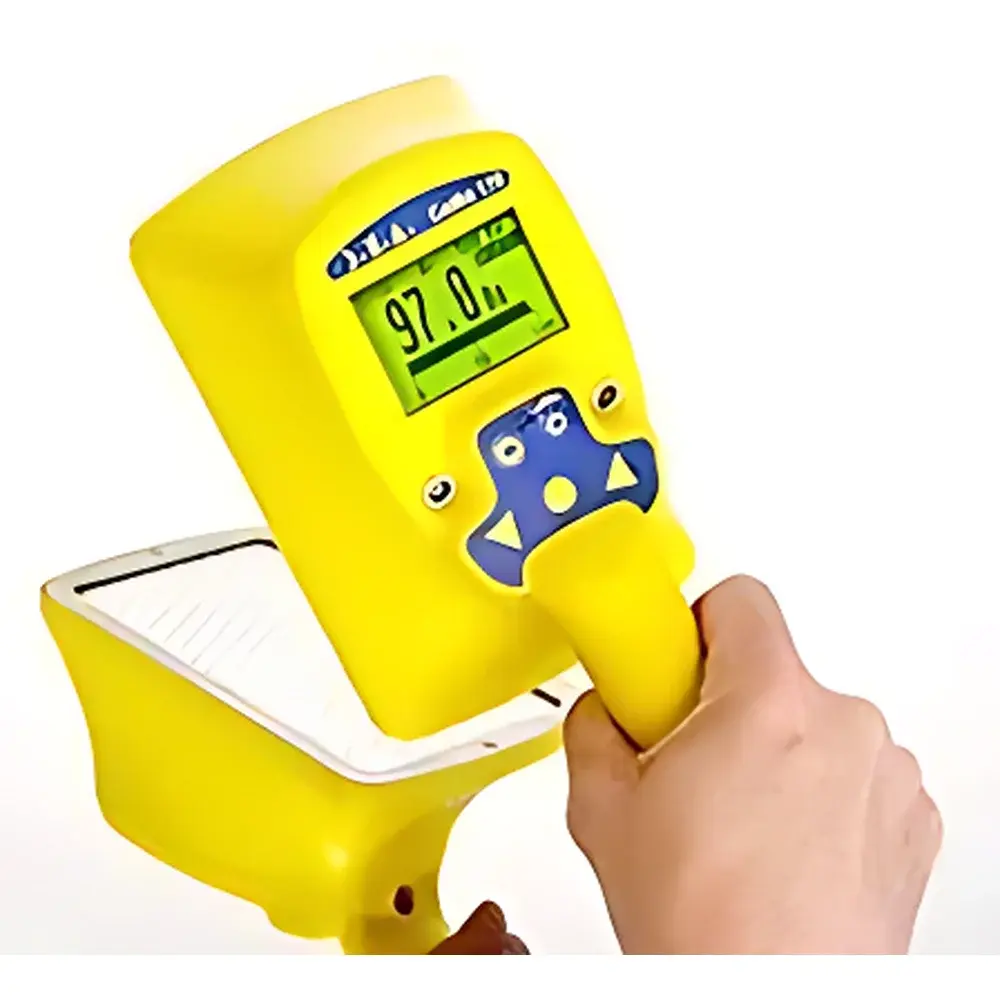
German SEA CoMo 170 Portable Surface Contamination Monitor
| Origin | Germany |
|---|---|
| Manufacturer Type | Authorized Distributor |
| Origin Category | Imported |
| Model | CoMo 170 |
| Instrument Type | Activity Meter (Radiation Survey Meter) |
| Detector Area | 170 cm² |
| Power Supply | 2 × AA 1.5 V alkaline or NiMH rechargeable batteries (up to 50 h operation) |
| Display | 128 × 64 pixel LCD with auto-sensing backlight |
| Weight | 750 g (incl. batteries) |
| Operating Temperature | –10 °C to +40 °C (optional –20 °C variant) |
| Detection Principle | Dual-layer scintillation detection (ZnS(Ag) for α, plastic scintillator for β/γ) |
| Units | cps, Bq, Bq/cm² (nSv/h, µSv/h, mSv/h with optional dose rate probe) |
| Data Storage | 750 measurement records with timestamp, transferable via optional PC software |
| Alarm | Adjustable audio-visual threshold, real-time background compensation |
| Nuclide Library | 25 user-editable radionuclides with automatic background subtraction and efficiency correction |
| Interface | 5-button intuitive menu navigation |
| Compliance | Designed for IEC 60846-1:2014, ISO 7503-1:2019, and compatible with GLP/GMP documentation workflows |
Overview
The German SEA CoMo 170 Portable Surface Contamination Monitor is a field-deployable, microprocessor-controlled radiation survey instrument engineered for rapid, quantitative assessment of alpha (α), beta (β), and gamma (γ) surface contamination. It employs a dual-layer scintillation detection architecture: a thin ZnS(Ag) layer optimized for high-efficiency α-particle detection (≥18% for 241Am, ≥22% for 238U), coupled with a large-area plastic scintillator (170 cm² active area) sensitive to β and low-energy γ emissions. Unlike gas-filled proportional counters, the CoMo 170 requires no pressurized gas supply or high-voltage stabilization—its solid-state detector ensures operational robustness in variable environmental conditions. The instrument operates on fundamental principles of pulse-height-independent counting, calibrated per ISO 7503-1:2019 for surface activity quantification in Bq/cm². Its design prioritizes metrological traceability, operator safety, and regulatory readiness—making it suitable for routine monitoring in nuclear facilities, decommissioning sites, emergency response units, and radiopharmaceutical handling laboratories.
Key Features
- Large-area (170 cm²) integrated scintillation detector enabling high statistical confidence in low-activity measurements
- Simultaneous α/β/γ discrimination without external probe swapping—achieved via pulse-shape-insensitive coincidence logic and energy-threshold gating
- Real-time background compensation with user-configurable background measurement duration (1–300 s)
- 25-entry customizable nuclide library supporting automatic efficiency correction and decay correction (including 14C, 32P, 90Sr/90Y, 131I, 241Am, 238U)
- Three selectable display units: counts per second (cps), absolute activity (Bq), or surface-specific activity (Bq/cm²)
- Auto-sensing LED-backlit LCD (128 × 64 pixels) with adjustable contrast for low-light or glove-operated environments
- Five-button interface with hierarchical menu structure—no training required for basic operation
- Onboard storage of up to 750 measurement records, each including date/time stamp, nuclide selection, measurement mode, and result
- Integrated battery management: detects NiMH rechargeables and activates charging circuitry when connected to external power (3 h full charge)
- Password-protected advanced settings to prevent unauthorized configuration changes
Sample Compatibility & Compliance
The CoMo 170 supports both direct measurement (e.g., floor, glovebox surfaces, PPE) and indirect wipe testing (using standardized 10 cm × 10 cm filter papers). Its geometry-corrected calibration accounts for non-uniform source distribution and edge effects per ISO 7503-1 Annex C. Optional accessories extend its application scope: a wall-mount bracket enables fixed-position hand/foot monitoring; a ground-survey adapter ensures consistent 1 cm lift-off distance for soil or pavement surveys; and certified check sources (241Am, 137Cs, 90Sr/90Y) facilitate daily performance verification. The instrument complies with IEC 60846-1:2014 for portable radiation protection instrumentation and meets the functional requirements for ALARA program implementation under IAEA Safety Standards Series No. RS-G-1.7. Data export capabilities support audit-ready reporting aligned with 21 CFR Part 11-compliant software (via optional SEA DataLink Suite).
Software & Data Management
The optional SEA DataLink PC software enables secure bidirectional communication via USB interface. Measurement records—including raw count data, applied nuclide, background subtraction status, and operator ID—can be exported as CSV or PDF reports with embedded metadata (instrument serial number, firmware version, calibration date). The software supports batch analysis, trend plotting over time, and automated pass/fail evaluation against site-specific action levels. Audit trails log all configuration changes and data exports, satisfying GLP and GMP documentation requirements. Firmware updates are delivered via signed binary packages to ensure integrity and traceability.
Applications
- Routine contamination screening in nuclear power plant auxiliary buildings, fuel fabrication labs, and spent fuel handling areas
- Post-decontamination verification following D&D (decommissioning and dismantling) operations
- Emergency response triage by civil defense, fire departments (CoMo 170F variant), and border control agencies
- Quality assurance in radiopharmaceutical production facilities (USP , EU GMP Annex 3)
- Environmental surveillance at legacy uranium mining sites and radioactive waste disposal facilities
- Personnel monitoring during entry/exit from controlled radiation zones (hand/foot contamination checks)
- Regulatory inspections conducted by national radiation protection authorities (e.g., BfS in Germany, NRC in USA)
FAQ
Does the CoMo 170 require annual recalibration?
Yes—calibration must be performed annually by an accredited laboratory traceable to national standards (e.g., PTB, NIST), with certificate documenting energy response, efficiency, and background stability.
Can the CoMo 170 measure low-energy beta emitters like H-3 or C-14 accurately?
While not optimized for tritium due to its very low endpoint energy (18.6 keV), the CoMo 170 achieves 14% detection efficiency for 14C (mean energy ~49 keV) when used with appropriate geometry and background subtraction.
Is the instrument suitable for outdoor use in rain or dust?
The IP54-rated housing provides protection against limited dust ingress and water splashes—but prolonged exposure to precipitation or abrasive particulates is not recommended without the optional protective cover.
How does the background compensation algorithm function?
The system performs a dedicated background acquisition cycle prior to sample measurement, then applies dynamic subtraction using weighted averaging across multiple consecutive readings to minimize statistical noise impact.
What is the minimum detectable activity (MDA) for Am-241 on stainless steel?
At 100 s counting time and typical background (0.1 cps α), MDA is ≤0.4 Bq/cm² (k = 2, 95% confidence) per ISO 11929:2019 uncertainty propagation methodology.







