
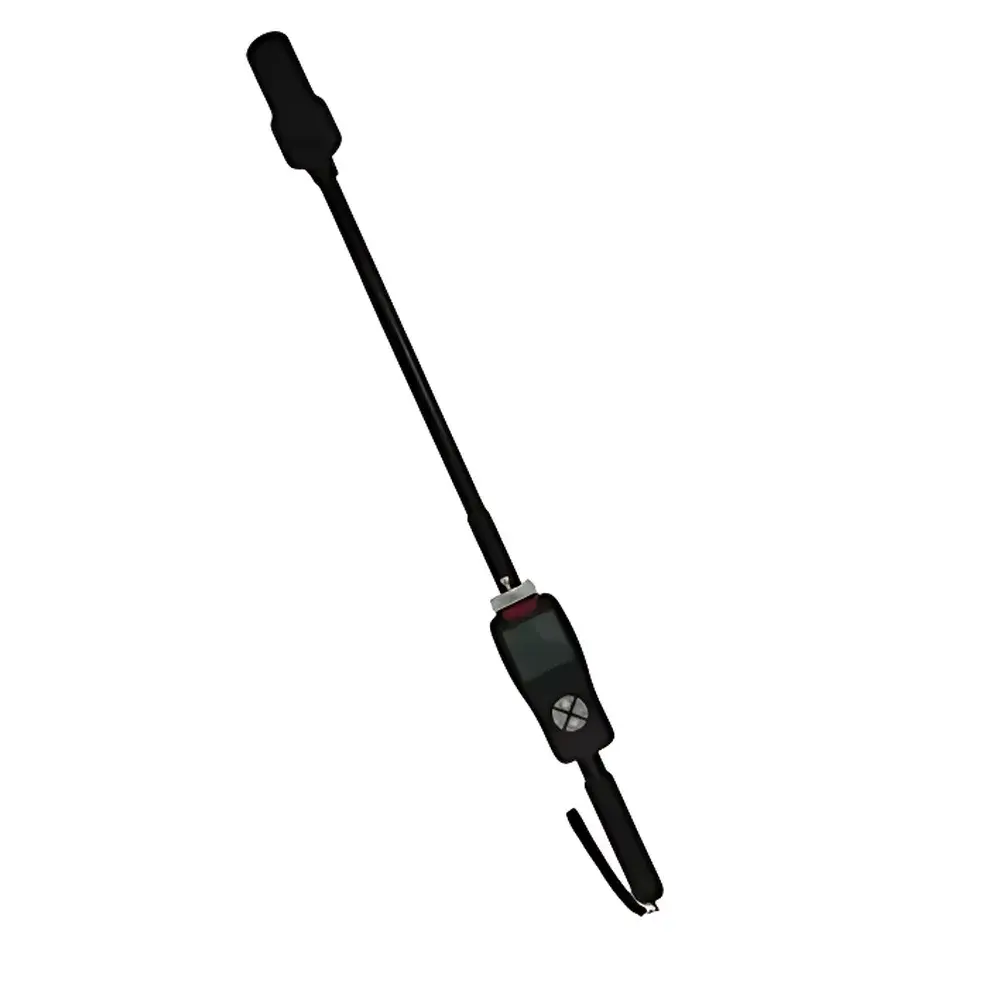
SMACH RD800 Telescopic X- and γ-Ray Dose Rate Meter
| Brand | SMACH |
|---|---|
| Origin | Fujian, China |
| Model | RD800 |
| Instrument Type | Portable Dose Rate Meter |
| Detection Principle | Scintillation + Geiger-Müller (GM) Dual-Detector Architecture |
| Measured Radiation | X-rays and γ-rays |
| Dose Rate Range | 0.01 μSv/h to 15 mSv/h (GM mode) |
| Sensitivity | 100 cps per μSv/h (¹³⁷Cs reference) for scintillator |
| Energy Response | 48 keV – 3 MeV (scintillator) |
| Detector Dimensions | Φ35 × 32 mm (active), Φ50 × 70 mm (housing) |
| IP Rating | IP68 |
| Operating Temperature | −25 °C to +50 °C |
| Positioning | Dual-band GNSS (GPS + BeiDou) |
| Data Storage | ~2000 records with timestamp, dose rate, accumulated dose, geotag, alarm status |
| Connectivity | 4G LTE full-network support |
| Power | Rechargeable Li-ion battery with extended field endurance |
| Telescopic Probe Rod | Adjustable length 1.0–4.5 m (standard) |
| Compliance | Designed to meet IEC 60846-1:2014 (radiation protection instrumentation — ambient and/or directional dose equivalent [rate] meters and/or monitors for beta, X and gamma radiation) |
| Software Compatibility | PC-based data export in .xlsx format with audit-ready metadata (time, location, detector ID, measurement mode) |
Overview
The SMACH RD800 Telescopic X- and γ-Ray Dose Rate Meter is an engineered solution for remote, high-fidelity radiation field assessment in environments where direct human access is restricted or hazardous. It operates on a dual-detector architecture: a high-sensitivity thallium-doped sodium iodide (NaI:Tl) scintillation detector optimized for low-dose-rate sensitivity and energy response across 48 keV–3 MeV, paired with an energy-compensated Geiger-Müller (GM) tube for extended high-range coverage up to 15 mSv/h. This hybrid detection strategy ensures metrological continuity across four orders of magnitude—from environmental background levels (0.01 μSv/h) to emergency response scenarios requiring rapid saturation-resistant measurement. The instrument adheres to the functional and performance requirements specified in IEC 60846-1:2014 for portable ambient dose equivalent rate meters, supporting both operational safety compliance and regulatory documentation workflows.
Key Features
- Dual independent detection channels: scintillator (0.01–800 μSv/h) and GM tube (0.01–15 mSv/h), each with dedicated calibration traceability and selectable measurement modes
- Telescopic probe rod system (1.0–4.5 m standard extension) constructed from aerospace-grade aluminum alloy—rigid, non-collapsible, and rated for repeated deployment in contaminated or confined spaces
- High-resolution LCD display showing real-time dose rate, accumulated dose, dynamic bar graph visualization, user-defined alarm thresholds, and GNSS-derived coordinates
- Configurable alarm logic: simultaneous dose rate and integrated dose threshold triggering with audible, visual, and haptic alerts
- Modular host interface supporting external detectors—including alpha/beta surface contamination probes, neutron-sensitive ³He tubes, and multi-radionuclide identification modules—via standardized digital bus protocol
- Onboard non-volatile memory storing ≥2000 measurement records with embedded metadata: UTC timestamp, latitude/longitude (±3 m CEP), detector serial ID, measurement mode flag, and alarm event flags
- 4G LTE Cat-4 cellular module enabling secure TLS-encrypted telemetry transmission to central command dashboards; optional TETRA or analog FM radio interface for legacy interoperability
Sample Compatibility & Compliance
The RD800 is designed for direct-field measurement of photon-emitting radionuclides without sample preparation. Its NaI:Tl scintillator exhibits uniform response to common isotopes including ¹³⁷Cs (662 keV), ⁶⁰Co (1.17 & 1.33 MeV), ¹⁹²Ir (300–612 keV), and ²⁴¹Am (59.5 keV), with energy compensation applied in firmware to minimize angular and spectral dependence. The GM channel provides robust gross-count verification under high-flux conditions. Device firmware implements linearization algorithms validated against NIST-traceable ¹³⁷Cs and ⁶⁰Co reference fields. Hardware and software architecture conform to IEC 61508 SIL2 principles for functional safety, and data logging meets ALARA documentation requirements under ISO 20553:2016 (radiological protection — monitoring of radioactive effluents). Optional configuration supports 21 CFR Part 11-compliant electronic signatures and audit trail generation for GMP-regulated nuclear medicine facilities.
Software & Data Management
Data retrieval occurs via USB-C or encrypted 4G upload to the SMACH Radiation Data Hub—a browser-based platform supporting role-based access control, geospatial heat mapping, trend analysis, and automated report generation (PDF/XLSX). Each exported record includes SHA-256 hash integrity verification, ensuring forensic-grade data provenance. Firmware updates are digitally signed and delivered over-the-air (OTA) with rollback capability. The host application supports batch calibration coefficient import/export, allowing site-specific correction factors for known shielding geometries or scatter conditions. All stored metadata comply with ISO/IEC 17025:2017 clause 7.5.2 for result reporting traceability.
Applications
- Nuclear emergency response: standoff survey of damaged reactor containment zones, spent fuel pool perimeters, or radiological dispersal device (RDD) sites
- Decommissioning & decontamination: real-time dose mapping during glovebox dismantling, pipe cutting, or concrete coring operations
- Border and customs radiation screening: mobile vehicle or cargo inspection using elevated probe positioning
- Medical physics QA: verification of LINAC leakage, brachytherapy source storage integrity, and PET cyclotron vault shielding
- Environmental monitoring: long-term unattended deployment at former uranium mining sites or NORM-contaminated industrial facilities
- First responder training: simulated hot-zone reconnaissance with configurable virtual source fields and GPS-referenced scenario replay
FAQ
What radiation types does the RD800 detect?
The RD800 is calibrated and type-tested for X-ray and gamma-ray photons only. It does not detect alpha, beta, or neutron radiation unless externally coupled to compatible add-on probes.
Is the telescopic rod included with the base unit?
Yes—the standard configuration includes a 1.0–4.5 m carbon-fiber-reinforced aluminum telescopic rod with locking collars, integrated cable routing, and strain-relief connectors.
Can measurement data be integrated into existing radiation safety information systems (RSIS)?
Yes—CSV and Excel exports include ISO 8601 timestamps, WGS84 coordinates, and SI units. An optional RESTful API enables direct ingestion into enterprise EHS platforms such as Sphera, Intelex, or SAP EH&S.
Does the device support GLP/GMP audit trails?
When configured with the Regulatory Edition firmware, the RD800 logs all operator actions (threshold changes, mode switches, calibration events) with digital signatures and immutable timestamps compliant with FDA 21 CFR Part 11 Annex 11 requirements.
What is the typical battery life under continuous operation?
With backlight enabled and GNSS active, the rechargeable Li-ion pack delivers ≥18 hours of continuous logging; standby time exceeds 120 hours. Battery health diagnostics are accessible via service menu.
Related Products







