
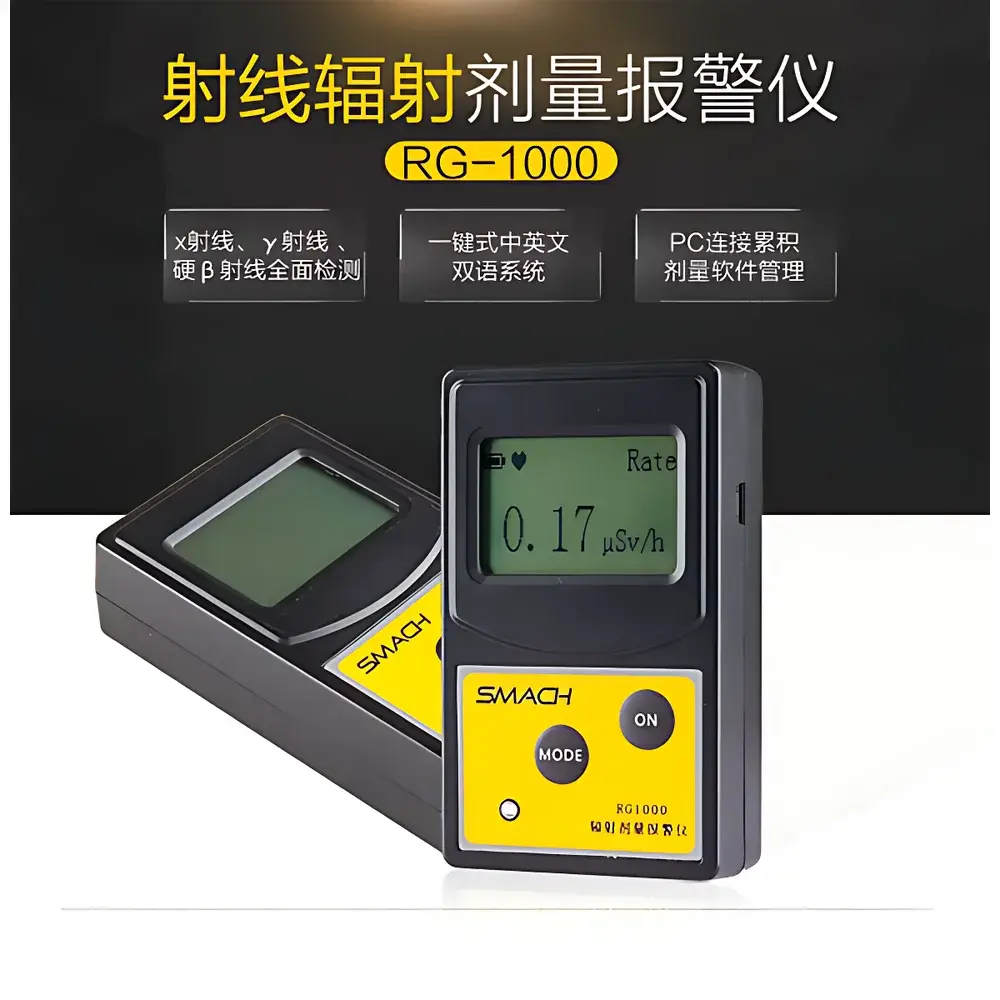
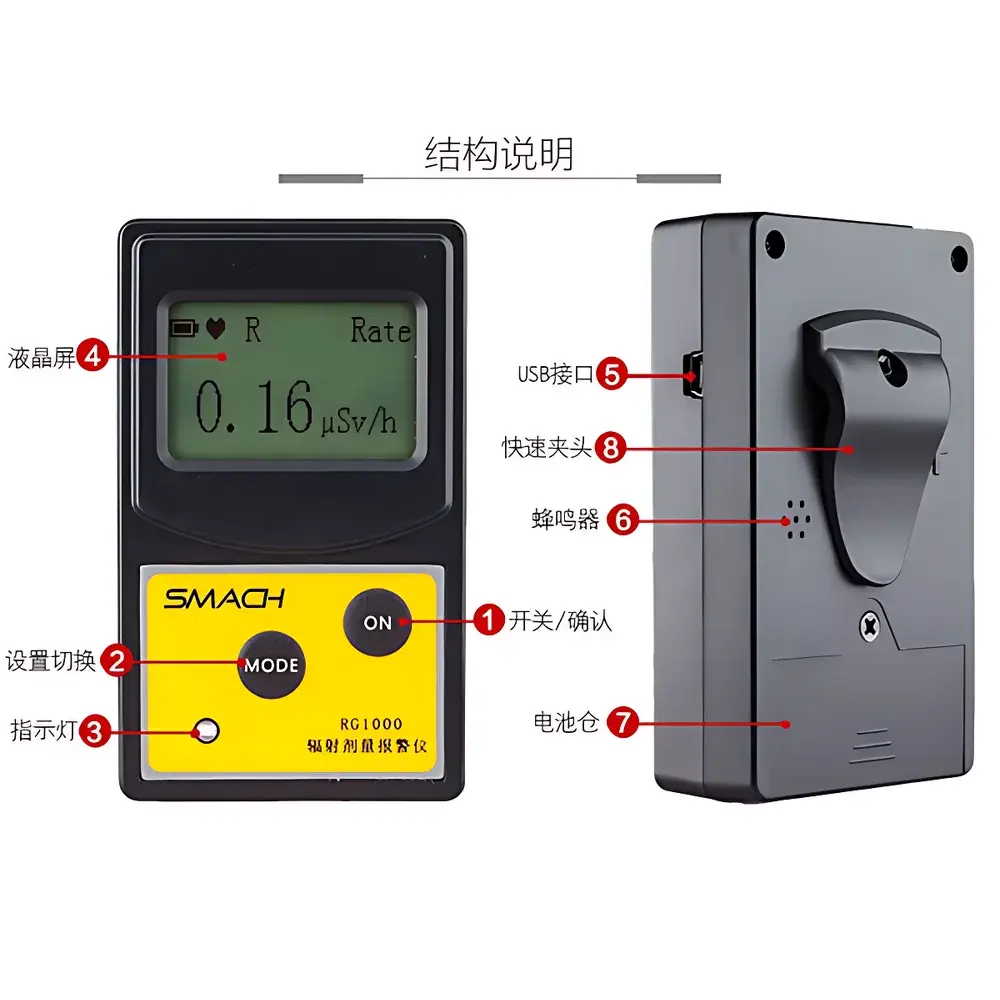
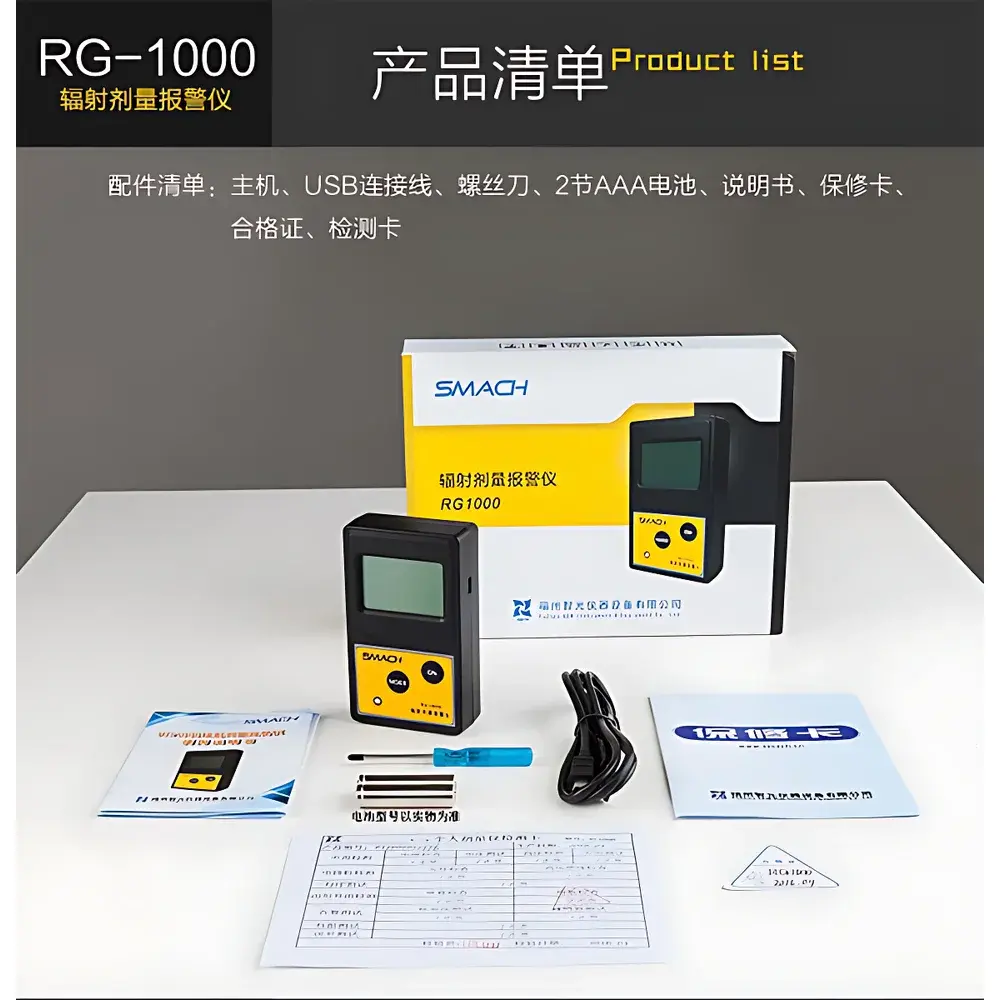
SMACH RG1000 Personal Radiation Dosimeter Alarm
| Brand | SMACH |
|---|---|
| Model | RG1000 |
| Instrument Type | Portable Dosimeter/Alarm |
| Detector Type | Energy-Compensated GM Tube |
| Measured Radiation | X and γ Rays |
| Dose Equivalent Rate Range | 0.00 µSv/h – 10 mSv/h |
| Cumulative Dose Equivalent Range | 0.00 µSv – 10 Sv |
| Sensitivity | ≥1.5 CPS/µSv/h (relative to ¹³⁷Cs) |
| Energy Response | 48 keV – 3.0 MeV |
| Relative Error | <10% at 1 mSv/h |
| Operating Temperature | −10 °C to +50 °C |
| Humidity Range | 0–95% RH (at +35 °C) |
| Dimensions | 100 × 60 × 26 mm |
| Power Supply | Two AAA batteries |
Overview
The SMACH RG1000 Personal Radiation Dosimeter Alarm is a compact, high-sensitivity portable instrument engineered for real-time monitoring of personal exposure to ionizing radiation in occupational environments. It operates on the principle of gas-filled Geiger-Müller (GM) detection, where incident X or γ photons ionize the fill gas within an energy-compensated GM tube, triggering discrete electrical pulses proportional to radiation intensity. Each pulse is processed to calculate both instantaneous dose equivalent rate (µSv/h) and cumulative dose equivalent (µSv–Sv), enabling continuous compliance tracking against regulatory limits defined by ICRP, IAEA Safety Standards, and national frameworks such as GBZ 128–2019 (China) and ANSI N42.20. Designed for wearability and low-power operation, the RG1000 delivers rapid response times (<2 s for alarm activation) and stable performance across variable field conditions—making it suitable for deployment in radiological protection programs requiring ALARA (As Low As Reasonably Achievable) adherence.
Key Features
- Integrated dual-function measurement: simultaneous real-time dose rate and cumulative dose logging with independent user-configurable alarm thresholds
- Energy-compensated GM detector ensuring flat energy response from 48 keV to 3.0 MeV—critical for accurate dosimetry across diagnostic X-ray, industrial γ sources (e.g., ⁶⁰Co, ¹³⁷Cs), and nuclear medicine isotopes
- High intrinsic sensitivity ≥1.5 CPS/µSv/h (referenced to ¹³⁷Cs), enabling reliable detection of environmental background (≈0.05–0.3 µSv/h) and early warning at low-dose-rate scenarios
- Robust electromagnetic interference (EMI) immunity verified per IEC 61000-4-3 (radiated RF immunity) and IEC 61000-4-4 (electrical fast transient burst), supporting use near MRI suites, LINACs, and industrial NDT equipment
- Non-volatile memory retains cumulative dose, alarm setpoints, and configuration parameters during battery replacement or power loss—ensuring data continuity for audit trails
- Configurable audible (≥85 dB at 30 cm) and visual (flashing LED) alarms with dual-mode alerting: dose rate threshold breach and/or cumulative dose limit exceedance
- Adjustable backlight LCD with dot-matrix display supports bilingual interface (English/Chinese) and intuitive menu navigation—optimized for gloved operation in PPE-restricted settings
- Extended operational life: up to 2,000 hours on two AAA alkaline cells; low-battery indicator provides ≥72 h advance warning prior to shutdown
Sample Compatibility & Compliance
The RG1000 is calibrated and validated for direct measurement of ambient dose equivalent H*(10) from photon fields encountered in routine occupational settings. It meets the performance criteria specified in ISO 15542–2:2018 (Radiation protection instrumentation — Personal dosemeters for use in mixed neutron/photon fields — Part 2: Photon-only instruments) and complies with the type-testing requirements of IEC 61526:2013 (Radiation protection instrumentation — Measurement of personal dose equivalents Hp(10) and Hp(0.07)). Its energy compensation design minimizes over-response below 100 keV and under-response above 1 MeV—reducing systematic bias compared to uncompensated GM detectors. The device is certified for use in accordance with national radiation safety regulations governing nuclear facilities (e.g., NRC 10 CFR 20), medical radiology (e.g., EU Council Directive 2013/59/Euratom), and industrial radiography (e.g., ASTM E2737).
Software & Data Management
Data export is supported via standard USB interface using proprietary PC software compatible with Windows 10/11. Exported files conform to CSV format with timestamped records of dose rate, cumulative dose, alarm events, and battery status—facilitating integration into enterprise radiation safety management systems (RSM). Audit trail functionality includes immutable logging of parameter changes (e.g., alarm threshold modifications), user ID tagging (where enabled), and firmware version metadata. While the RG1000 does not implement FDA 21 CFR Part 11 electronic signature controls, its data structure supports GLP/GMP-aligned recordkeeping when deployed with documented SOPs and controlled access protocols.
Applications
- Radiation safety officers conducting routine personnel dosimetry audits in nuclear power plants and fuel cycle facilities
- Clinical staff in diagnostic radiology, interventional cardiology, and radiotherapy departments requiring real-time feedback during fluoroscopically guided procedures
- Field technicians performing industrial radiographic testing (RT) of welds, pipelines, and pressure vessels
- Customs and border inspection personnel screening cargo and scrap metal for orphan radioactive sources
- Emergency response teams deploying during radiological dispersal device (RDD) incidents or nuclear facility anomalies
- Research personnel working with sealed γ sources (e.g., ¹³⁷Cs, ⁶⁰Co) or X-ray generators in university laboratories and material science centers
FAQ
What radiation types does the RG1000 detect?
The RG1000 is optimized for X-ray and gamma-ray photons only. It is not sensitive to alpha, beta, or neutron radiation due to inherent GM tube wall attenuation and lack of appropriate converter materials.
Can the alarm thresholds be customized in the field?
Yes—both dose rate and cumulative dose alarm thresholds are fully programmable via the onboard menu system without requiring external software or service tools.
Is calibration traceable to national standards?
Each unit ships with a factory calibration certificate traceable to CNIM (China National Institute of Metrology) or equivalent accredited laboratory, including energy-specific response factors and uncertainty budgets.
How is data integrity maintained during battery replacement?
All critical parameters—including accumulated dose, alarm setpoints, and configuration flags—are stored in non-volatile EEPROM, preserving data across power cycles and battery swaps.
Does the RG1000 support multi-user identification?
No—the device lacks built-in user authentication or RFID/NFC pairing; dose records are assigned to the physical unit rather than individual operators. For personnel-specific tracking, external assignment protocols must be implemented administratively.
Related Products







