
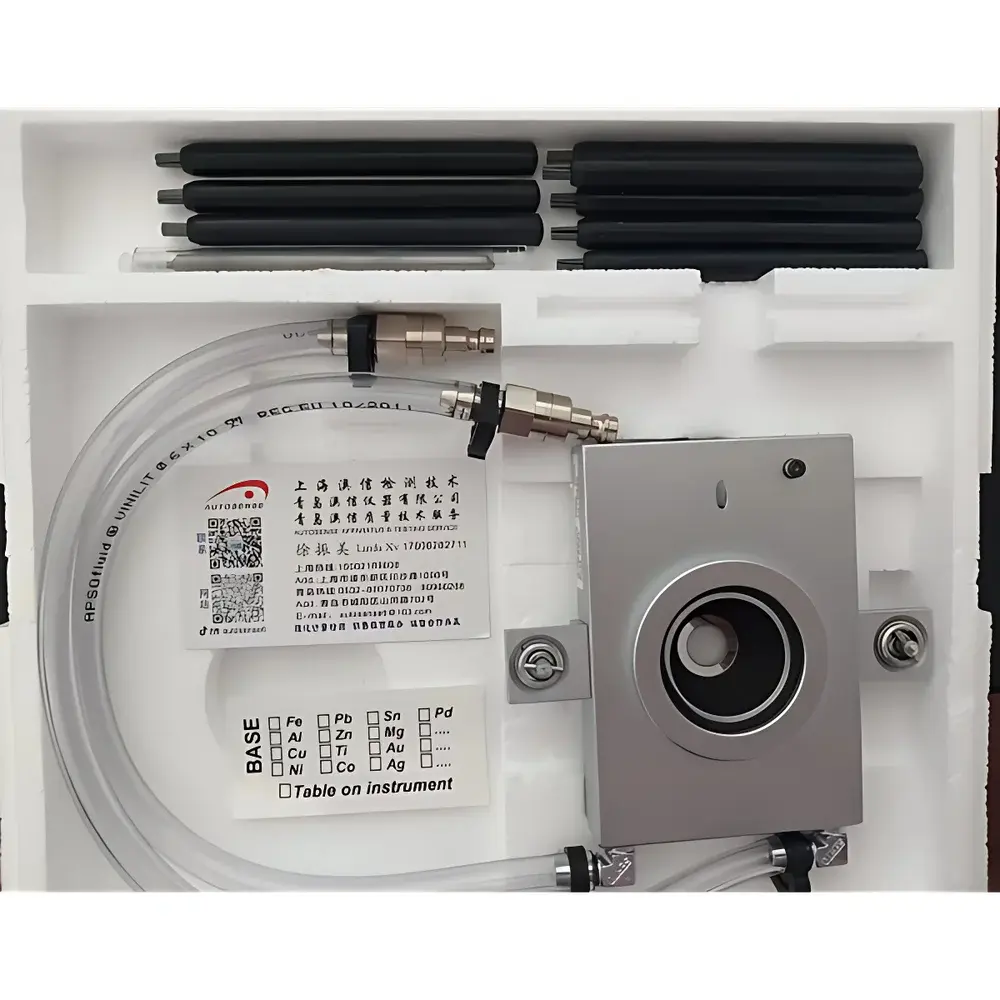
Thermo Fisher ARL 8860 Direct-Reading Optical Emission Spectrometer
| Brand | Thermo Fisher |
|---|---|
| Origin | USA |
| Model | ARL 8860 |
| Type | Spark Optical Emission Spectrometer (OES) |
| Measurement Principle | Arc/Spark Excitation + Polychromator-Based UV-VIS Detection |
| Typical Applications | Metallic Alloy Composition Analysis, QC/QA in Foundries & Metal Production |
| Compliance | ASTM E1479, ISO 11577, EN 10052, USP <730>, GLP/GMP-Ready Configuration Options |
Overview
The Thermo Fisher ARL 8860 is a high-performance direct-reading optical emission spectrometer (OES) engineered for precise, rapid elemental analysis of conductive metallic samples. Utilizing controlled spark or arc excitation in an argon-purged environment, the instrument atomizes and ionizes sample surfaces, generating characteristic atomic emission spectra across the ultraviolet to visible range (130–800 nm). Light dispersion is achieved via a fixed polychromator with optimized grating and thermally stabilized photomultiplier tube (PMT) detectors, enabling simultaneous multi-element quantification with sub-ppm detection limits for key alloying elements (e.g., C, S, P, Mn, Cr, Ni, Al, Cu, Ti, Mo). Designed for integration into high-throughput production laboratories, the ARL 8860 delivers robust repeatability (<1.5% RSD for major elements in certified reference materials) and long-term stability without routine recalibration—critical for foundry process control, incoming material verification, and heat-to-heat certification per ASTM E1479 and ISO 11577.
Key Features
- High-resolution Paschen-Runge polychromator with 32–64 pre-aligned PMT channels, supporting simultaneous measurement of up to 64 elements
- Advanced spark source with adjustable energy, frequency, and pre-spark conditioning—optimized for cast iron, aluminum, copper, magnesium, and titanium alloys
- Integrated argon purging system with real-time flow monitoring and automatic pressure regulation (≤0.1 mbar residual oxygen)
- Self-diagnostic optics chamber with temperature stabilization (±0.1 °C) and sealed optical path to prevent contamination
- Modular sample stand accommodating flat, cylindrical, and irregular geometries (up to Ø100 mm × 50 mm height); optional automated sample changer (up to 40 positions)
- CE-marked, RoHS-compliant hardware architecture with redundant cooling circuits and electromagnetic interference (EMI) shielding
Sample Compatibility & Compliance
The ARL 8860 accepts solid, electrically conductive metal samples—including as-cast, machined, or ground surfaces—with minimal preparation (typically 10–20 µm surface removal). It supports standardized reference materials (CRM) from NIST, BAM, and JSS, and is validated for use with ISO 5725-based uncertainty estimation protocols. The system meets analytical requirements outlined in ASTM E1479 (Standard Practice for Spectrochemical Analysis by Spark Source OES), ISO 11577 (Metallic Materials — Spark Discharge Atomic Emission Spectrometry), and EN 10052 (Vocabulary of Heat Treatment Terms). Optional 21 CFR Part 11-compliant software modules provide audit trails, electronic signatures, and role-based access control—enabling full traceability in regulated environments (e.g., aerospace casting suppliers, medical device component manufacturers).
Software & Data Management
Controlled via Thermo Scientific OMNI-Tool™ software, the ARL 8860 offers intuitive method development, calibration management, and real-time spectral visualization. Calibration models are built using certified reference materials and support both univariate and multivariate (PLS) regression approaches. Data export conforms to ASTM E1382 (Standard Guide for Computerized Data Acquisition in Spectrochemical Analysis) and includes CSV, XML, and LIMS-compatible formats (ASTM E1461). Raw spectral data, background correction logs, and drift compensation records are retained with time-stamped metadata. Optional integration with Thermo Fisher’s QMS (Quality Management Suite) enables automated report generation aligned with ISO/IEC 17025 documentation requirements.
Applications
- Real-time grade identification and segregation in scrap sorting and recycling facilities
- Final composition verification prior to shipment in aluminum extrusion, stainless steel forging, and superalloy turbine disk production
- Low-carbon steel carbon equivalence (CEV) calculation for weldability assessment per AWS D1.1
- Sulfur and phosphorus monitoring in ductile iron nodularity control
- Trace element screening (e.g., Pb, Sn, As) in lead-free brass and RoHS-compliant copper alloys
- Support for APQP Stage 3 (Production Part Approval Process) documentation in automotive Tier-1 supplier audits
FAQ
What sample preparation is required for the ARL 8860?
Flat, clean, and conductive surfaces are mandatory. Grinding with SiC paper (P120–P400) or milling is standard; no acid etching or coating is needed.
Can the ARL 8860 analyze non-conductive materials like ceramics or polymers?
No—it requires electrical conductivity for spark excitation. Non-metals must be analyzed via alternative techniques (e.g., XRF for bulk composition or SEM-EDS for localized analysis).
Is remote diagnostics and service support available?
Yes—Thermo Fisher’s SecureLink™ remote connectivity enables encrypted firmware updates, spectral troubleshooting, and predictive maintenance alerts via secure TLS 1.2 channels.
How often does the instrument require wavelength calibration verification?
Under stable lab conditions, annual verification using a mercury-argon lamp standard is recommended; daily internal checks via built-in deuterium and tungsten references ensure baseline stability.
Does the system comply with environmental operating specifications?
It operates continuously at 15–30 °C ambient temperature and ≤70% non-condensing humidity, with vibration isolation mounting recommended for floor-mounted configurations.






