
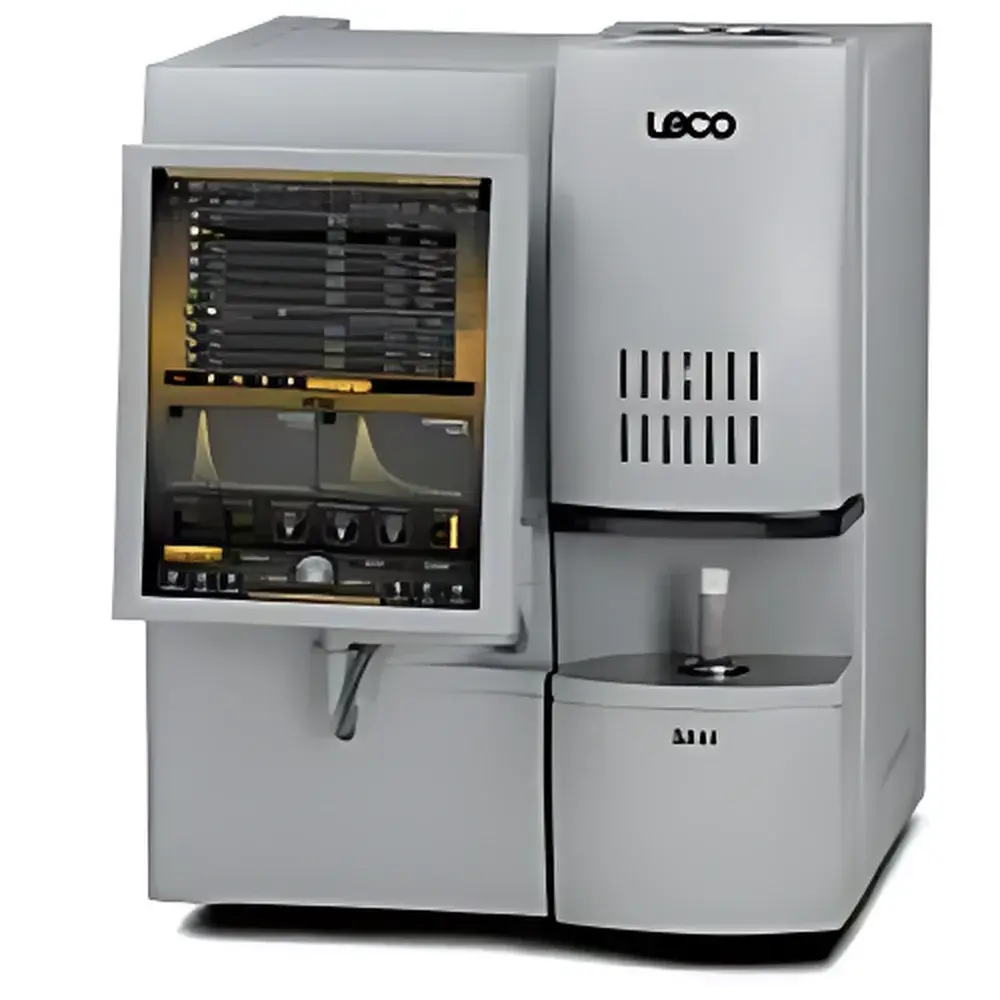
LECO CS844 Combustion-Based Carbon-Sulfur Analyzer
| Brand | LECO |
|---|---|
| Origin | USA |
| Model | CS844 |
| Detection Principle | High-Frequency Induction Combustion Coupled with Dual-Range Infrared Absorption Spectroscopy |
| Sample Throughput | Up to 60 Samples per Batch (with optional autosampler) |
| Carbon Range | 0.0001–10.00% (w/w), Sulfur Range: 0.0001–1.00% (w/w) |
| Detection Limits | C ≤ 0.1 ppm, S ≤ 0.1 ppm (based on 1 g sample) |
| Compliance | ASTM E1019, ISO 15350, GB/T 20123, JIS G 1211 |
| Software | Cornerstone™ v5.x (FDA 21 CFR Part 11 compliant audit trail, GLP/GMP-ready) |
Overview
The LECO CS844 Combustion-Based Carbon-Sulfur Analyzer is a high-precision elemental analyzer engineered for quantitative determination of total carbon and total sulfur in ferrous and non-ferrous metals, ores, slags, ceramics, and other inorganic solid materials. It operates on the principle of high-frequency induction combustion—where a weighed sample is flash-combusted in a pure oxygen atmosphere at temperatures exceeding 2,000 °C inside a graphite crucible. The evolved CO₂ and SO₂ gases are swept through a dust filter and catalytic converter, then quantified via dual-range, temperature-stabilized infrared (IR) absorption cells. Each IR cell employs thermoelectrically cooled detectors and proprietary optical path design to deliver high signal-to-noise ratio and long-term baseline stability. The CS844 is designed for routine QC/QA laboratories requiring trace-level detection, regulatory compliance, and unattended multi-hour operation.
Key Features
- Six-axis adjustable, glare-resistant 10.1-inch capacitive touchscreen with industrial-grade UI navigation—enabling glove-compatible operation and intuitive workflow control.
- Tool-free, fully automated dual-brush furnace head cleaning system—reducing scheduled maintenance downtime by >70% versus legacy models.
- Thermally isolated dual IR detection cells with active temperature stabilization (±0.02 °C)—eliminating drift caused by ambient fluctuations and ensuring reproducibility across shifts and seasons.
- High-efficiency solid-state RF generator (4.0 MHz) with adaptive power regulation—extending graphite crucible and oscillator tube service life while maintaining consistent combustion efficiency across heterogeneous samples (e.g., high-alloy steels, refractory oxides).
- Integrated heated ceramic dust filter and post-combustion catalyst—enhancing SO₂ recovery and minimizing memory effects for low-sulfur analysis (e.g., ultra-low-carbon stainless steels, nuclear-grade zirconium).
- High-vacuum external dust evacuation system—directing particulates into a sealed external collector without internal deposition, preserving optical path integrity and reducing recalibration frequency.
Sample Compatibility & Compliance
The CS844 accommodates solid samples ranging from 0.1 to 1.0 g, including cast iron, stainless steel, titanium alloys, manganese nodules, limestone, fly ash, and sintered carbides. Sample introduction supports manual loading or optional 10-position or 60-position robotic autosamplers with programmable batch sequencing and weight integration via RS-232/USB-connected analytical balances. All hardware and software components meet requirements for ISO/IEC 17025-accredited testing labs. The system complies with ASTM E1019 (Standard Test Methods for Determination of Carbon, Sulfur, Nitrogen, and Oxygen in Steel, Iron, Nickel, and Cobalt Alloys), ISO 15350 (Steels — Determination of Total Carbon and Sulfur Content — Infrared Absorption Method after Combustion in an Induction Furnace), and JIS G 1211. Cornerstone™ software includes full 21 CFR Part 11 functionality—including electronic signatures, role-based access control, immutable audit trails, and automatic data backup—to support FDA-regulated environments and GLP/GMP audits.
Software & Data Management
Cornerstone™ v5.x is a purpose-built, modular software platform developed exclusively for LECO combustion analyzers. Its architecture separates core functions into four navigable modules: Analyze, Diagnose, Setup, and Instrument. Real-time combustion profile visualization—displaying O₂ flow, furnace temperature, pressure differentials, and IR detector response—enables immediate troubleshooting without interrupting analysis. Batch grouping logic allows users to assign replicate analyses, reference materials, and blanks within a single run; standard deviation, %RSD, and confidence intervals are auto-calculated per group. Reporting supports customizable templates (PDF, CSV, XML) with embedded metadata (operator ID, calibration status, environmental conditions). Diagnostic tools include interactive maintenance simulations, annotated component schematics, and context-sensitive help linked directly to firmware revision history.
Applications
The CS844 delivers validated performance in metallurgical process control (e.g., ladle analysis pre-casting), raw material certification (scrap sorting, ore grade verification), failure analysis (sulfur-induced hot shortness in forging), and advanced materials R&D (carbon partitioning in Q&P steels, sulfur segregation in Ni-base superalloys). Its dual-range IR configuration enables simultaneous high-accuracy measurement of both ultra-trace sulfur (≤10 ppm) in bearing steels and high-carbon content (up to 10 wt%) in cast irons—without manual range switching or recalibration. The heated dust filtration system ensures reliable sulfur quantification in high-silica or high-calcium matrices where conventional filters exhibit adsorption artifacts.
FAQ
What sample types are compatible with the CS844?
Solid metallic and inorganic non-metallic materials—including ferrous alloys, non-ferrous metals, ores, slags, refractories, and ceramics—with particle size ≤ 1 mm and moisture content < 0.1%.
Is the CS844 suitable for regulatory-compliant reporting?
Yes. Cornerstone™ software provides full 21 CFR Part 11 compliance, including electronic signatures, audit trail logging, and secure user authentication—validated for use in pharmaceutical excipient testing and aerospace material certification.
How often does the infrared detector require recalibration?
Under normal operation with daily standardization using certified reference materials (CRMs), recalibration is recommended every 6 months or after major maintenance events (e.g., IR cell replacement, furnace rebuild).
Can the CS844 be integrated into a laboratory information management system (LIMS)?
Yes. Native support for ASTM E1381/E1482-compliant ASCII and ASTM E1702 XML export formats enables seamless bidirectional data exchange with major LIMS platforms via TCP/IP or file-based transfer.
What maintenance tasks require operator intervention?
Daily: CRM verification, dust collector emptying, O₂ trap replacement. Weekly: Graphite crucible inspection, brush wear check. Quarterly: IR cell purge gas filter replacement. All procedures are guided by on-screen diagnostics with video-assisted instructions.




