
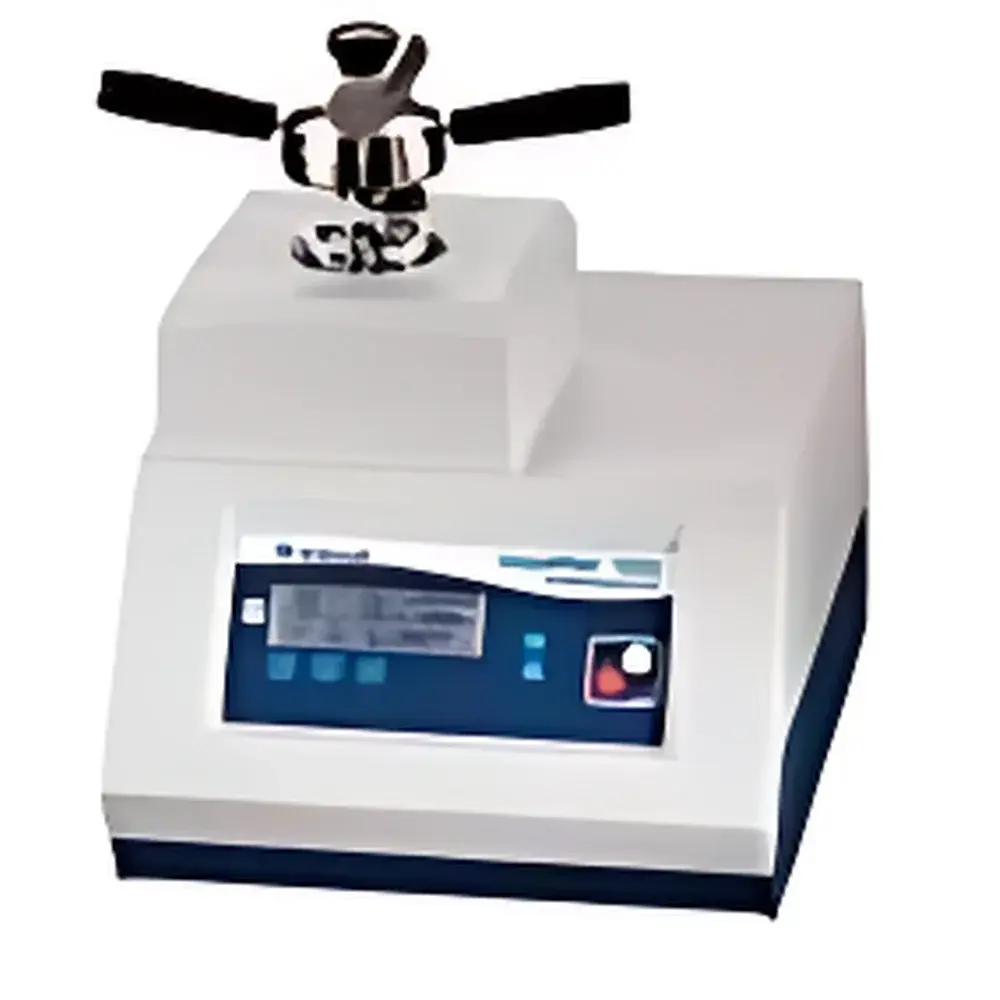
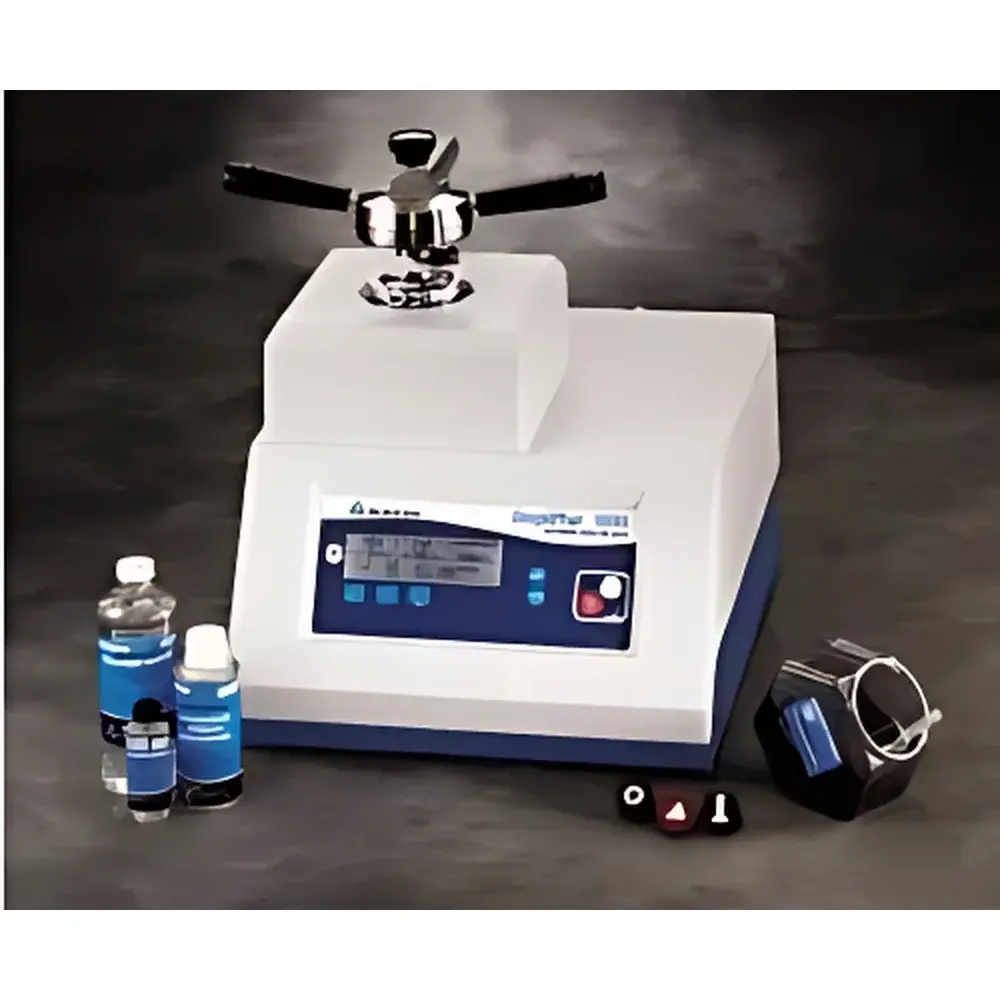
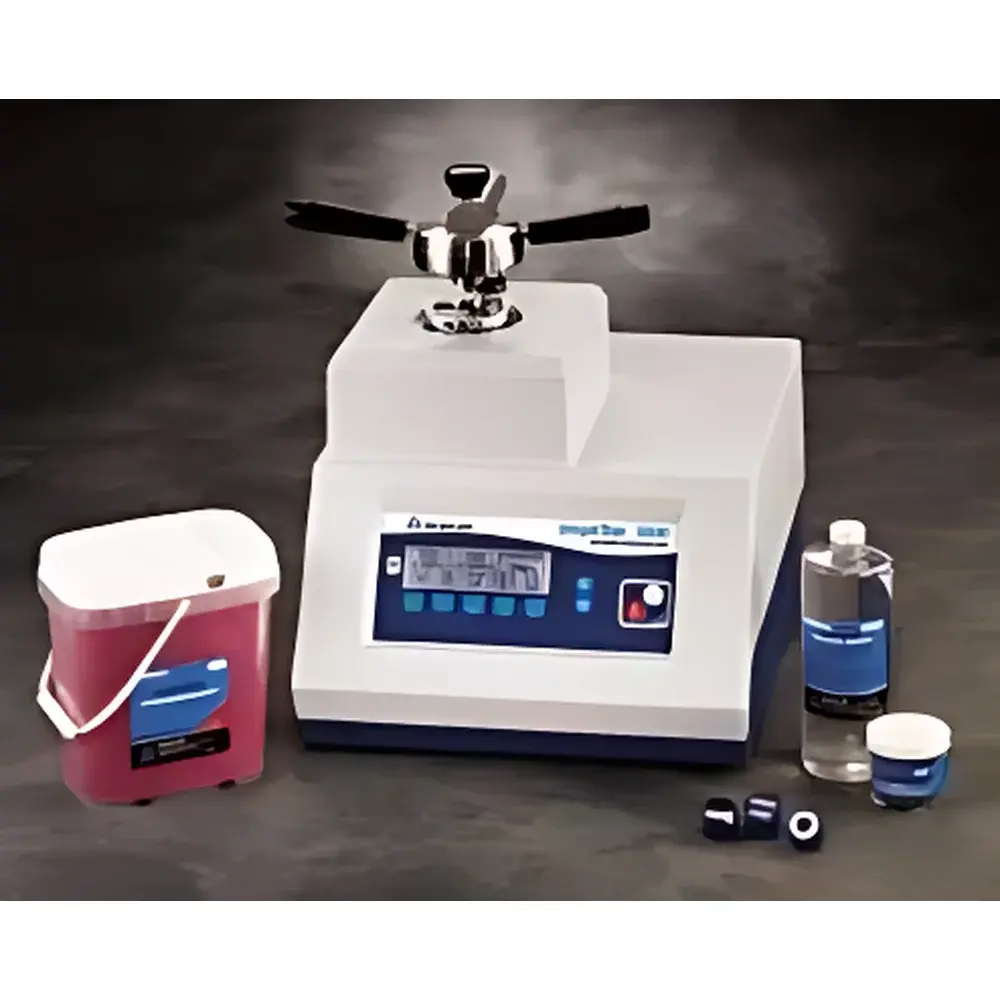
Buehler Simplimet 1000 Fully Automated Hot Mounting Press
| Brand | Buehler |
|---|---|
| Origin | USA |
| Model | Simplimet 1000 |
| Mounting Pressure Range | 80–300 bar (5-bar increments) |
| Temperature Range | 50–180 °C (10 °C increments) |
| Heating Time | 0–20 min (10-sec increments) |
| Cooling Time | 0–30 min (10-sec increments) |
| Heating Power | 1500 W @ 220 V |
| Control Voltage | 24 V DC |
| Dimensions (W×D×H) | 405 × 520 × 580 mm |
| Weight | 33 kg |
| Mold Diameters | 25 mm, 30 mm, 40 mm, 50 mm, 1", 1¼", 2" |
| Display | Touchscreen LCD with English/Chinese interface |
| Compliance | CE-marked, GLP-compatible control architecture, ISO 14644-1 Class 7 cleanroom-compatible operation |
Overview
The Buehler Simplimet 1000 is a fully automated hot mounting press engineered for precision, repeatability, and operator safety in metallurgical, materials science, and failure analysis laboratories. It employs thermosetting resin compression molding under controlled temperature and hydraulic pressure—principally utilizing the principles of thermal consolidation and viscous flow to embed specimens within a rigid, dimensionally stable matrix. Unlike manual or semi-automated systems, the Simplimet 1000 integrates a microprocessor-controlled electric-hydraulic actuation system that eliminates dependence on external compressed air sources, thereby reducing infrastructure requirements and enhancing operational reliability. Designed for routine use in QC/QA labs and R&D environments, it supports standardized specimen preparation per ASTM E3, ISO 14577, and ASTM E1558—ensuring compatibility with downstream metallographic procedures including grinding, polishing, and microscopic evaluation.
Key Features
- Fully automated cycle execution: Once parameters are set via the intuitive touchscreen interface, the system autonomously executes heating, compression, dwell, and cooling phases without manual intervention.
- Electric-hydraulic pressure generation: Delivers precise, programmable mounting pressures from 80 to 300 bar in 5-bar increments—enabling optimization for soft polymers, brittle ceramics, or high-density composites.
- Wide thermal range: Programmable temperature control from 50 °C to 180 °C (10 °C steps), compatible with epoxy, phenolic, acrylic, and conductive thermosetting resins.
- Dual-mode timing resolution: Heating and cooling durations configurable from 0 to 20 minutes and 0 to 30 minutes respectively, with 10-second granularity for fine-tuned process validation.
- Modular mold system: Supports standard cylindrical molds (25 mm, 30 mm, 40 mm, 50 mm, 1″, 1¼”, 2″) with interchangeable upper/lower plungers and dual-mold spacers to accommodate multi-specimen workflows.
- Thermally insulated mold cover with positive-lock positioning ensures uniform heat distribution and prevents operator contact during active cycles.
- 24 V DC low-voltage control architecture enhances electrical safety and electromagnetic compatibility in shared lab environments.
- Metric/imperial unit switching and multilingual UI (English/Chinese) support international deployment and cross-regional training protocols.
Sample Compatibility & Compliance
The Simplimet 1000 accommodates a broad spectrum of specimen geometries and material classes—including ferrous/non-ferrous metals, sintered powders, electronic components, geological cores, and composite laminates—provided they fit within specified mold dimensions and withstand prescribed thermal profiles. Its design adheres to CE Directive 2006/42/EC (Machinery Directive) and IEC 61000-6-2/6-3 for electromagnetic immunity and emissions. All control logic retains last-used parameter sets across power cycles, supporting GLP-aligned documentation practices. While not FDA 21 CFR Part 11 certified out-of-the-box, its deterministic control architecture permits integration into validated workflows when paired with audit-trail-capable LIMS or ELN platforms.
Software & Data Management
The Simplimet 1000 operates via embedded firmware with no external PC dependency. All process parameters—including pressure, temperature, time stamps, and cycle completion status—are logged internally and displayed in real time on the high-contrast LCD. The system supports manual override functions (e.g., emergency cooling, plunger retraction) with hardware interlocks. For traceability, users may export cycle logs via optional RS-232 or USB-to-serial adapters (sold separately), enabling integration with laboratory informatics systems for long-term data archiving and statistical process control (SPC) analysis.
Applications
- Preparation of cross-sectional samples for optical microscopy, SEM, and EDS analysis.
- Mounting of fragile or porous specimens requiring edge retention and dimensional stability.
- Embedding of electrically conductive samples using carbon-loaded or metal-filled resins for charge dissipation during SEM imaging.
- Routine QC mounting in foundries, aerospace component suppliers, and additive manufacturing facilities where batch consistency is governed by internal SOPs aligned with ISO/IEC 17025.
- Teaching laboratories requiring robust, repeatable instrumentation for undergraduate metallurgy and materials engineering curricula.
FAQ
Does the Simplimet 1000 require compressed air?
No—it uses an integrated electric-hydraulic system, eliminating the need for external air compressors or pneumatic infrastructure.
Can I run multiple specimens simultaneously?
Yes, using dual-mold spacers and compatible multi-cavity molds (e.g., 4×25 mm or 2×30 mm configurations), subject to thermal uniformity validation.
Is the system compatible with conductive mounting media?
Yes—its full temperature and pressure range supports carbon-impregnated epoxies and metallic filler resins commonly used for SEM sample preparation.
What maintenance is required?
Routine cleaning of mold surfaces and periodic inspection of hydraulic seals; no scheduled lubrication or calibration is mandated under normal operating conditions.
How is thermal uniformity verified across the mold cavity?
Buehler provides optional NIST-traceable calibration inserts and recommends quarterly verification using calibrated thermocouples placed at top/mid/bottom mold zones per ASTM E220.
Related Products



