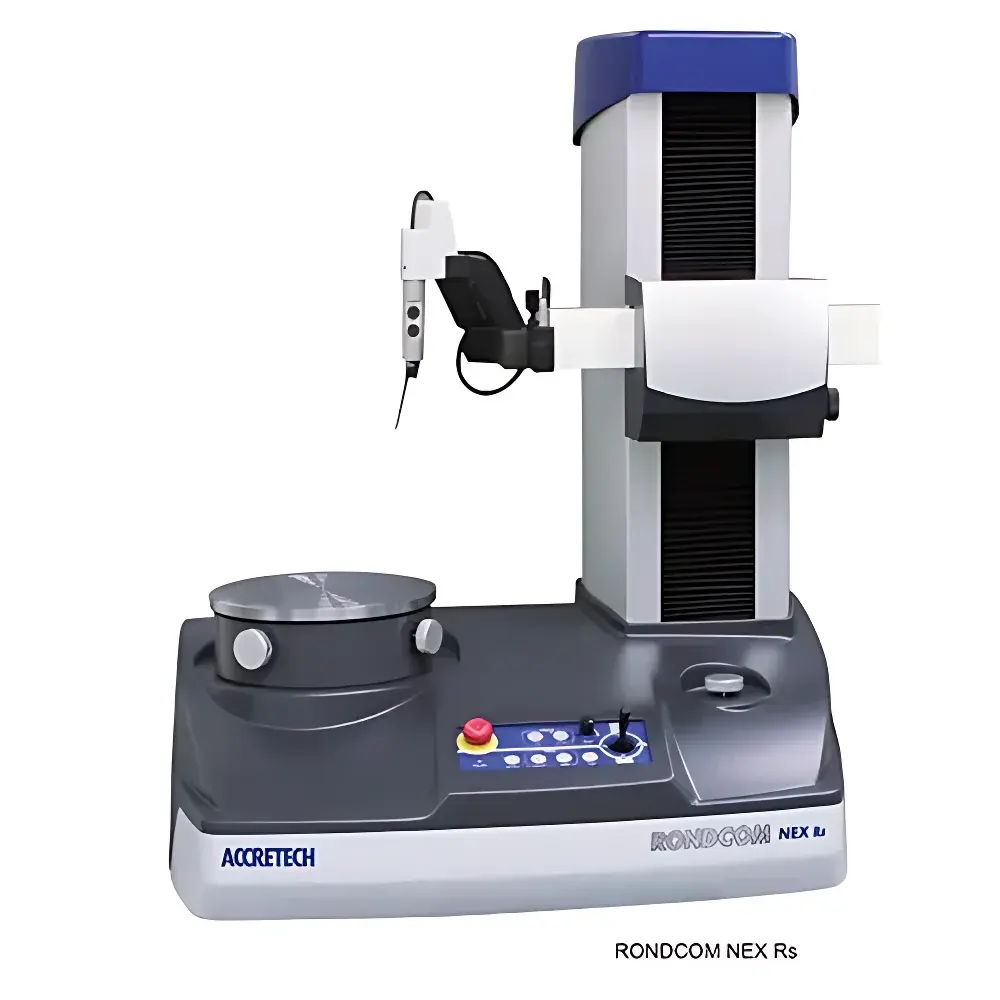
Accretech NEX Rs Cylindricity Measuring Instrument
| Brand | Accretech |
|---|---|
| Origin | Japan |
| Model | NEX Rs |
| Measurement Capabilities | Roundness, Cylindricity, Straightness (axis & surface), Parallelism, Perpendicularity, Coaxiality, Concentricity, Taper, Diameter, Radial Runout (single & total), Linearity of Cylindrical Generatrix, Surface Straightness (face), Face Runout, Flatness, Wall Thickness Variation, Angular Deviation, Small-Arc Radius, Piston Profile Analysis |
| Sensor Mount | Patented Offset-Type Holder (eliminates R-axis interference) |
| Software Platform | ACCTee Integrated Metrology Software (file-centric workflow, Windows-native GUI with icon-driven measurement, analysis, and reporting) |
Overview
The Accretech NEX Rs is a high-precision, benchtop cylindricity measuring instrument engineered for metrology laboratories and precision manufacturing environments requiring traceable, multi-parameter geometric form analysis. Based on the established principles of radial deviation measurement using high-resolution rotary indexing and vertical linear scanning, the NEX Rs employs a rigid granite base, air-bearing precision spindle (with angular repeatability ≤ 0.1 arcsec), and a vertically traversing tactile probe system to capture point-cloud data across cylindrical, planar, and complex rotational surfaces. Its core architecture adheres to ISO 1101 (Geometrical Product Specifications — Geometrical tolerancing), ISO 12181 (Roundness), and ISO 12780 (Straightness), enabling compliance-critical measurements in aerospace, automotive powertrain, hydraulic component, and medical device production where GD&T conformance is audited under AS9100, IATF 16949, or ISO 13485 frameworks.
Key Features
- Patented Offset-Type Sensor Holder: Eliminates mechanical interference between the probe arm and the rotating R-axis during measurement of complex geometries—including stepped shafts, flanged parts, and asymmetric components—without requiring manual repositioning or fixture redesign.
- Single-Mount Dual-Function Operation: Enables rapid transition between outer diameter (OD) and upper face (top surface) measurement by simply pivoting the sensor holder—no tool change, no recalibration, no realignment required.
- High-Stability Mechanical Architecture: Incorporates a massive granite base with vibration-damping feet, thermally stabilized spindle housing, and low-drift linear motion guides to ensure sub-micron thermal and dynamic stability over extended measurement cycles.
- Modular Probe Compatibility: Supports interchangeable stylus configurations—including diamond-tipped, spherical, and custom-profile probes—with automatic probe recognition and compensation via integrated calibration routines.
- Real-Time Data Integrity Monitoring: Embedded diagnostics continuously validate spindle speed consistency, probe deflection limits, and encoder signal integrity, flagging potential outliers before analysis completion.
Sample Compatibility & Compliance
The NEX Rs accommodates workpieces up to Ø300 mm × 500 mm height (standard configuration), with optional extensions for larger diameters. It supports both precision ground and as-machined surfaces, including hardened steels, ceramics, aluminum alloys, and polymer composites. All measurement routines are fully compatible with ISO/IEC 17025-accredited calibration protocols. The system’s uncertainty budget documentation aligns with EURAMET cg-19 (Guidelines on Cylindricity Calibration) and supports full traceability to NMI-Japan (National Metrology Institute of Japan) standards. Measurement reports include full audit trails, environmental condition logging (temperature, humidity), and operator identification—meeting GLP and GMP documentation requirements per FDA 21 CFR Part 11 when used with ACCTee’s electronic signature module.
Software & Data Management
ACCTee is a file-based, Windows-native metrology software platform designed to unify measurement acquisition, geometric evaluation, statistical process control (SPC), and report generation within a single environment. Its interface features context-sensitive icons, drag-and-drop profile alignment, and parameterized template libraries compliant with ISO GPS matrix definitions. All operations—from setup and calibration to tolerance assignment and pass/fail evaluation—are stored within self-contained .acx project files, ensuring full reproducibility and version control. Data export supports ASCII, CSV, DXF, and STEP AP214 formats; SPC charts (X̄–R, Cp/Cpk) are auto-generated from repeated measurements. ACCTee includes built-in GD&T symbol rendering, deviation color mapping (±µm heatmaps), and automated comparison against CAD nominal geometry (via optional Best-Fit alignment module).
Applications
- Aerospace turbine shafts and bearing races requiring certified cylindricity < 0.5 µm and coaxiality < 1.0 µm
- Automotive fuel injector nozzles and piston pins where wall thickness variation must be evaluated at multiple cross-sections
- Medical orthopedic implant stems demanding full-profile roundness and taper conformity per ASTM F2573
- Hydraulic pump rotors and valve spools requiring simultaneous assessment of radial runout, face runout, and generatrix straightness
- Optical lens mounts and precision bearing housings where perpendicularity between mounting face and bore axis must be verified to ±2 arcsec
- R&D validation of additive-manufactured cylindrical components exhibiting anisotropic surface topography
FAQ
What standards does the NEX Rs comply with for calibration and reporting?
The system complies with ISO 12181-1 (roundness), ISO 12780-1 (straightness), ISO 1101 (GD&T), and supports calibration traceability to JCSS-accredited laboratories in Japan.
Can ACCTee generate reports compliant with FDA 21 CFR Part 11?
Yes—when configured with user authentication, electronic signatures, and audit trail logging enabled, ACCTee meets Part 11 requirements for electronic records and signatures.
Is thermal drift compensation available during long-duration measurements?
The NEX Rs incorporates real-time ambient temperature monitoring and applies empirically derived thermal expansion corrections to vertical axis positioning based on material-specific coefficients.
Does the system support automated GD&T evaluation per ASME Y14.5–2018?
ACCTee implements ASME Y14.5–2018 datuming logic, including composite position tolerances, projected tolerance zones, and datum feature simulator modeling.
What is the typical measurement uncertainty for cylindricity on a 100-mm-diameter steel part?
Under controlled lab conditions (20 ± 0.5 °C, vibration isolation), expanded uncertainty (k=2) for cylindricity is ≤ 0.35 µm for parts within the standard measurement envelope.