
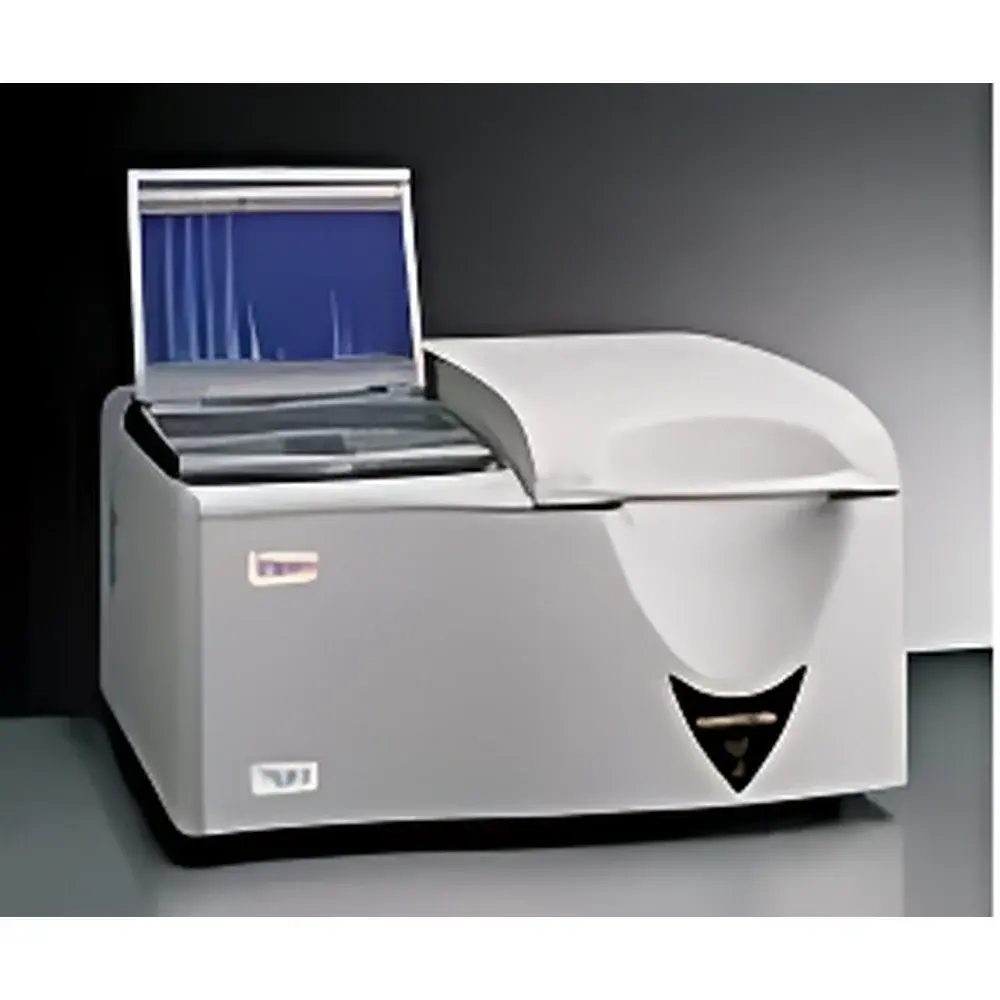
Thermo Scientific ARL QUANT’X Energy Dispersive X-Ray Fluorescence Spectrometer
| Brand | Thermo Fisher |
|---|---|
| Origin | Switzerland |
| Model | ARL QUANT'X EDXRF |
| Detection Limit | Sub-nanogram (sub-ng) level for many elements |
| Detector | Peltier-cooled Si(Li) |
| Excitation | Rh anode X-ray tube |
| Software | WinTrace™ |
| Compliance | Fully compatible with ISO 8258, ASTM E1621, IEC 62321 (RoHS), USP <232>/<233>, and GLP/GMP data integrity requirements |
| Sample Forms | Solids, powders, filters, thin films, liquids, and particulates |
Overview
The Thermo Scientific ARL QUANT’X Energy Dispersive X-Ray Fluorescence (EDXRF) Spectrometer is a benchtop analytical instrument engineered for high-precision, multi-element quantification across diverse sample matrices. Operating on the fundamental principle of energy-dispersive X-ray fluorescence, the system irradiates a sample with primary X-rays from a rhodium-target X-ray tube, inducing characteristic secondary (fluorescent) X-ray emission from constituent elements. These emitted photons are resolved by a thermoelectrically cooled silicon-lithium [Si(Li)] detector and processed via digital pulse processing (DPP) electronics to generate high-resolution spectra. Unlike wavelength-dispersive systems, EDXRF enables simultaneous detection of elements from sodium (Na, Z=11) to uranium (U, Z=92) without mechanical scanning—delivering rapid, non-destructive analysis with sub-nanogram detection limits for key transition metals and heavy elements under optimized conditions.
Key Features
- Peltier-cooled Si(Li) detector with <145 eV Mn Kα resolution at 0°C, ensuring high spectral fidelity and long-term stability without liquid nitrogen dependency
- Digital Pulse Processing (DPP) architecture enabling real-time dead-time correction, pile-up rejection, and adaptive baseline restoration
- High-power, variable-voltage (up to 50 kV) and current (up to 1 mA) Rh-anode X-ray tube with selectable filter sets for optimized excitation across light and heavy element ranges
- Motorized sample stage with programmable XYZ positioning and automatic height sensing for reproducible geometry control
- Compact footprint (60 × 55 × 45 cm) and integrated shock-absorbing chassis, certified for transport and field deployment per IEC 60068-2 environmental testing standards
- Modular vacuum and helium purge options for enhanced sensitivity to light elements (Na–F) in air-sensitive or low-Z applications
Sample Compatibility & Compliance
The ARL QUANT’X accepts heterogeneous samples in native form—no fusion or pelletization required—including pressed powders, suspended particulates on polycarbonate or quartz filters, dried liquid residues, thin-film coatings on substrates, and bulk solids up to 100 mm diameter. Its sample chamber accommodates standard 32-mm filter holders, 37-mm and 47-mm membrane filters, and custom fixtures for irregular geometries. From a regulatory standpoint, the platform supports full audit trails, electronic signatures, and 21 CFR Part 11–compliant user access controls when configured with WinTrace™ in validated mode. Method validation aligns with ISO/IEC 17025 requirements, and routine operation complies with ASTM E1621 (standard test method for elemental analysis by EDXRF), IEC 62321-5 (RoHS screening), and EPA Method 6200 (field portable XRF for soils).
Software & Data Management
WinTrace™ software provides a unified interface for acquisition, quantification, and reporting. It implements both fundamental parameter (FP) algorithms—accounting for matrix absorption, enhancement, and secondary fluorescence—and empirical calibration models using unlimited reference standards. The software supports multi-layer film analysis (e.g., plating thickness + composition), quantitative speciation of oxidation states (where applicable), and automated multi-condition measurement sequences (e.g., varying kV/filter for light/heavy element optimization). All raw spectra, processing parameters, and metadata are stored in a relational database with versioned method files, supporting full traceability and reprocessing. Export formats include ASTM E1348-compliant .csv, .xlsx, and .trc (binary spectrum) files for LIMS integration.
Applications
- RoHS/WEEE compliance screening of plastics, PCBs, and consumer electronics for Cd, Pb, Hg, Cr(VI), and Br-based flame retardants
- Environmental monitoring of airborne particulate matter (PM2.5/PM10) collected on filters for toxic metal profiling (As, Sb, Ni, V)
- Geochemical analysis of soil and sediment cores for contamination assessment (Pb, Zn, Cu, Mn, Fe)
- Quality control of nutritional supplements for elemental impurities per USP / and ICH Q3D guidelines
- Thin-film metrology in semiconductor and magnetic media manufacturing (NiFe, CoCrTa, Al2O3 layer thickness and stoichiometry)
- Forensic trace evidence analysis—including gunshot residue (GSR), paint chips, and glass fragments—without sample consumption
FAQ
Does the ARL QUANT’X require liquid nitrogen cooling?
No. The Si(Li) detector uses solid-state Peltier cooling, eliminating cryogenic handling and enabling continuous 24/7 operation.
Can it quantify light elements such as sodium or magnesium?
Yes—when operated under vacuum or helium purge, detection of Na (Z=11) through F (Z=9) is achievable with appropriate calibration and background modeling.
Is method transfer possible between different ARL QUANT’X units?
Yes. WinTrace™ supports export/import of fully validated methods—including spectral libraries, FP parameters, and calibration curves—with checksum verification to ensure cross-instrument reproducibility.
How does the system handle heterogeneous or irregularly shaped samples?
The motorized stage includes auto-height sensing and configurable ROI mapping; optional sample cups and collimators enable repeatable positioning of granular or powdered materials.
What documentation is provided for regulatory audits?
A complete validation package is included: IQ/OQ protocols, 21 CFR Part 11 configuration reports, electronic signature logs, and raw data archiving procedures compliant with GLP and ISO 17025 Annex A.5.
Related Products





