
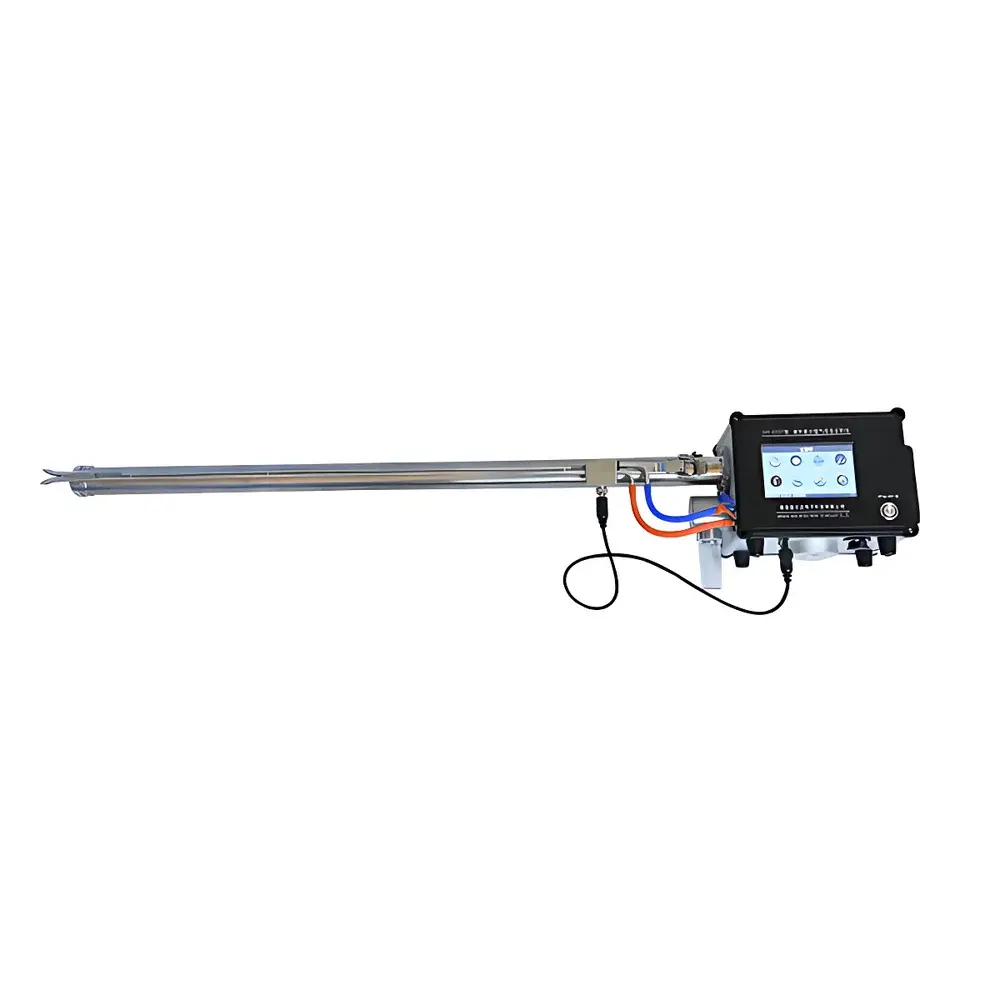
Genetec GH-6037 Portable UV-Differential Absorption Spectroscopy (DOAS) Flue Gas Analyzer with Integrated Battery
| Key | Brand: Genetec |
|---|---|
| Origin | Shandong, China |
| Manufacturer Type | Manufacturer |
| Model | GH-6037 |
| Instrument Type | Portable Flue Gas Analyzer |
| Measurement Principle | UV-Differential Absorption Spectroscopy (DOAS), Hot-Wet Method |
| Measured Gases | SO₂, NO, NO₂, NH₃ (O₂, CO, and additional O₂ sensors optional) |
| Accuracy | ≤ ±5% FS |
| Repeatability | ≤ 2.0% RSD |
| Response Time | ≤ 90 s (T₉₀) |
| Drift | ≤ 5.0% FS within 1 h |
| Compliance Standards | GB/T 37186–2018, HJ 1045–2019, JJG 968–2002, HJ/T 397–2007, HJ/T 76–2007, HJ/T 47–1999, HJ/T 44–2015, HJ 1131–2020, HJ 1132–2020 |
Overview
The Genetec GH-6037 is a fully integrated, battery-powered portable flue gas analyzer engineered for high-accuracy, real-time measurement of key combustion pollutants—including sulfur dioxide (SO₂), nitric oxide (NO), nitrogen dioxide (NO₂), and ammonia (NH₃)—directly in hot, humid, particulate-laden flue streams. It employs ultraviolet differential absorption spectroscopy (UV-DOAS) under hot-wet sampling conditions, eliminating the need for gas conditioning or dilution and preserving analyte integrity across variable moisture content (up to saturation). Unlike extractive cold-dry systems, the GH-6037 maintains the entire optical path—including sample cell, filter heater, and probe—above dew point (>180 °C typical), preventing SO₂ adsorption on wet surfaces and minimizing cross-interference from water vapor absorption bands. Its compact, ruggedized chassis houses a pulsed xenon light source, long-path absorption cell, and temperature-stabilized optical module, enabling sub-ppm detection limits and low thermal drift (<0.5% FS/°C) across ambient operating ranges of −20 °C to 50 °C.
Key Features
- Integrated hot-wet DOAS architecture: Full-path heating (probe, filter, gas cell) ensures representative, condensation-free sampling without chemical scrubbing or permeation drying.
- 5-inch wide-temperature TFT capacitive touchscreen with multi-modal control: Local UI, Bluetooth-enabled mobile app, and Ethernet/Wi-Fi remote configuration support field interoperability.
- Pulsed xenon cold-light source: Delivers stable UV output (200–400 nm) with >10⁷ shot lifetime, minimizing thermal load and spectral drift versus deuterium lamps.
- Optimized optical design: Molded UV-grade quartz optics, 1.2 m effective path length, and wavelength calibration via embedded Hg/Ne reference lines ensure long-term photometric stability.
- Modular sampling interface: Quick-release, rotatable Pitot tube assembly enables 0–90° angular adjustment for horizontal or vertical duct insertion; integrated thermocouple and humidity sensor provide simultaneous flue temperature, velocity, and moisture content calculation per HJ/T 397–2007.
- Vacuum-insulated heated gas chamber: Maintains constant internal temperature (±0.5 °C) independent of ambient or stack surface heat, critical for reproducible absorbance quantification.
- Triple-stage filtration: Stainless steel pre-filter + large-area PTFE membrane (0.2 μm) + hydrophobic final stage protects optical windows and extends service intervals beyond 200 hours in high-dust environments.
- Onboard condensate management: Dual-chamber water trap with auto-drain logic and vacuum-sealed pump protection prevents liquid ingress during extended sampling.
- Industrial-grade enclosure: IP54-rated sealed housing with shock-absorbing elastomer mounts meets MIL-STD-810G for drop, vibration, and thermal cycling resilience.
Sample Compatibility & Compliance
The GH-6037 is validated for direct analysis of raw flue gas from coal-fired boilers, waste incinerators, cement kilns, and catalytic cracking units—particularly where low-SO₂ (15% v/v) conditions challenge conventional electrochemical or NDIR analyzers. Its measurement methodology aligns with multiple regulatory frameworks: it satisfies the performance criteria defined in HJ 1045–2019 for portable UV-absorption instruments, supports compliance verification against GB/T 37186–2018 for SO₂/NOₓ quantification, and enables CEMS validation per HJ/T 76–2007 Annex D. The system’s hot-wet operation inherently complies with HJ/T 44–2015 requirements for zero-baseline stability and interference rejection, while its data logging architecture incorporates audit-trail metadata (operator ID, GPS stamp, calibration timestamp) compatible with GLP/GMP documentation workflows.
Software & Data Management
Firmware v3.2 includes embedded data acquisition firmware compliant with ISO/IEC 17025 traceability requirements. Each measurement record stores raw spectra, processed absorbance integrals, environmental parameters (T, P, RH), and diagnostic flags (lamp energy, cell temperature, flow rate). Internal storage retains ≥1 million timestamped records (1-min averaging default); export options include USB mass-storage mode (CSV/Excel), Bluetooth printing to portable thermal printers, and secure TLS 1.2 upload to cloud-based emission monitoring platforms. Calibration history, user access logs, and fault codes are retained separately with SHA-256 hashing for integrity verification—supporting FDA 21 CFR Part 11 electronic signature readiness when paired with external identity management.
Applications
- Field verification of continuous emission monitoring systems (CEMS) during performance qualification and periodic accuracy audits.
- Ammonia slip monitoring downstream of SCR/SNCR denitrification units in power plants and industrial furnaces.
- Stack testing for EPA Method 18 / ISO 15712-2 equivalent measurements under varying load conditions.
- Mobile source emissions screening at municipal waste facilities, biomass co-firing sites, and marine engine exhaust stacks.
- Research-grade speciation studies requiring simultaneous multi-gas quantification without interconversion artifacts (e.g., NO₂ ↔ N₂O₄ equilibrium preservation).
FAQ
Does the GH-6037 require zero/span calibration before each use?
No—factory-calibrated with NIST-traceable gas standards; field verification using certified span gases is recommended every 72 hours or after maintenance.
Can the instrument measure O₂ and CO simultaneously with UV gases?
Yes—optional electrochemical O₂ and CO sensors integrate seamlessly into the same sampling stream; all data are time-synchronized and reported in a unified dataset.
What is the maximum allowable flue gas temperature at the probe inlet?
The heated probe withstands continuous exposure up to 200 °C; for higher-temperature applications (>200 °C), an optional ceramic-coated extension sleeve is available.
How is moisture interference mitigated in UV-DOAS measurement?
By maintaining the entire optical path above dew point and applying spectral deconvolution algorithms that mathematically separate H₂O absorption features from target gas cross-sections—per the methodology validated in HJ 1131–2020.
Is remote firmware update supported?
Yes—over-the-air (OTA) updates via Wi-Fi or cellular modem (optional module) preserve regulatory compliance during evolving method revisions.







