
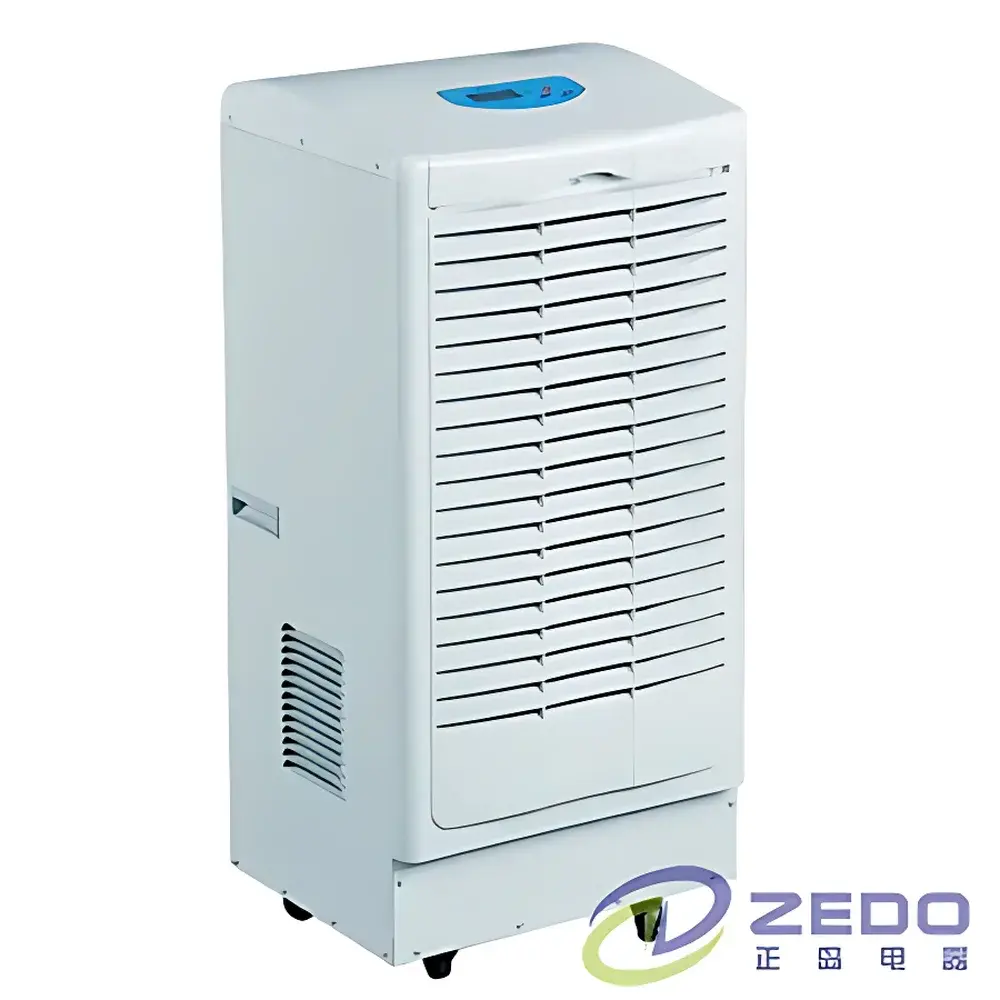
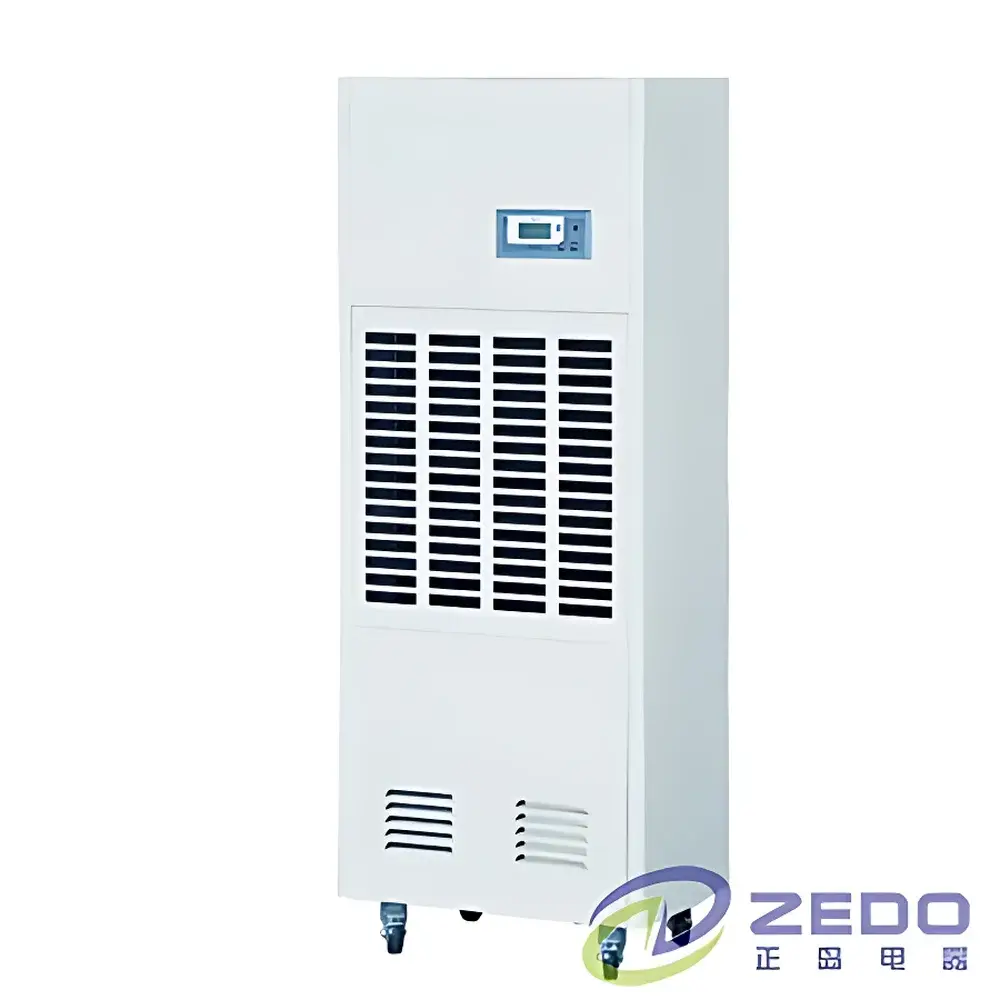
ZEDO ZD-8138C Industrial Desiccant Dehumidifier for Electronics Manufacturing Environments
| Brand | ZEDO |
|---|---|
| Origin | Zhejiang, China |
| Manufacturer Type | OEM/ODM Manufacturer |
| Country of Origin | China |
| Model | ZD-8138C |
| Instrument Type | Compressor-Based Refrigerant Dehumidifier |
| Dehumidification Capacity | 138 L/day (36.5 gal/day) |
| Control Method | Microprocessor-Based Humidity Setpoint Control |
| Drainage | Continuous via PVC Drain Hose |
| Power Supply | 220 V AC, 50 Hz |
| Input Power | 2000 W |
| Operating Temperature Range | 5–38 °C |
| Noise Level | ≤50 dB(A) |
| Dimensions (W×D×H) | 480 × 430 × 1100 mm |
| Net Weight | 58 kg |
| Air Filtration | Standard Activated Carbon + Particle Filter |
| Safety Protections | Three-Minute Compressor Delay, High/Low Pressure Switches, Overload & Undervoltage Protection |
| Sensor | Japanese Shinyo High-Accuracy Hygrothermograph |
Overview
The ZEDO ZD-8138C is an industrial-grade refrigerant dehumidifier engineered specifically for controlled environments where precise humidity management is critical to process integrity and product reliability—particularly electronics manufacturing cleanrooms, SMT assembly areas, component storage vaults, and precision instrument calibration labs. It operates on the principle of mechanical refrigeration: ambient air is drawn across a finned-tube evaporator coil cooled below the dew point, causing moisture to condense and drain as liquid water; the now-dry air is then reheated via the condenser coil to maintain near-ambient discharge temperature while significantly reducing relative humidity (RH). This thermodynamic cycle ensures stable RH control in the range of 40–60 %, which aligns with IPC-J-STD-033 guidelines for moisture-sensitive device (MSD) handling and long-term storage of PCBAs, ICs, and passive components.
Key Features
- Robust compressor-based architecture using a high-efficiency scroll compressor and environmentally compliant R-410A refrigerant, delivering consistent dehumidification performance under continuous duty cycles.
- Optimized heat exchanger design featuring internally grooved copper tubing with hydrophilic aluminum fins, maximizing latent heat transfer and minimizing frost accumulation during low-temperature operation.
- Dual centrifugal fan system with external rotor motors provides high-volume airflow (>850 m³/h) at low acoustic emission (≤50 dB[A]), ensuring uniform humidity distribution without disruptive noise in operator-intensive zones.
- Microcontroller-driven interface with Japanese Shinyo hygrometer and thermistor sensors enables ±3 % RH accuracy and programmable setpoint control (30–80 % RH), with real-time display of current RH, temperature, and operational status.
- Integrated safety architecture includes compressor delay circuitry, high/low pressure cutouts, thermal overload protection, undervoltage sensing, and automatic fault diagnostics—displayed via LED indicators for rapid maintenance response.
- Modular mechanical layout separates airflow and refrigerant circuits, facilitating service access to filters, coils, and electrical components without system depressurization or refrigerant recovery.
Sample Compatibility & Compliance
The ZD-8138C is validated for use in ISO Class 7–8 cleanroom-adjacent environments and conforms to key regional and industry-specific requirements for humidity-critical infrastructure. Its design supports compliance with IPC-J-STD-033 Revision D (Moisture Sensitivity Level classification), IEC 60068-2-30 (damp heat cyclic testing), and ASTM D4332 (standard practice for conditioning containers, packages, or packaging components for testing). While not certified to UL 1995 or CE EN 60335-2-40 out-of-the-box, its electrical components—including Schneider contactors, Siemens thermal relays, and ABB circuit breakers—meet IEC 60947 standards. Units are supplied with factory calibration certificates traceable to NIM (National Institute of Metrology, China) for humidity and temperature sensors.
Software & Data Management
The ZD-8138C operates as a standalone, embedded-control appliance with no cloud connectivity or proprietary software dependency. All configuration, monitoring, and alarm logging occur locally via the front-panel LCD and tactile interface. Event history—including runtime hours, compressor cycles, sensor drift alerts, and fault codes—is retained in non-volatile memory for up to 12 months and accessible via diagnostic mode. For integration into facility-wide environmental monitoring systems (EMS), optional 4–20 mA analog outputs (RH and temperature) and Modbus RTU (RS-485) communication are available upon request—enabling audit-ready data capture compatible with FDA 21 CFR Part 11–compliant SCADA platforms when paired with validated data loggers.
Applications
- Electronics manufacturing: SMT reflow staging zones, MSD dry cabinets, bare PCB warehousing, and post-assembly aging rooms.
- Quality assurance laboratories: Calibration of hygrometers, reference standard storage, and stability testing chambers.
- Critical infrastructure: Bank vaults, archival document repositories, museum artifact storage, and medical device sterilization prep areas.
- Industrial metrology: Coordinate measuring machine (CMM) rooms, laser interferometer enclosures, and optical alignment benches requiring sub-45 % RH to prevent lens fogging or thermal drift.
- Pharmaceutical secondary packaging: Blister pack sealing lines and lyophilized product staging where residual moisture compromises barrier integrity.
FAQ
What is the recommended relative humidity setpoint for electronics assembly areas?
For moisture-sensitive devices per IPC-J-STD-033, the target RH range is 30–60 %, with 40–50 % being optimal for SMT line environments to balance ESD control and solder paste rheology.
Can the ZD-8138C operate continuously at 5 °C ambient temperature?
Yes—the unit is rated for continuous operation between 5–38 °C; however, below 15 °C, defrost cycling frequency increases, and dehumidification capacity may reduce by up to 25 % due to lower vapor pressure differential.
Is the unit suitable for installation in a positive-pressure cleanroom?
It can be installed externally with ducted intake/exhaust; internal placement requires confirmation that airflow resistance does not compromise room pressure differentials or particle count compliance.
Does the unit include data logging capability for GMP/GLP audits?
Standard configuration logs only operational events; full audit-trail data logging requires optional RS-485 interface and third-party validated EMS software.
What maintenance intervals are recommended for optimal performance?
Air filter cleaning every 2 weeks; evaporator and condenser coil inspection every 3 months; refrigerant charge verification annually or after compressor replacement.



