RhizoAnalysis Root Phenotyping Software by PM-Tech
| Brand | PM-Tech |
|---|---|
| Origin | Germany |
| Model | RhizoAnalysis |
| Licensing | Perpetual License (Local Installation) |
| System Requirements | Windows 7–10 (32/64-bit) |
| Language Support | English, Simplified Chinese, Traditional Chinese |
| Compliance | ISO/IEC 17025-aligned data traceability framework, GLP-compatible metadata logging |
Overview
RhizoAnalysis is a specialized root phenotyping software platform developed by PM-Tech (Germany) for quantitative morphological and topological analysis of plant root systems captured via high-resolution root scanning—typically following excavation, hydroponic imaging, or rhizobox-based digitization. Engineered for reproducible, operator-independent root trait extraction, the software implements calibrated image segmentation algorithms grounded in grayscale thresholding, color-space decomposition (RHS & CIELAB-derived UCL), and skeleton-based graph theory to reconstruct root architecture from 2D digital images. Its core analytical engine supports both static snapshot analysis and longitudinal comparative studies, making it suitable for controlled-environment phenotyping pipelines, stress physiology experiments (e.g., drought, salinity, nutrient deficiency), and ecological root-soil interaction modeling.
Key Features
- Automated Root Segmentation: Adaptive color thresholding and multi-channel intensity masking enable robust separation of root structures from heterogeneous backgrounds (soil particles, agar, water media) without manual tracing.
- Comprehensive Morphometric Quantification: Computes standardized traits per root segment—including length, diameter distribution (weighted mean, min/max, SD), surface area, projected area, volume estimation (via cylinder approximation), tip count, and branching density.
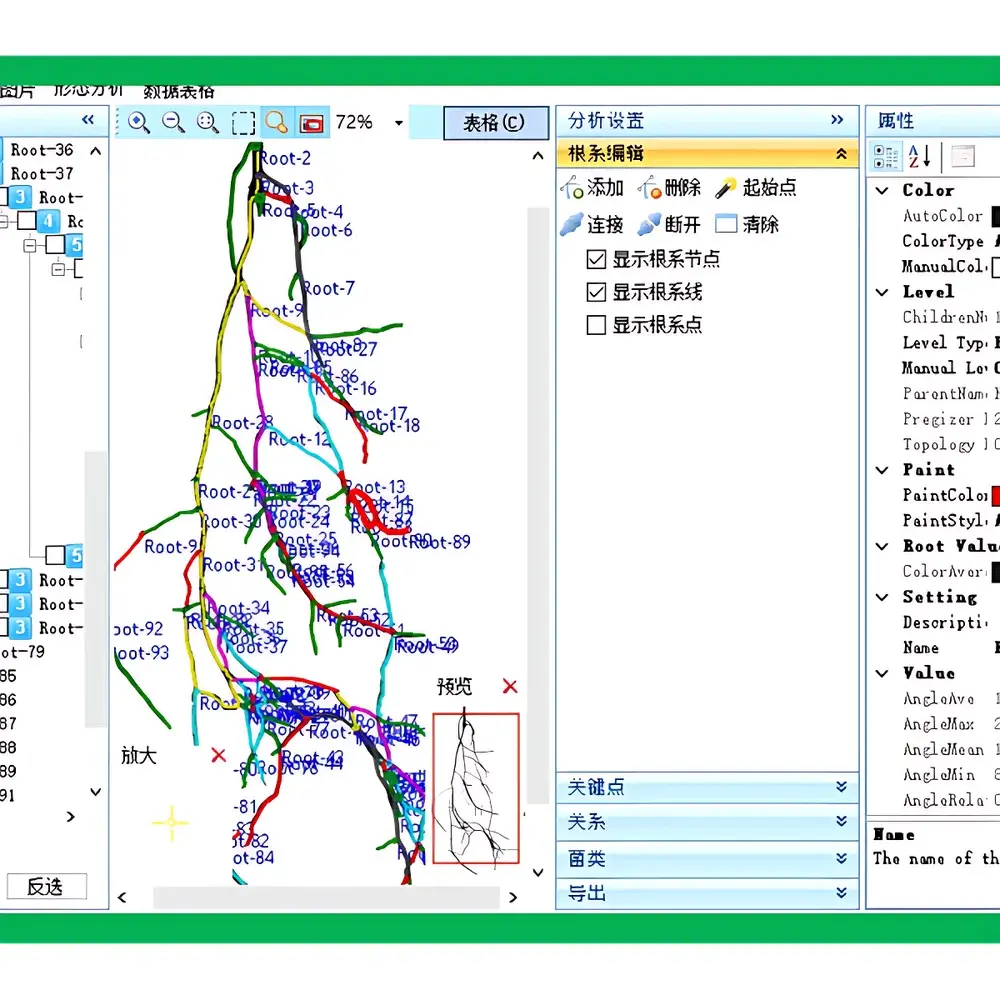
- Topological Architecture Analysis: Constructs hierarchical parent-child root graphs using three configurable classification schemes: Pregizer (order-based), Topology (linkage-based), and Custom (user-defined node rules). Outputs order-specific metrics: mean diameter per order, angular deviation, projection area decay, length variance, and connection number.
- Color-Based Viability Assessment: Integrates RHS (Royal Horticultural Society) and UCL (University College London) color space models to classify root segments by hue, saturation, and lightness—enabling semi-quantitative viability mapping (e.g., distinguishing live vs. senesced tissue based on chromatic shifts).
- Metadata-Embedded Workflow: Supports time-stamped acquisition logs, georeferenced field metadata, experimental condition tagging (treatment ID, replication number), and user annotations—ensuring full traceability under GLP/GMP-aligned study protocols.
- Post-Processing Flexibility: Includes non-destructive image adjustment tools: DPI normalization, geometric rotation, contrast enhancement, unsharp masking, and resolution-preserving rescaling—critical for cross-lab dataset harmonization.
Sample Compatibility & Compliance
RhizoAnalysis accepts TIFF, PNG, BMP, and JPEG inputs at ≥300 DPI with 8–16-bit depth. It is validated for scanned root images obtained from flatbed scanners (Epson Perfection V850, Canon CanoScan 9000F Mark II), macro photography setups, and rhizotron imaging systems. The software adheres to FAIR (Findable, Accessible, Interoperable, Reusable) data principles: all output tables include column headers compliant with MIAPPE (Minimum Information About a Plant Phenotyping Experiment) v1.1. Audit trails record parameter adjustments, threshold changes, and export timestamps—supporting 21 CFR Part 11 readiness when deployed with validated Ukey hardware encryption modules. Exported CSV/Excel files retain full metadata linkage for downstream integration into R, Python (scikit-image, NetworkX), MATLAB, or SPSS environments.
Software & Data Management
Data management follows a project-centric architecture: each experiment is stored as an independent .rpa project file containing embedded images, processed skeletons, topology graphs, and relational metadata. Batch processing enables parallel analysis of multi-treatment datasets with consistent parameter sets. All visual outputs—including root overlays, order heatmaps, angle distribution histograms, and color-coded viability maps—are fully editable: axis labels, legend positions, color palettes, and font sizing are adjustable prior to export. Charts export natively as SVG (vector) or high-DPI PNG; tabular results support direct Excel (.xlsx) export with formula-free formatting, preserving numeric precision and unit annotations (mm, mm², mm³, °). No cloud dependency: all computation occurs locally, satisfying institutional data sovereignty requirements.
Applications
- Root system architecture (RSA) phenotyping in model species (Arabidopsis, rice, maize) and crops (wheat, soybean, tomato)
- Evaluation of genetic variation in root plasticity under abiotic stress (water deficit, aluminum toxicity, low phosphorus)
- Quantifying root decay dynamics during senescence or pathogen infection
- Validating root growth simulations in functional-structural plant models (FSPMs)
- Standardizing root trait reporting for QTL mapping and genome-wide association studies (GWAS)
- Supporting OECD Test Guideline 208 (terrestrial plant toxicity) and ISO 11269-2 (soil ecotoxicity) root endpoint assessments
FAQ
Is RhizoAnalysis compatible with Mac or Linux operating systems?
No—RhizoAnalysis is built exclusively for Windows 7 through Windows 10 (both 32-bit and 64-bit editions). Virtual machine deployment is not officially supported due to hardware-level USB key (Ukey) authentication requirements.
Does the software require internet connectivity for activation or routine use?
Activation requires one-time online validation via PM-Tech’s license server; thereafter, operation is fully offline. No telemetry, cloud sync, or periodic re-authentication is performed.
Can RhizoAnalysis process images from X-ray CT or MRI root scans?
It is optimized for 2D planar root images (scanned excavated roots or rhizobox surfaces). While binary masks from segmented 3D volumes can be imported as 2D projections, native 3D reconstruction or voxel-based analysis is outside its scope.
How does RhizoAnalysis ensure measurement reproducibility across users?
Through deterministic thresholding algorithms, immutable project files, and embedded calibration markers (e.g., scale bar detection), the software eliminates subjective operator input after initial image import—enabling inter-laboratory repeatability studies compliant with ISO 5725-2.
Is technical support available in English for international institutions?
Yes—PM-Tech provides English-language documentation, video tutorials, and email-based engineering support (response within 3 business days). On-site training and method validation assistance are available upon request.