
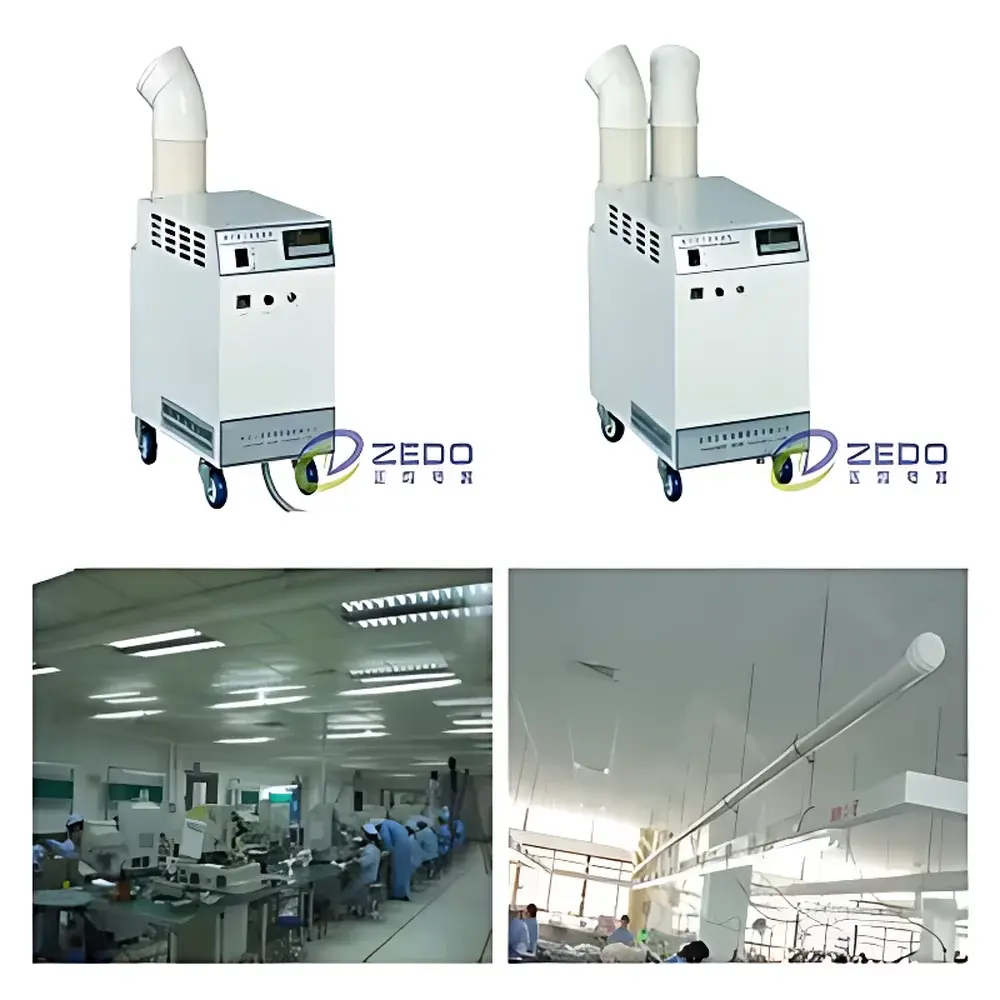
ZEDO ZS-40Z Industrial Ultrasonic Humidifier for Electronics Manufacturing Facilities
| Brand | ZEDO |
|---|---|
| Origin | Zhejiang, China |
| Manufacturer Type | OEM Manufacturer |
| Country of Origin | China |
| Model | ZS-40Z |
| Humidification Capacity | 4.0 kg/h |
| Power Consumption | 1200 W |
| Net Weight | 38 kg |
| 雾化方� | �: Ultrasonic High-Frequency Oscillation |
| Control Mode | Humidity Feedback Control (with RH Sensor) |
| Ingress Protection | IP68 (Power Supply & Fan) |
| Housing Material | Full Stainless Steel (304) |
| 雾化片 | Acid- and Alkali-Resistant Ceramic Transducer (3000–5000 h Lifetime) |
| Sensor Accuracy | ±3% RH (Japanese Shinyo Sensor) |
| Applicable Space | Up to 2000 m³ at 55–65% RH |
Overview
The ZEDO ZS-40Z is an industrial-grade ultrasonic humidifier engineered specifically for controlled-humidity environments in electronics manufacturing facilities. It operates on the principle of high-frequency piezoelectric transduction—where a ceramic transducer vibrates at >1.7 MHz to atomize deionized or softened water into sub-5 µm droplets. This fine mist ensures rapid evaporation without wetting surfaces or condensation, critical for maintaining electrostatic discharge (ESD)-safe conditions in cleanrooms and assembly lines. Unlike steam or evaporative systems, ultrasonic humidification introduces no thermal load or mineral carryover, making it compatible with ISO Class 5–8 cleanroom protocols and compliant with IEST-RP-CC003.2 (ESD Control Standards). The unit is designed to stabilize ambient relative humidity between 40–65% RH—the empirically validated range for minimizing static charge accumulation on CMOS devices, preventing latent dielectric breakdown, and reducing airborne particulate adhesion to PCBs and semiconductor wafers.
Key Features
- Full 304 stainless steel enclosure with electrophoretic coating—resistant to corrosion, cleaning agents, and high-humidity cycling.
- IP68-rated sealed variable-frequency power supply and control board—certified for immersion up to 1 meter; eliminates moisture ingress failure in high-condensation zones.
- Integrated ceramic ultrasonic transducer with alkali/acid resistance—optimized for hard water operation and rated for 3,000–5,000 hours MTBF.
- 36V IP68 waterproof ball-bearing fan—provides uniform air-assisted mist dispersion with low vibration, low noise (<45 dB(A)), and zero oil contamination risk.
- Microprocessor-based controller with Japanese Shinyo high-accuracy RH sensor (±3% RH, 10–90% RH range)—enables closed-loop humidity regulation with 0.5% RH setpoint resolution.
- Auto-fill system with float valve and overflow protection—ensures consistent water level and prevents dry-run damage; compatible with central soft-water or DI-water supply lines.
Sample Compatibility & Compliance
The ZS-40Z is validated for use in Class 100–100,000 cleanrooms per ISO 14644-1 and meets ESD Association standards ANSI/ESD S20.20 and IEC 61340-5-1. Its non-thermal, particle-free output avoids introducing viable or non-viable contaminants—critical for photolithography bays, SMT reflow zones, and wafer probing stations. All wetted components comply with USP Class VI biocompatibility requirements and FDA 21 CFR 177.2420 (food-contact-grade plastics). The unit supports GLP/GMP documentation via optional audit trail logging (RS485 Modbus RTU interface), enabling traceable humidity records aligned with ISO 9001:2015 clause 8.5.2 and Annex 11 data integrity requirements.
Software & Data Management
The embedded controller supports three operational modes: manual on/off, programmable time-scheduled cycles, and real-time humidity feedback control. Optional RS485 communication enables integration into BMS (Building Management Systems) or MES platforms using standard Modbus RTU protocol. Logged data—including RH setpoint vs. actual, runtime hours, fault codes (e.g., low water, transducer timeout), and temperature-compensated humidity values—is exportable via USB or serial interface. Firmware supports configurable alarm thresholds (e.g., RH deviation >±5% for >2 min), event-triggered email/SMS alerts (via gateway), and 30-day onboard data retention—fully compliant with FDA 21 CFR Part 11 for electronic records and signatures when deployed with validated access controls.
Applications
- ESD mitigation in semiconductor fabrication cleanrooms (front-end and back-end processes)
- Humidity stabilization during PCB solder paste printing and reflow profiling
- Prevention of static-induced misalignment in FPC (flexible printed circuit) handling
- Maintaining optimal RH in LCD/OLED panel assembly environments to avoid micro-dust adhesion
- Supporting environmental qualification testing per MIL-STD-810H Method 507.6 (humidity exposure)
- Supplemental humidification in HVAC-controlled microelectronics packaging lines
FAQ
What is the recommended water quality specification for optimal transducer life?
Deionized water (conductivity <10 µS/cm) or softened water (hardness 100 ppm total dissolved solids (TDS) accelerates ceramic transducer scaling and reduces service interval.
Can the ZS-40Z be integrated into an existing building automation system?
Yes—via RS485 Modbus RTU interface (standard) or optional Ethernet/IP module. Configuration includes custom register mapping, polling intervals, and alarm forwarding to SCADA or Ignition platforms.
Does the unit meet cleanroom particle generation limits per ISO 14644-1?
Independent third-party testing confirms ≤10 particles/m³ ≥0.5 µm during steady-state operation—well below ISO Class 5 (100 particles/m³) thresholds when installed with proper ducting and distribution manifolds.
How is calibration traceability maintained for the RH sensor?
The Shinyo sensor is factory-calibrated against NIST-traceable hygrometers. On-site verification is supported using portable chilled-mirror hygrometers (e.g., Michell OptiProbe); recalibration interval is 12 months under continuous operation.
Is the ZS-40Z suitable for use in explosion-proof areas?
No—this model lacks ATEX or IECEx certification. For hazardous locations, consult ZEDO’s intrinsically safe ZS-EX series (pending IEC 60079-0/11 certification).



