
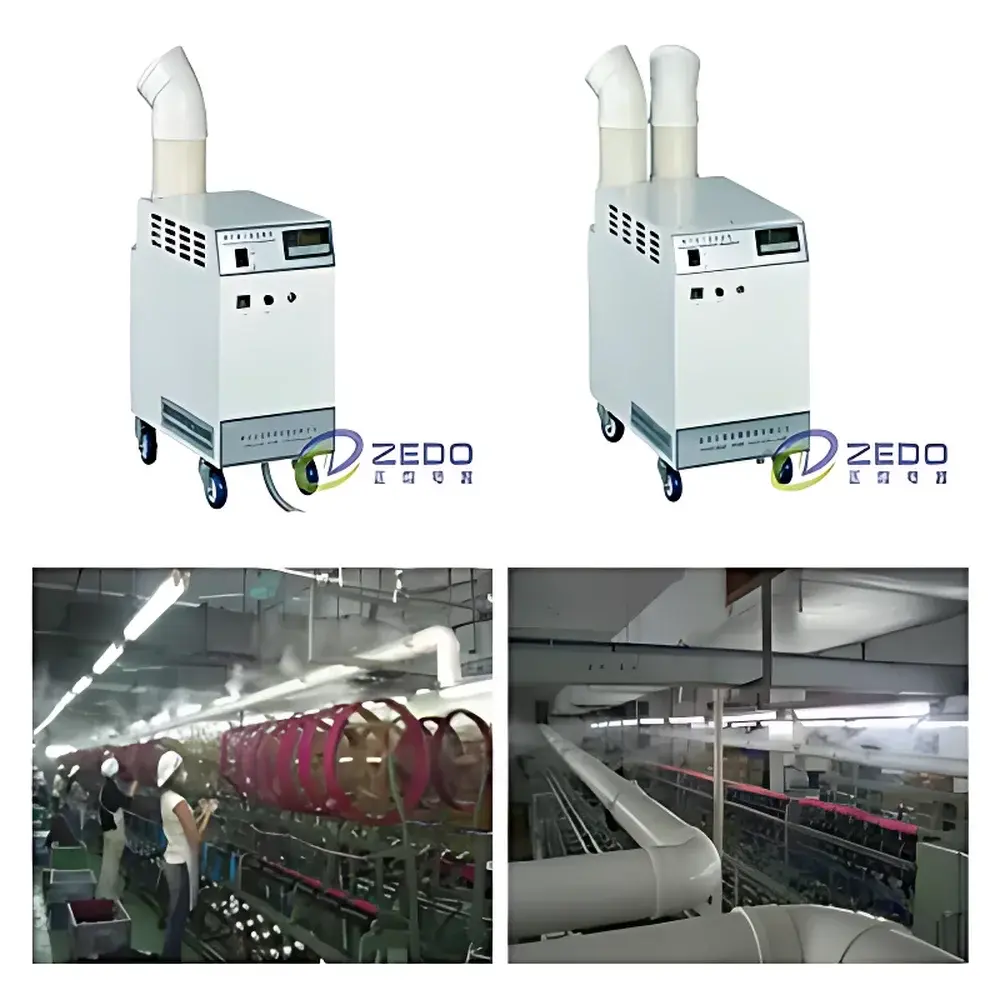
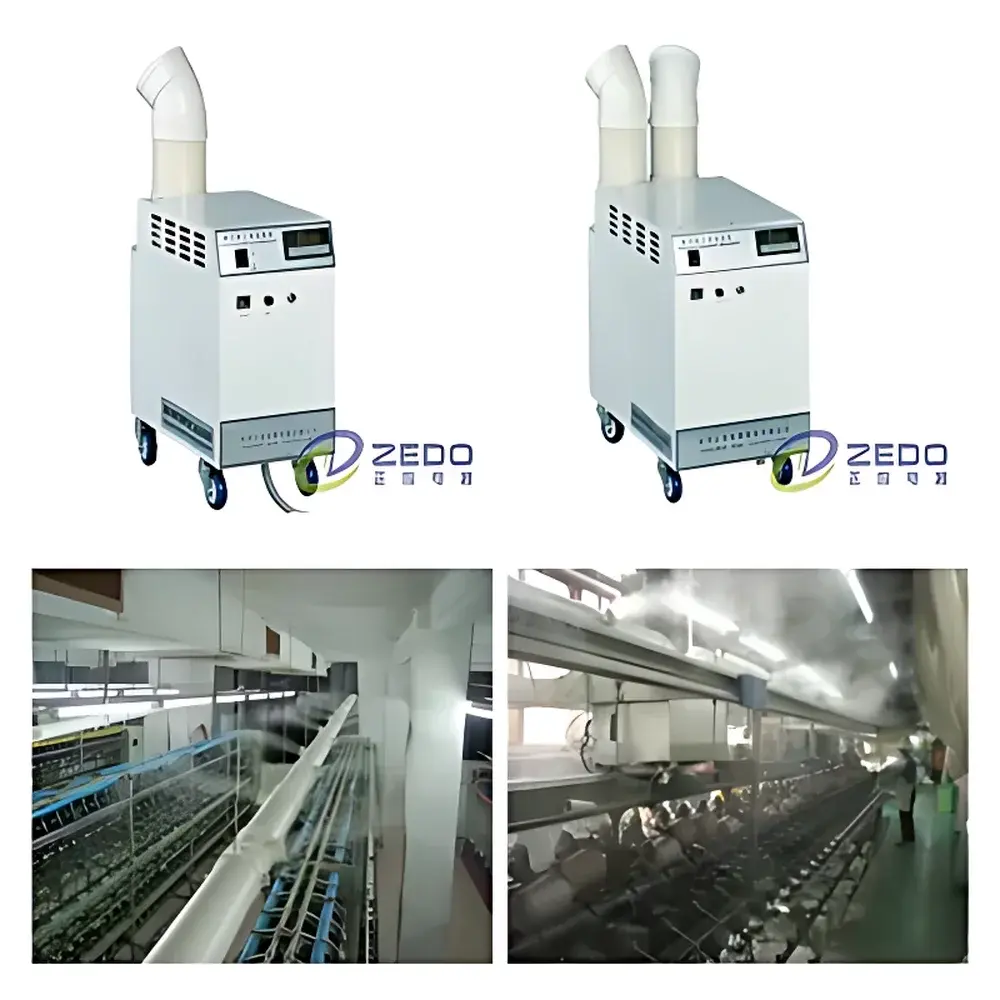
ZEDO ZS-40Z Ultrasonic Industrial Humidifier for Textile Manufacturing
| Brand | ZEDO |
|---|---|
| Origin | Zhejiang, China |
| Manufacturer Type | Direct Manufacturer |
| Model | ZS-40Z |
| Humidification Capacity | 12 kg/h |
| Power Consumption | 1200 W |
| Control Mode | Humidity Feedback (with Japanese Shinyei High-Accuracy RH Sensor) |
| 雾化方� | �: Four-Nozzle Mist Distribution |
| Enclosure Material | Full Stainless Steel (304) |
| IP Rating | IP68 Waterproof Power Supply & Fan |
| Ultrasonic Frequency | ≥1.7 MHz |
| Ceramic Transducer Lifespan | 3000–5000 hours |
| Operating Voltage | 36 V DC (Fan), 220 V AC (Unit) |
| Certifications | CE-compliant design, GLP-supporting control log architecture |
Overview
The ZEDO ZS-40Z Ultrasonic Industrial Humidifier is an engineered environmental control solution designed specifically for textile manufacturing facilities where precise, stable relative humidity (RH) maintenance is critical to process integrity and product quality. Unlike evaporative or steam-based systems, the ZS-40Z employs high-frequency ultrasonic transduction (≥1.7 MHz) to atomize deionized or softened water into sub-10 µm droplets—enabling rapid vapor-phase integration without condensation, drip risk, or thermal load. This principle ensures near-instantaneous RH response in large-volume production halls (up to 3,000 m³ per unit) while supporting localized microclimate adjustment at spinning, weaving, or winding stations. Its operation is grounded in piezoelectric energy conversion: electrical input drives ceramic transducers to oscillate at resonant frequency, shearing surface water into fine mist carried by a sealed, corrosion-resistant airflow system. The device is not a laboratory-grade analytical instrument but a GMP-aligned industrial environmental conditioner—deployed in cleanroom-adjacent textile QC labs, yarn testing chambers, and pilot-scale weaving environments where RH deviation directly impacts tensile strength, elongation, static charge accumulation (per ASTM D257), and fiber cohesion.
Key Features
- Full 304 stainless steel enclosure with powder-coated finish—resistant to alkaline cleaning agents, textile sizing residues, and ambient humidity-induced corrosion.
- Integrated ultrasonic transducer module with auto-shutoff dry-run protection and ceramic diaphragms rated for 3,000–5,000 operational hours under hard-water conditions (tested per ISO 11784 for durability).
- IP68-rated sealed variable-frequency power supply and 36 V DC waterproof fan—certified for submersion up to 1 meter; eliminates moisture ingress failure modes common in textile mill environments.
- Four-channel mist distribution system with adjustable nozzles—enables uniform saturation across ceiling-mounted ducted arrays or targeted delivery via flexible PVC tubing (ID 8 mm).
- Microprocessor-based controller with Shinyei HS-2000 series capacitive RH sensor (±2% RH accuracy, 0–95% RH range)—supports programmable setpoints, hysteresis tuning, and real-time logging via RS-485 Modbus RTU interface.
- Auto-fill system with float valve and overflow cutoff—compatible with centralized soft-water supply lines or standalone 50 L reservoirs; includes sediment filter housing (25 µm).
Sample Compatibility & Compliance
The ZS-40Z is compatible with municipal tap water (when pre-filtered), softened water, and deionized water—optimized for feed conductivity ≤150 µS/cm to prevent transducer scaling. It meets mechanical safety requirements aligned with IEC 60335-1 and electromagnetic compatibility per EN 61000-6-3/6-4. While not an ISO/IEC 17025-accredited measurement device, its humidity regulation performance supports compliance with textile-specific standards including ASTM D1776 (Conditioning Textiles), ISO 139 (Standard Atmosphere for Testing), and GB/T 6529 (Chinese national standard for textile conditioning). Data logging functionality—including timestamped RH readings, runtime hours, and fault codes—is structured to support GLP audit trails when integrated with validated SCADA systems.
Software & Data Management
The unit operates via embedded firmware (v3.2+) with no external PC dependency. Configuration is performed through a backlit LCD touchscreen with tactile membrane keys—supporting multi-language UI (English, Spanish, Chinese). All operational parameters—including target RH, differential band, fan speed ramp rate, and maintenance alerts—are stored in non-volatile memory. Event logs retain the last 1,024 entries (power cycles, sensor drift warnings, low-water events) with UTC timestamps. Optional Modbus RTU integration enables centralized monitoring via BMS platforms (e.g., Siemens Desigo, Honeywell EBTS) or custom Python-based dashboards using pymodbus libraries. Audit-ready CSV exports are generated upon USB flash drive insertion—formatted to align with FDA 21 CFR Part 11 electronic record requirements when deployed in regulated textile R&D labs.
Applications
- Relative humidity stabilization in cotton spinning rooms (target: 75–85% RH per ASTM D1776 Annex A1) to reduce yarn breakage and improve twist retention.
- Static mitigation in synthetic fiber processing zones—suppressing electrostatic discharge (ESD) above 3 kV (per ANSI/ESD S20.20) during filament drawing and texturing.
- Controlled conditioning of wool and silk bales prior to carding—maintaining fiber moisture regain within ±0.5% tolerance to prevent brittleness.
- Humidity buffering in textile metrology labs housing tensile testers (e.g., Instron 5565), moisture analyzers (Mettler Toledo HR83), and dimensional stability chambers.
- Supplemental humidification in HVAC bypass loops where central AHUs cannot achieve required dew point elevation (e.g., winter operation below –10°C outdoor air).
FAQ
What is the recommended water quality specification for optimal transducer longevity?
Deionized water (conductivity < 10 µS/cm) is ideal; softened water (≤150 µS/cm) is acceptable with quarterly descaling using 3% citric acid solution.
Can the ZS-40Z integrate with existing building management systems (BMS)?
Yes—via isolated RS-485 Modbus RTU port (addressable node ID, 9600 baud, 8N1); protocol documentation and register map provided upon request.
Does the unit include validation documentation for GxP environments?
Factory calibration certificates (as-found/as-left) and IQ/OQ templates compliant with ISO 13485 Annex C are available as optional deliverables.
How is condensation prevented during high-humidity operation?
By generating sub-10 µm aerosols with latent heat absorption < 0.05 kJ/kg—ensuring full evaporation before contact with chilled surfaces or machinery housings.
What maintenance intervals are specified for textile mill deployments?
Ceramic transducer inspection every 1,000 hours; filter replacement every 3 months; full system verification annually per ZEDO Maintenance Protocol ZP-MT-40Z-2023.
Related Products



