
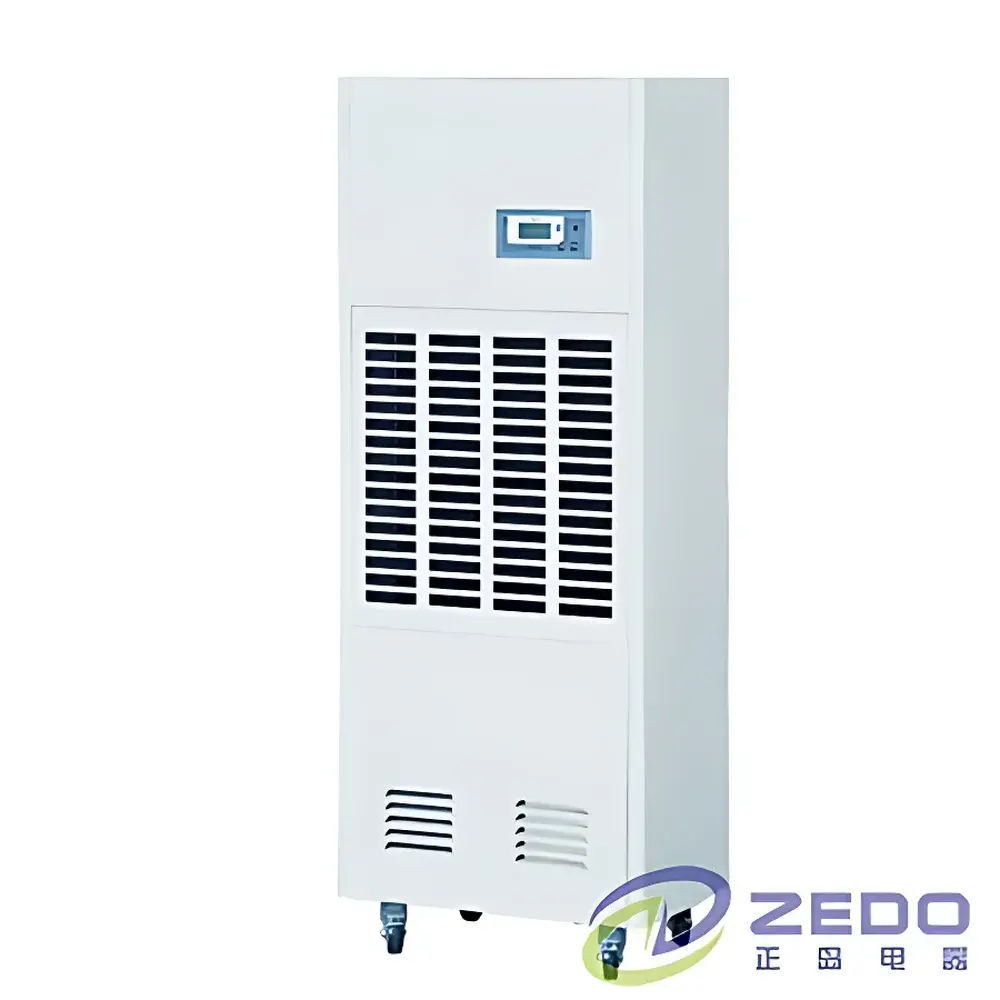
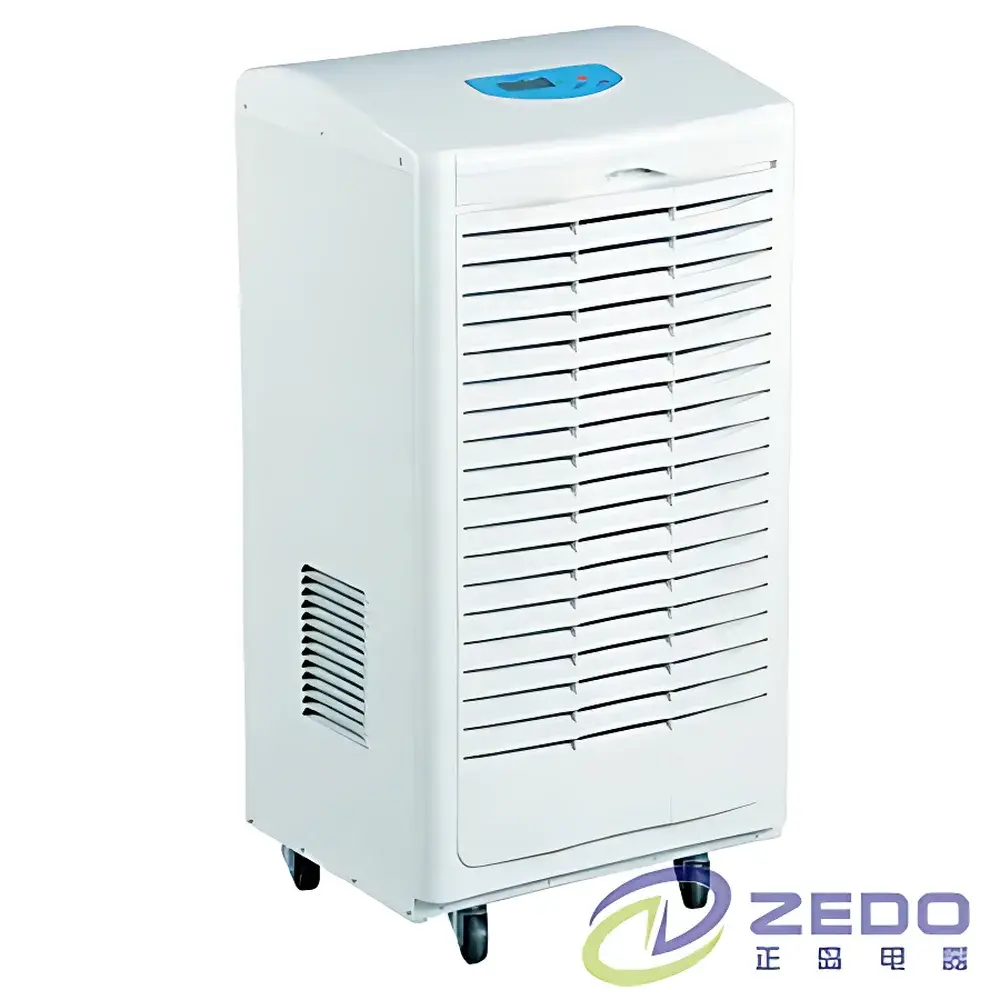
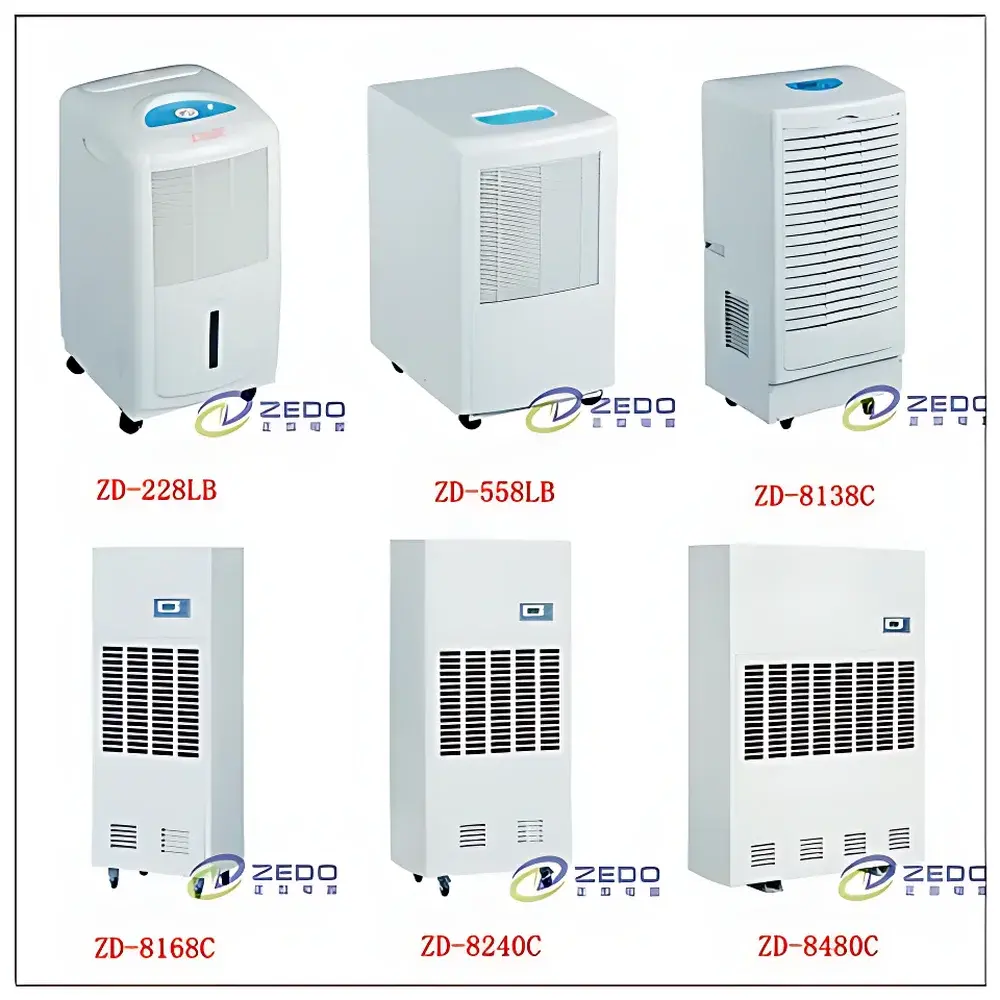
ZEDO ZD-8168C Industrial Basement Dehumidifier
| Brand | ZEDO |
|---|---|
| Origin | Zhejiang, China |
| Manufacturer Type | OEM/ODM Manufacturer |
| Country of Origin | China |
| Model | ZD-8168C |
| Dehumidification Capacity | 168 L/day (7 L/h) |
| Control Method | Intelligent Humidity Setpoint Control |
| Drainage | Continuous via PVC Drain Hose |
| Applicable Area | 130–180 m² |
| Power Supply | 380 V AC, 50 Hz |
| Input Power | 2800 W |
| Operating Temperature Range | 5–38 °C |
| Noise Level | 52 dB(A) |
| Dimensions (W×D×H) | 605 × 410 × 1650 mm |
| Net Weight | 126 kg |
| Compressor Type | Scroll-type, R410A Refrigerant |
| Heat Exchanger | Hydrophilic Aluminum Fin-Tube with Internal Grooved Copper Tubes |
| Fan System | Dual-Centrifugal External Rotor Blower |
| Filtration | Standard Activated Carbon Filter |
| Safety Protections | High/Low Pressure Switch, Overload & Undervoltage Protection, 3-Minute Compressor Delay Start |
| Microcontroller | Embedded Microprocessor with Japanese SHINYO High-Accuracy RH/T Sensor |
| Fault Detection | Real-time Diagnostic Display |
Overview
The ZEDO ZD-8168C Industrial Basement Dehumidifier is an engineered solution for sustained humidity control in large-scale, non-ventilated subterranean environments—such as underground utility rooms, parking garages, storage basements, data center subfloors, and pharmaceutical cold-chain logistics vaults. Designed specifically to operate reliably under high ambient humidity (>80% RH) and moderate thermal gradients (5–38 °C), this unit employs a closed-loop refrigerant-based condensation cycle grounded in thermodynamic principles of dew point depression. Its core architecture separates airflow and refrigeration circuits to minimize cross-contamination risk and maximize service accessibility—critical for GxP-aligned facilities where environmental integrity must be continuously verifiable. Unlike portable or residential-grade units, the ZD-8168C delivers industrial-grade dehumidification capacity (168 L/day) without requiring supplemental heating or desiccant regeneration, making it suitable for continuous 24/7 operation in mission-critical infrastructure.
Key Features
- Scroll-type compressor with R410A refrigerant—optimized for energy efficiency, low vibration, and extended service life under cyclic load conditions typical of basement environments.
- Hydrophilic aluminum fin-tube heat exchanger with internally grooved copper tubing—enhances latent heat transfer coefficient and resists corrosion from prolonged exposure to humid, saline-laden air.
- Dual-centrifugal external rotor blower system—engineered for high static pressure capability (≥120 Pa) to overcome duct resistance in retrofit installations and maintain uniform air distribution across 130–180 m² coverage zones.
- Embedded microcontroller with SHINYO high-accuracy temperature/humidity sensor (±2% RH, ±0.5 °C)—enables precise setpoint control (30–80% RH adjustable in 1% increments) and real-time diagnostics via LED interface.
- Integrated safety architecture—including high/low refrigerant pressure cutoffs, thermal overload relays, undervoltage detection, and automatic 3-minute compressor restart delay—to comply with IEC 60335-1 and GB 4706.32 standards.
- Structural modularity—refrigeration and airflow modules are physically decoupled per ISO 5170 guidelines, enabling component-level maintenance without system isolation or refrigerant recovery.
Sample Compatibility & Compliance
The ZD-8168C is compatible with environments housing hygroscopic-sensitive assets including precision optical assemblies, lithium chloride-based humidity reference standards, sealed calibration chambers, and archival-grade document storage vaults. It meets CE marking requirements for electromagnetic compatibility (EN 61000-6-3/6-4) and safety (EN 60335-1). While not certified to UL 1995 or CSA C22.2 No. 1995, its electrical architecture conforms to IEC 61000-4 immunity thresholds applicable to industrial indoor settings. For GLP/GMP-regulated applications, optional audit-trail-capable controllers (with time-stamped event logging and password-protected parameter access) can be integrated to support FDA 21 CFR Part 11 compliance when paired with validated networked data acquisition systems.
Software & Data Management
The base unit operates via a standalone microcontroller with no cloud dependency. Optional RS-485 Modbus RTU output enables integration into BMS platforms (e.g., Siemens Desigo, Honeywell Enterprise Buildings Integrator) for centralized monitoring of runtime hours, fault codes, and average RH deviation. Data logging intervals (1–60 min) and alarm thresholds (e.g., RH >75% for >2 h) are programmable via front-panel interface. When deployed in multi-unit configurations, master-slave synchronization prevents simultaneous compressor cycling—reducing peak demand and grid harmonics. Firmware updates are performed locally via USB port; no internet connection is required, preserving air-gapped operational security.
Applications
- Underground electrical substations and switchgear rooms—preventing condensation-induced tracking and insulation degradation on busbars and CT/PT terminations.
- Pharmaceutical warehouse basements—maintaining ≤60% RH to inhibit microbial growth on secondary packaging and prevent moisture migration into blister-packed solid dosage forms.
- Museum archive vaults with subfloor concrete slabs—controlling interstitial moisture flux to preserve cellulose-acetate film reels and parchment manuscripts.
- Research facility cleanroom support spaces—supplying dry make-up air to adjacent ISO Class 7/8 environments without introducing particulate contamination.
- Military command bunkers and hardened communications nodes—ensuring uninterrupted operation of RF equipment subject to MIL-STD-810H humidity exposure profiles.
FAQ
What is the minimum ambient temperature at which the ZD-8168C maintains rated dehumidification capacity?
Rated capacity (168 L/day) is guaranteed between 15–35 °C at 80% RH. Below 15 °C, capacity declines gradually due to reduced evaporator surface temperature differential; frost protection logic automatically initiates defrost cycles without user intervention.
Can the unit be ducted for remote air intake and exhaust?
Yes—integrated static pressure head supports up to 8 m of flexible ducting (Ø250 mm) with ≤15° total bend angle. Factory-installed flanges accept standard HVAC transition fittings.
Is the activated carbon filter replaceable, and what is its service life?
The standard filter is rated for 6 months under continuous operation in typical basement air (dust loading <0.1 mg/m³); replacement kits include pre-calibrated RH sensor recalibration stickers.
Does the unit support dry-contact alarm outputs for building management systems?
Yes—two configurable dry-contact relays (NO/NC) are provided: one for “Compressor Running”, another for “High RH Alarm” (user-defined threshold).
How is condensate drainage managed during power interruption?
The internal condensate pan includes a 2.5 L overflow reservoir with float-switch shutdown—preventing spillage during brownouts or scheduled maintenance outages.



