
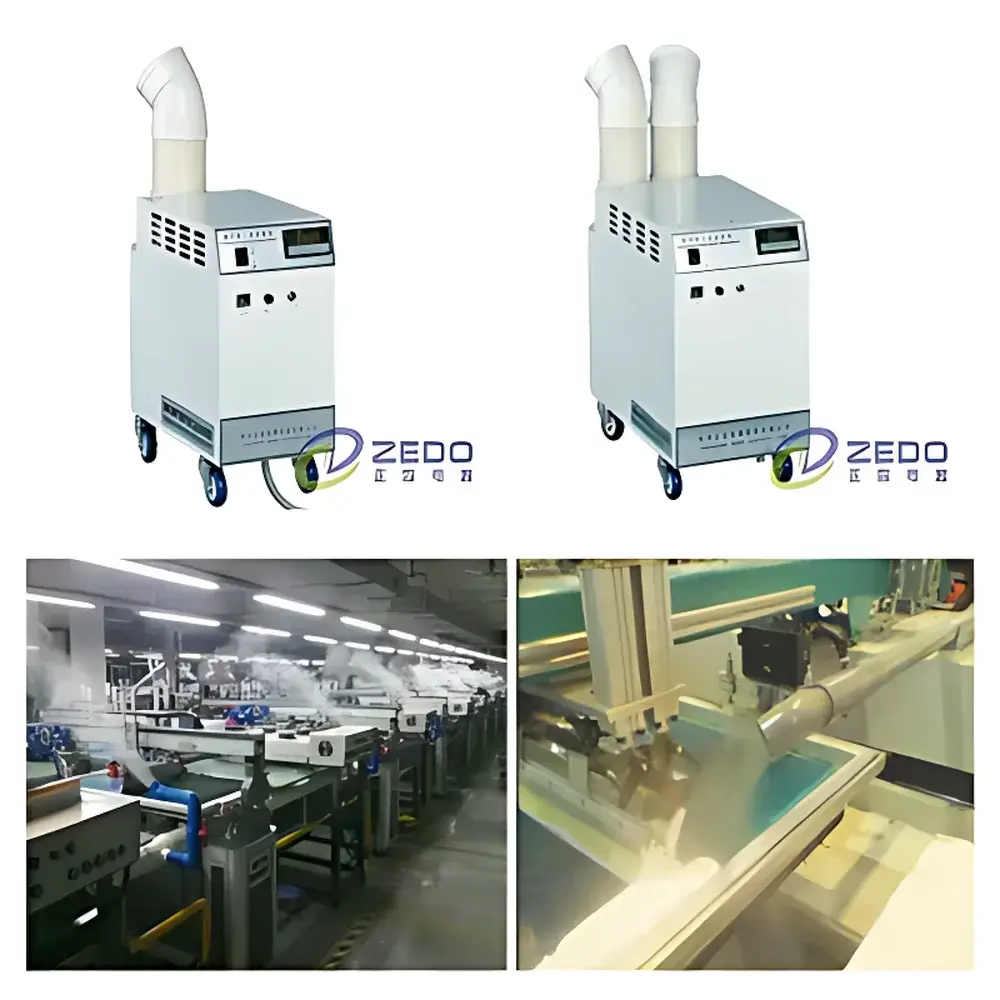
ZEDO ZS-20Z Industrial Ultrasonic Humidifier for Large-Format Inkjet Printers
| Brand | ZEDO |
|---|---|
| Origin | Zhejiang, China |
| Manufacturer Type | OEM/ODM Manufacturer |
| Country of Origin | China |
| Model | ZS-20Z |
| Humidification Capacity | 2.0 kg/h |
| Power Consumption | 600 W |
| Operating Humidity Range | 40–60 %RH (recommended for inkjet printing environments) |
| 雾化方� | �: Ultrasonic High-Frequency Oscillation |
| Control Mode | Humidity Feedback Control (with Japanese SUGINO high-precision capacitive RH sensor) |
| IP Rating | IP68 (fully sealed power supply & fan) |
| Construction | Full Stainless Steel Enclosure (304 SS) |
| Net Weight | 22 kg |
| Noise Level | <35 dB(A) |
| Ceramic Transducer Lifespan | 3000–5000 hours |
Overview
The ZEDO ZS-20Z Industrial Ultrasonic Humidifier is an engineered environmental control solution specifically designed for large-format solvent, eco-solvent, UV, and latex inkjet printing systems. Unlike general-purpose humidifiers, the ZS-20Z addresses two critical failure modes in industrial inkjet operations: nozzle clogging and electrostatic discharge (ESD). It operates on ultrasonic high-frequency oscillation (1.7 MHz), atomizing deionized or softened water into sub-5 µm droplets without heat, mechanical compression, or steam generation. This cold-mist principle ensures rapid vapor-phase equilibrium in enclosed print booths or production zones—minimizing condensation risk while delivering precise, stable relative humidity (RH) control within the 40–60 %RH range recommended by major printhead manufacturers (e.g., Konica Minolta, Ricoh Gen5, Epson I3200). The unit is classified under laboratory-grade gas processing equipment due to its role in conditioning ambient air as a process-critical gaseous medium—not merely comfort humidification.
Key Features
- Full 304 stainless steel enclosure with electrophoretic coating—resistant to corrosion, chemical exposure, and high-humidity degradation.
- Integrated ultrasonic transducer module with ceramic diaphragms rated for alkaline/acidic water compatibility and 3000–5000 hours of continuous operation.
- IP68-rated hermetically sealed variable-frequency power supply and 36 V DC waterproof fan—capable of submerged operation at 1 m depth, eliminating moisture ingress failures.
- Microprocessor-based humidity controller featuring a SUGINO (Japan) capacitive RH sensor with ±2 %RH accuracy and 0.1 %RH resolution, enabling closed-loop feedback regulation.
- Auto-fill system with float valve and overflow protection; optional integration with building management systems (BMS) via 0–10 V or 4–20 mA analog output.
- Low-noise design (<35 dB[A]) suitable for controlled-environment labs and cleanroom-adjacent printing facilities.
Sample Compatibility & Compliance
The ZS-20Z is compatible with all major large-format inkjet platforms requiring stable ambient RH—including flatbed, roll-to-roll, and hybrid printers used in signage, textile, and packaging applications. It supports compliance with ISO 14644-1 (cleanroom air quality), ASTM D2674 (inkjet media conditioning), and internal QC protocols for ESD-sensitive manufacturing per ANSI/ESD S20.20. While not a medical device, its construction meets GLP-relevant material traceability standards (full stainless steel wetted parts, RoHS-compliant electronics). No refrigerants, oils, or consumable filters are required—reducing lifecycle maintenance and eliminating cross-contamination risks in shared lab or pilot-line spaces.
Software & Data Management
The onboard controller logs humidity setpoint, actual RH, runtime, and fault codes (e.g., low-water, transducer timeout) with timestamped records stored in non-volatile memory. Optional RS485 Modbus RTU interface enables integration into LabVIEW, SCADA, or LIMS platforms for audit-ready data capture. All firmware updates are performed via secure USB port with version rollback capability. The system complies with FDA 21 CFR Part 11 requirements for electronic record integrity when configured with user-access controls and audit-trail logging enabled—making it suitable for regulated R&D environments where environmental parameters must be documented per SOP.
Applications
- Preventing printhead nozzle clogging caused by rapid solvent evaporation and pigment precipitation in low-RH environments.
- Mitigating electrostatic charge accumulation on PVC, PET, and vinyl substrates—reducing misdirected ink droplet trajectories and “flying dot” defects.
- Stabilizing ink viscosity and drying kinetics during qualification testing of new media or UV-curable formulations.
- Supporting ISO/IEC 17025-accredited calibration labs that validate environmental conditions for print quality metrology (e.g., spectrophotometric color measurement).
- Supplementing HVAC systems in pilot-scale digital printing cells where localized humidity compensation is required without duct modification.
FAQ
What is the recommended operating RH range for optimal inkjet printer performance?
40–60 %RH is the industry-standard target range specified by printhead OEMs to balance static dissipation and solvent evaporation rate. Below 40 %RH, ESD voltage can exceed 6–10 V, risking permanent piezoelectric actuator damage.
Can the ZS-20Z be integrated with existing building automation systems?
Yes—via optional 0–10 V analog input for setpoint modulation or 4–20 mA output for RH monitoring. Modbus RTU (RS485) integration is supported for centralized environmental logging.
Is deionized water required for operation?
While not mandatory, DI or softened water (hardness < 50 ppm CaCO₃) is strongly recommended to extend ceramic transducer life and prevent scale buildup in the reservoir.
Does the unit require periodic filter replacement?
No—unlike evaporative or steam-based humidifiers, the ZS-20Z has no consumable filters, wicks, or descaling cartridges. Maintenance is limited to quarterly reservoir cleaning and annual transducer inspection.
How does the ZS-20Z differ from standard commercial humidifiers in lab settings?
It delivers calibrated, repeatable RH control—not just bulk moisture addition—with industrial-grade materials, IP68 sealing, and traceable sensor calibration—meeting requirements for method validation and environmental qualification studies.



