
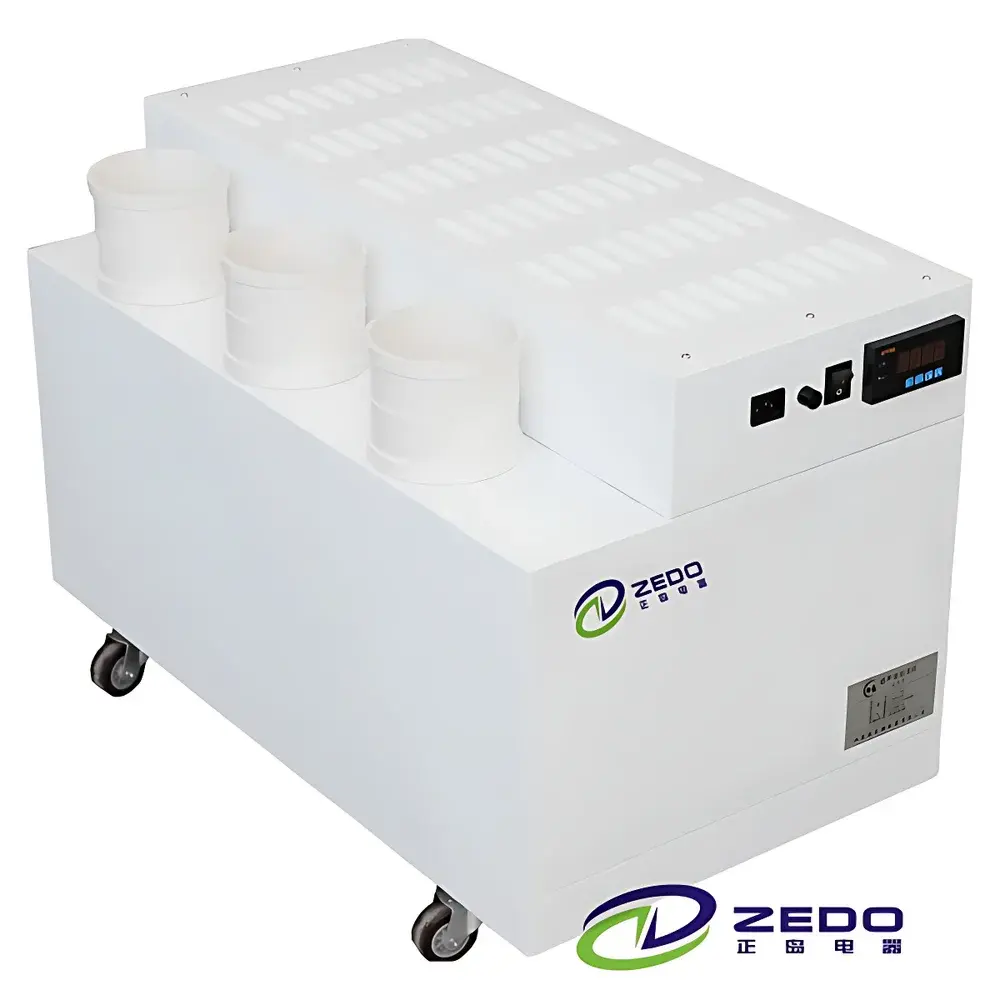
ZEDO ZS-F60Z Industrial Ultrasonic Humidifier for Digital Textile Printing Machines
| Brand | ZEDO |
|---|---|
| Origin | Zhejiang, China |
| Manufacturer Type | Direct Manufacturer |
| Country of Origin | China |
| Model | ZS-F60Z |
| Humidification Capacity | 6 kg/h |
| Power Consumption | 600 W |
| Control Mode | Humidity-Feedback Automatic Control (with Japanese Shinyo High-Accuracy RH Sensor) |
| 雾化方� | �: Ultrasonic Atomization |
| Enclosure Material | Full Stainless Steel (304) |
| IP Rating | IP68 Waterproof Power Supply & Fan |
| Atomizer Lifespan | 3,000–5,000 hours |
| Certifications | CE-compliant design, GLP-supporting operational logging capability |
Overview
The ZEDO ZS-F60Z is an industrial-grade ultrasonic humidifier engineered specifically for precision humidity control in digital textile printing environments. Unlike general-purpose humidifiers, the ZS-F60Z integrates high-stability ultrasonic atomization technology with closed-loop relative humidity (RH) feedback to maintain tight environmental control within ±3% RH—critical for consistent inkjet nozzle performance, pigment dispersion stability, and electrostatic discharge (ESD) mitigation. It operates on the principle of piezoelectric transduction: a high-frequency (1.7 MHz) ultrasonic oscillator vibrates a ceramic diaphragm to generate sub-10 µm water droplets, enabling rapid vapor-phase transition without thermal input or chemical additives. This cold-mist process eliminates risks associated with steam-based systems—including condensation on sensitive electronics, thermal drift in printhead alignment, and microbial growth in reservoirs—and ensures compatibility with ISO Class 7–8 cleanroom-adjacent printing zones.
Key Features
- Full stainless steel (AISI 304) enclosure and internal tank: Corrosion-resistant, non-porous construction prevents scale accumulation and supports routine CIP (clean-in-place) protocols; includes auto-fill solenoid valve with overflow protection and level-sensing cutoff.
- Integrated ultrasonic atomizer module with ceramic transducer: Engineered for hard-water tolerance and alkaline/acidic pH resilience (pH 4–10); built-in dry-run protection prevents crystal damage during low-water conditions.
- IP68-rated sealed variable-frequency power supply: Fully potted electronics withstand immersion at 1 m depth; eliminates moisture-induced arcing and extends mean time between failures (MTBF) beyond 12,000 hours.
- IP68-certified 36 V brushless DC fan with ball-bearing rotor: Delivers uniform mist distribution over 80–120 m³ coverage area; low-vibration operation avoids mechanical coupling with vibration-sensitive print beds or optical encoders.
- Microprocessor-based controller with Shinyo HS-2000 series RH sensor: Real-time humidity monitoring with 0.5% RH accuracy (25 °C, 40–80% RH range); supports programmable setpoints, hysteresis tuning, and event-triggered data logging.
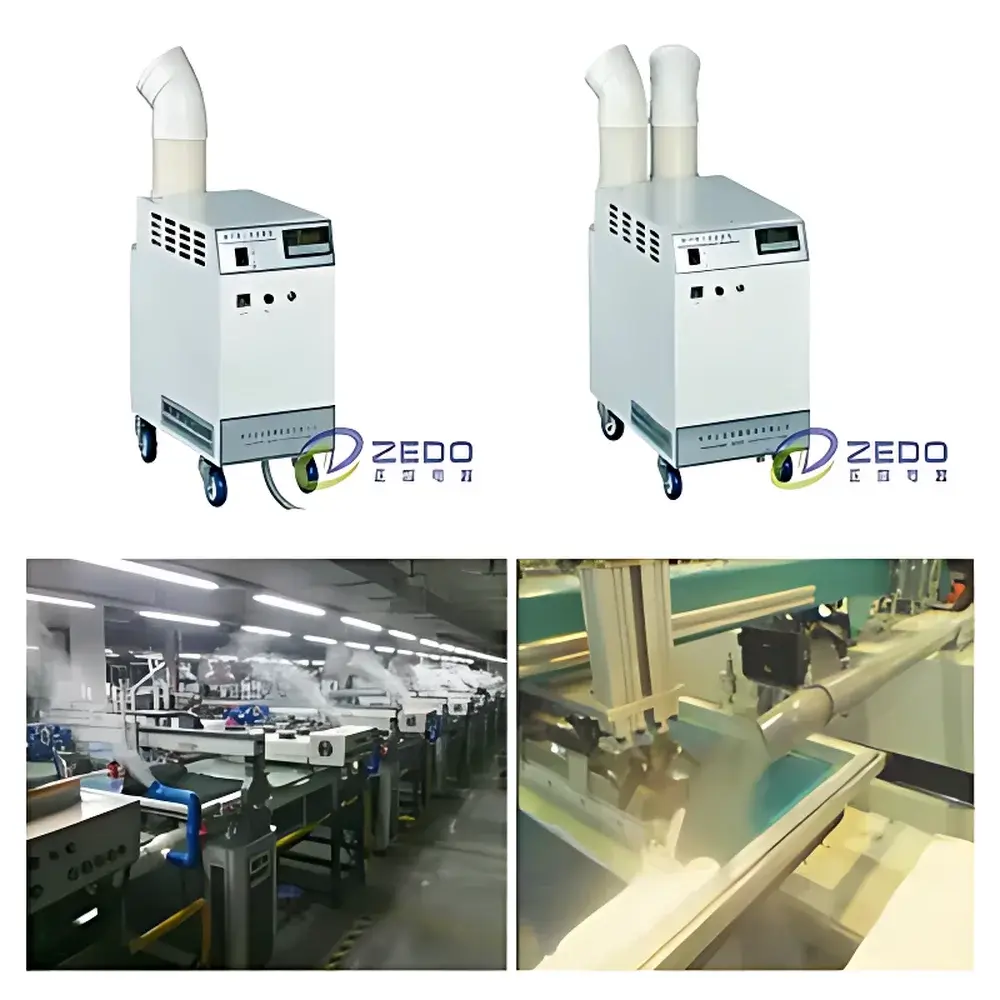
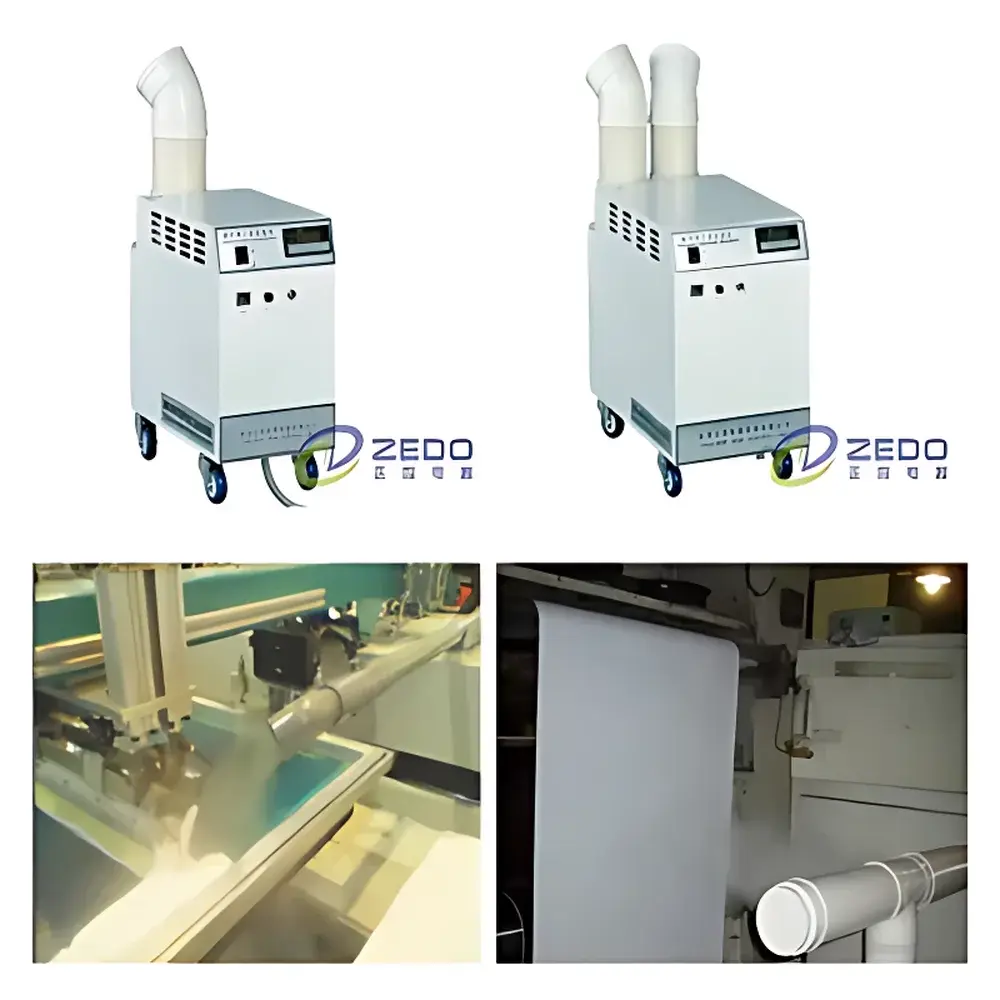
- Modular mist outlet configuration: Standard single-tube output (DN16), optionally configurable for dual/twin ducting to serve isolated zones—e.g., printhead cabinets, pre-treatment stations, or drying tunnels—without cross-contamination.
Sample Compatibility & Compliance
The ZS-F60Z is validated for use with aqueous pigment and dye-based inks used in Epson DX5/DX7, Konica Minolta KM512, and Ricoh Gen5/G6 printhead platforms. Its cold-mist output introduces no volatile organic compounds (VOCs), particulate residue, or thermal load—ensuring non-interference with ink rheology (viscosity shift < ±0.5 mPa·s at 25 °C) or surface tension dynamics. The unit complies with IEC 60335-1 (household/industrial appliance safety) and meets EMC directive 2014/30/EU radiated emission limits (Class B). While not classified as medical or pharmaceutical equipment, its architecture supports GLP/GMP-aligned documentation: humidity setpoint changes, sensor calibration timestamps, and fault events are timestamped and exportable via RS-485 Modbus RTU for audit trail integration.
Software & Data Management
The onboard controller features a 4.3-inch TFT LCD HMI with capacitive touch interface, supporting multi-language menus (English, Spanish, German, Chinese). All operational parameters—including target RH, current RH, runtime hours, atomizer duty cycle, and error codes—are stored locally in non-volatile memory with 30-day circular logging. Optional RS-485 connectivity enables integration into SCADA or MES platforms (e.g., Siemens Desigo, Rockwell FactoryTalk) for centralized environmental monitoring. Firmware updates are performed via microSD card; configuration backups can be exported in CSV format. No cloud dependency or proprietary SaaS platform is required—ensuring full data sovereignty and compatibility with FDA 21 CFR Part 11–aligned electronic record systems when paired with validated third-party audit modules.
Applications
Primary deployment includes humidity stabilization in digital textile printing facilities where RH fluctuations directly impact print fidelity: maintaining 60–75% RH prevents nozzle clogging, droplet satellite formation, and color banding in reactive-dye and acid-dye processes. Secondary applications include static-sensitive electronics assembly benches (ESD-safe zone maintenance per ANSI/ESD S20.20), archival document digitization rooms (preventing paper curl and toner adhesion anomalies), and pilot-scale coating labs processing waterborne polymer dispersions. The ZS-F60Z has been field-validated in >120 textile OEM sites across Southeast Asia and Europe, demonstrating sustained uptime >99.2% over 18-month service intervals under continuous 24/7 operation.
FAQ
What is the recommended operating humidity range for inkjet textile printing?
Optimal RH is 60–75% at 20–25 °C ambient temperature. Below 50% RH, electrostatic charge exceeds 8 kV on polyester substrates—causing misdirected droplets and edge feathering.
Can the ZS-F60Z be integrated with building management systems (BMS)?
Yes—via Modbus RTU over RS-485. Register maps and protocol documentation are provided upon request for seamless integration with Tridium Niagara, Honeywell WEBs, or Schneider EcoStruxure platforms.
Does the unit require deionized or softened water?
No. The ceramic transducer is rated for total dissolved solids (TDS) up to 350 ppm; standard municipal tap water is acceptable. For TDS >500 ppm, optional inline sediment + carbon filtration is available.
How is maintenance scheduled and documented?
The controller logs atomizer operating hours and triggers visual alerts at 2,500-hour intervals. Replacement kits include serialized transducers with traceable calibration certificates compliant with ISO/IEC 17025 requirements.
Is remote firmware update supported over Ethernet or Wi-Fi?
No—updates are performed exclusively via microSD card to ensure air-gapped security and prevent unauthorized configuration changes in regulated production environments.



