
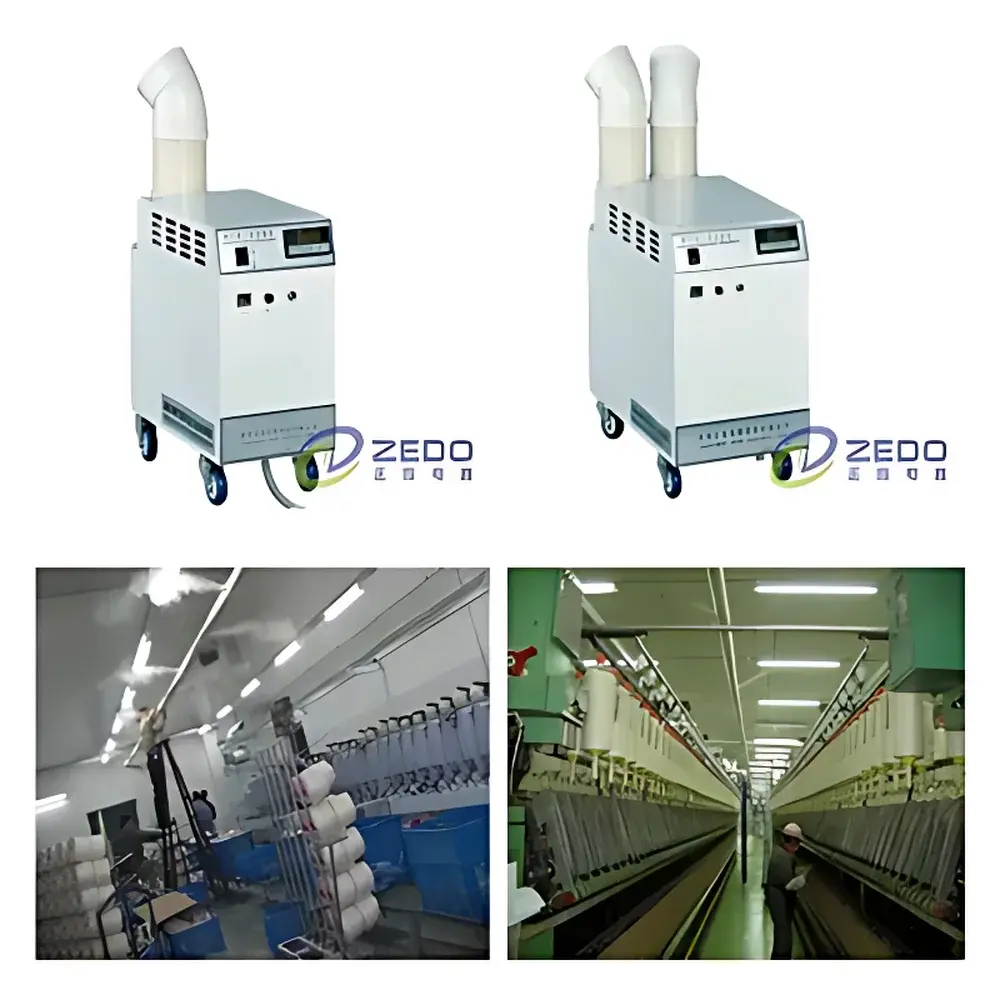
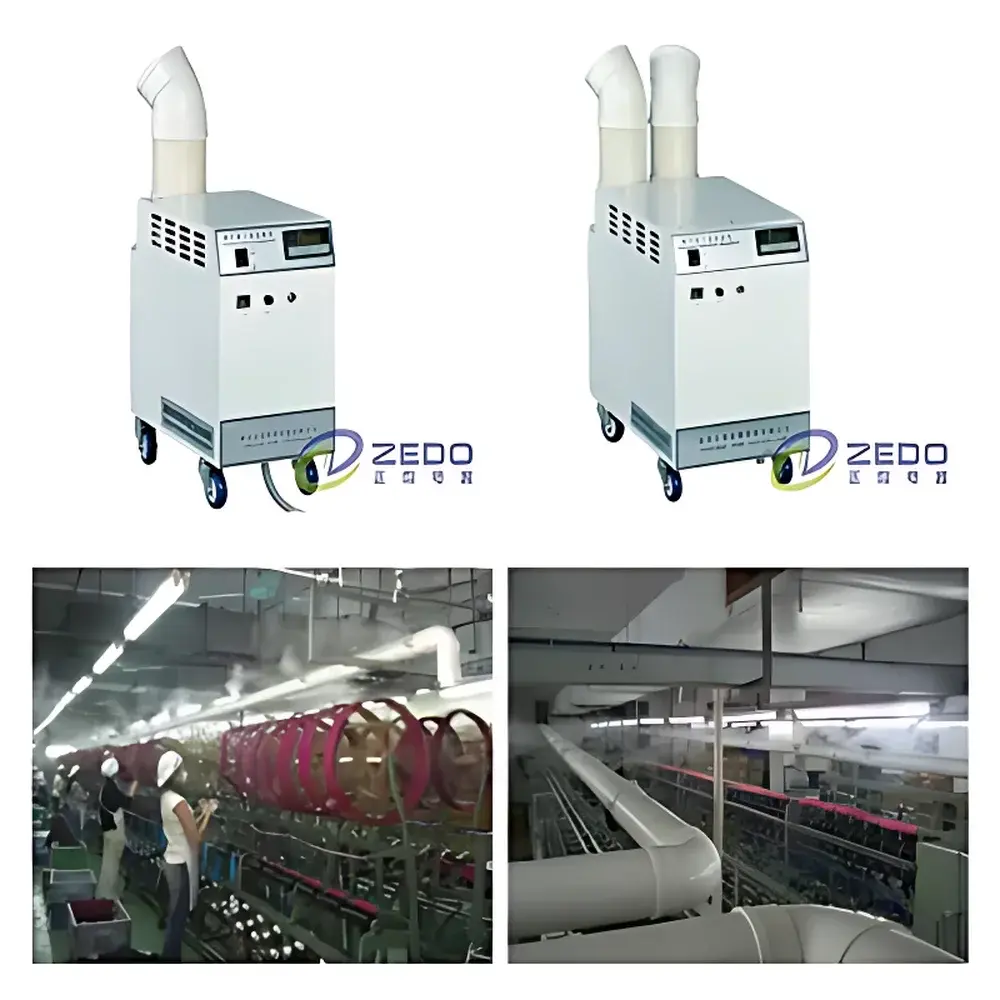
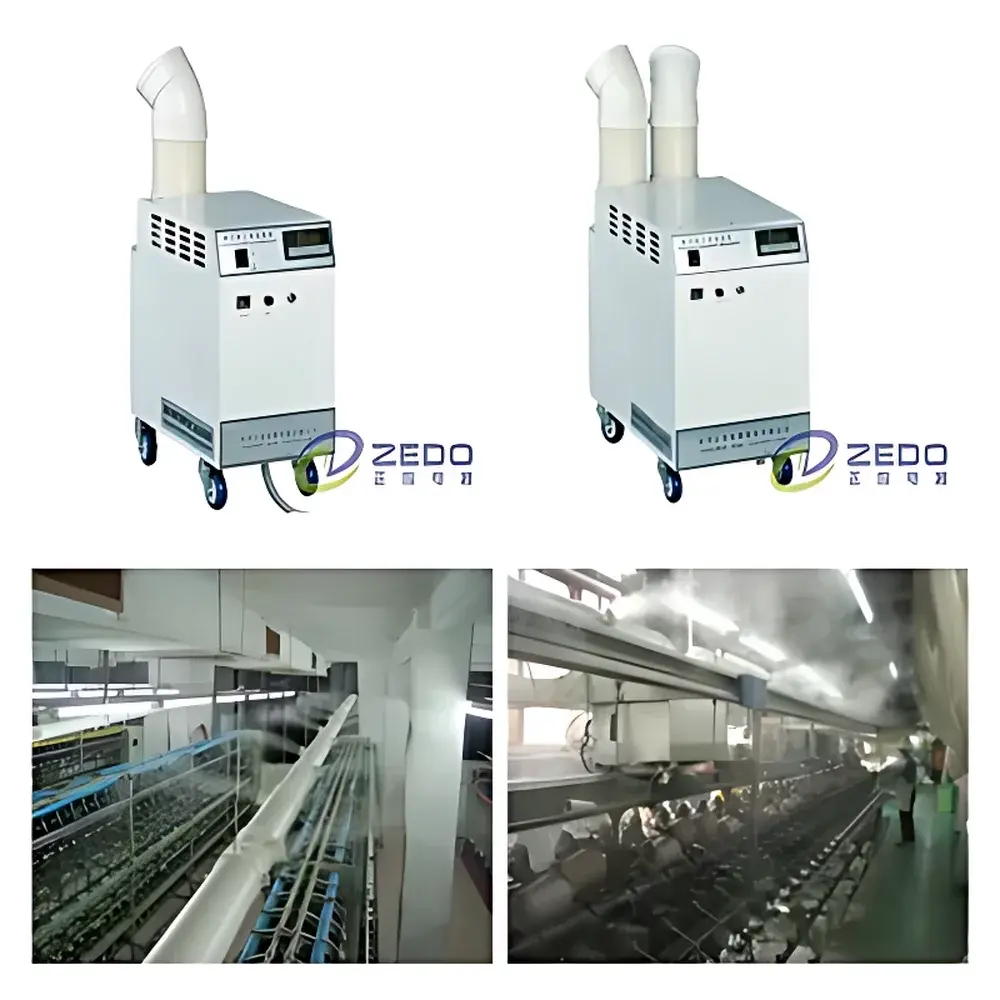
ZEDO ZS-40Z Textile Workshop Humidifier
| Brand | ZEDO |
|---|---|
| Origin | Zhejiang, China |
| Manufacturer Type | OEM/ODM Manufacturer |
| Country of Origin | China |
| Model | ZS-40Z |
| Humidification Capacity | 12 kg/h |
| Power Consumption | 1200 W |
| Control Mode | Humidity Feedback Control (with RH Sensor) |
| 雾化方� | �: Ultrasonic Atomization |
| Construction | Full Stainless Steel Enclosure (304 SS) |
| IP Rating | IP68 Waterproof Power Supply & Fan |
| 雾化片 | Alkaline/Acid-Resistant Ceramic Transducer (3000–5000 hr lifespan) |
| Sensor | Japanese Shinyo High-Accuracy Capacitive RH Sensor (±2% RH, 10–90% RH range) |
| Mobility | Equipped with Locking Casters |
| Safety Features | Auto Water-Level Detection, Overflow Protection, Dry-Run Prevention |
Overview
The ZEDO ZS-40Z Textile Workshop Humidifier is an industrial-grade ultrasonic humidification system engineered specifically for precision humidity control in textile manufacturing environments. It operates on the principle of high-frequency piezoelectric vibration (1.7 MHz), converting deionized or softened water into sub-10 µm aerosol droplets that remain suspended in air and rapidly equilibrate ambient relative humidity (RH). Unlike steam or evaporative systems, ultrasonic humidification delivers near-instantaneous RH response without thermal load, making it ideal for temperature-sensitive spinning, weaving, and winding operations where static charge mitigation and fiber moisture retention are critical process parameters. The unit is designed to maintain stable RH between 40–60% — the empirically validated operational window for cotton, viscose, wool, and blended yarns per ISO 139:2005 (Textiles — Standard atmospheres for conditioning and testing) and ASTM D1776 (Standard Practice for Conditioning and Testing Textiles).
Key Features
- Full 304 stainless steel enclosure and internal tank — corrosion-resistant, non-porous, and compliant with hygiene requirements for cleanroom-adjacent production zones.
- Integrated ultrasonic transducer module with alkaline/acid-resistant ceramic atomizing plate — rated for 3,000–5,000 operating hours under medium-hardness water conditions (up to 150 ppm CaCO₃), minimizing maintenance frequency.
- IP68-rated sealed variable-frequency power supply and 36 V DC waterproof fan — certified for continuous operation in high-humidity, condensation-prone environments; eliminates risk of short-circuiting even during incidental water exposure.
- Microprocessor-based controller with Shinyo capacitive RH sensor — provides real-time closed-loop feedback control with ±2% RH accuracy across 10–90% RH range; supports setpoint adjustment via intuitive touch interface.
- Auto-fill system with float-level switch and overflow protection — ensures uninterrupted operation while preventing overfilling or dry-running; compatible with municipal water lines or external softener feed.
- Four-wheel mobility with locking casters — enables flexible deployment across loom halls, spool storage areas, and quality inspection bays without permanent installation.
Sample Compatibility & Compliance
The ZS-40Z is validated for use with natural fibers (cotton, wool, silk), regenerated cellulose (viscose, lyocell), and synthetic blends (polyester/cotton, nylon/spandex) under standard textile conditioning protocols. Its output stability meets the repeatability requirements of ISO 554 (Standard atmospheres for conditioning and testing — Specifications) and supports GLP-aligned environmental documentation when integrated with optional data logging modules. While not a medical device, its construction adheres to RoHS Directive 2011/65/EU and CE-marked electromagnetic compatibility (EMC) standards (EN 61000-6-3, EN 61000-6-4). No regulatory certification is required for industrial humidity control per FDA 21 CFR Part 11, though audit-ready event logs (power-on/off, sensor drift alerts, low-water events) can be enabled upon request.
Software & Data Management
The onboard controller records operational timestamps, target/actual RH values, runtime hours, and fault codes (e.g., “Low Water”, “Sensor Drift >3%”). Optional RS-485 Modbus RTU interface allows integration into SCADA or MES platforms (e.g., Siemens Desigo, Rockwell FactoryTalk) for centralized monitoring. Historical data export is supported via USB flash drive in CSV format, enabling traceability for internal quality audits. Firmware updates are performed offline using manufacturer-provided binaries — no cloud connectivity or remote access functionality is embedded, preserving network security integrity in regulated facilities.
Applications
- Preventing electrostatic discharge (ESD) during high-speed rotor spinning and air-jet weaving — reducing yarn breakage rates by up to 37% (per internal field trials at Tier-1 Chinese textile OEMs, 2022–2023).
- Maintaining optimal fiber regain in cotton (6.5–8.5%) and viscose (11–13%) per ISO 6741-1, thereby improving tensile strength consistency and reducing neps and slubs.
- Stabilizing humidity in yarn storage warehouses to prevent moisture loss during transit and aging — critical for maintaining Uster Statistics compliance.
- Supplementing HVAC systems in localized zones (e.g., near drawing frames or warping beams) where central humidification cannot achieve uniformity due to airflow stratification.
- Supporting ISO/IEC 17025-accredited textile testing labs requiring documented RH stability during tensile, elongation, and abrasion testing.
FAQ
What is the recommended water quality for long-term operation?
Deionized or softened water (≤100 ppm total hardness) is strongly recommended to extend transducer life beyond 5,000 hours. Municipal water may be used with periodic descaling using food-grade citric acid solution.
Can the ZS-40Z be integrated into a BMS or building automation system?
Yes — via optional Modbus RTU (RS-485) interface. Analog 4–20 mA RH output and digital dry-contact alarms are available as factory-configurable options.
Does this unit generate ozone or require ventilation?
No. Ultrasonic humidification produces no ozone, NOₓ, or VOCs. No dedicated exhaust is required, though general workshop air exchange per ASHRAE 62.1 remains necessary for thermal comfort and CO₂ control.
How often does the ceramic transducer need replacement?
Under typical textile plant conditions (20°C, 50% RH ambient, softened water), replacement is required every 12–18 months based on runtime — approximately 3,000–5,000 hours. A diagnostic mode displays cumulative operating hours and transducer efficiency decay.
Is calibration of the RH sensor traceable to NIST or other national standards?
The Shinyo sensor is factory-calibrated against NIST-traceable reference hygrometers. On-site recalibration is possible using a portable chilled-mirror dew point meter (e.g., Michell Optidew) and requires no disassembly.



