
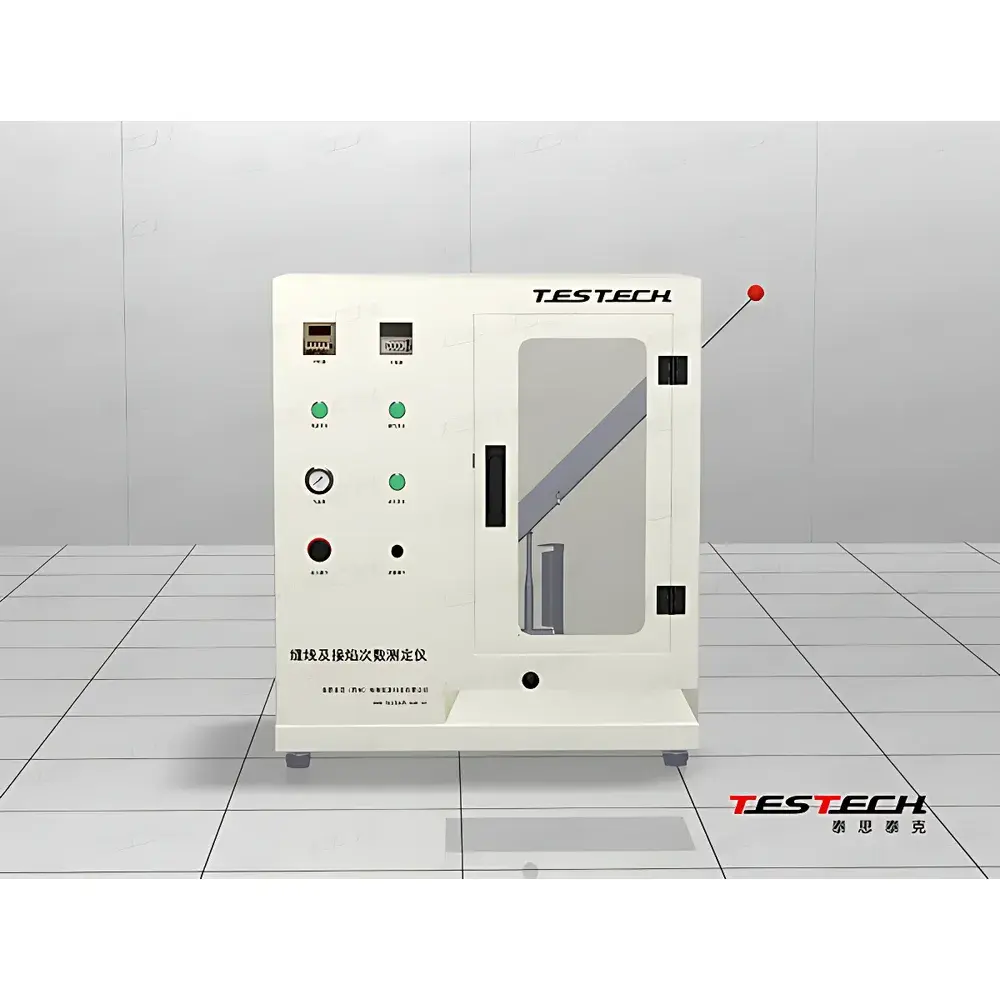
TESTech TTech-GB8965-3 Flame Resistance Tester for Protective Clothing (Compliant with GB 8965–1998)
| Brand | TESTech |
|---|---|
| Origin | Jiangsu, China |
| Manufacturer Type | Direct Manufacturer |
| Country of Origin | China |
| Model | TTech-GB8965-3 |
| Power Supply | AC 220 V ±10 V |
| Dimensions (L×W×H) | 0.6 × 0.3 × 0.65 m |
| Weight | 20 kg |
| Ambient Temperature Range | 20–40 °C |
| Relative Humidity | ≤75 % RH |
| Ignition Method | Electronic Spark Ignition |
| Burner | Imported Gas Torch (Butane/Propane, No Air Inlet) |
| Gas Purity | ≥95 % |
| Gas Flow Rate | 0–1000 mL/min |
| Sample Holder | 45° Inclined Stainless Steel Helical Coil (10 mm ID, 0.5 mm Wire Diameter) |
| Viewing Window | Heat-Resistant Borosilicate Glass |
| Ventilation | Six 12-mm Diameter Vents on Top and Side Edges |
| Timer Resolution | 0.1 s |
| Enclosure Material | 304 Stainless Steel |
| Gas Source | Customer-Supplied LPG, Butane or Propane |
Overview
The TESTech TTech-GB8965-3 Flame Resistance Tester is a purpose-built instrument engineered to evaluate the flame propagation behavior of flame-retardant protective clothing in accordance with the Chinese national standard GB 8965–1998, “Flame Retardant Protective Clothing.” This test method employs a controlled open-flame exposure protocol to assess the afterflame time, afterglow time, and char length of textile specimens under standardized thermal insult conditions. The apparatus operates on the principle of direct flame impingement using a calibrated gas torch, with precise spatial orientation (45° sample inclination), defined burner geometry, and regulated fuel flow—ensuring high reproducibility across laboratories. Designed for use in quality control laboratories, textile R&D centers, and certification testing facilities, the system delivers traceable, operator-independent results essential for regulatory compliance and material qualification.
Key Features
- Robust 304 stainless steel chamber construction ensures long-term corrosion resistance and structural integrity during repeated thermal cycling.
- Heat-resistant borosilicate glass viewing window enables real-time visual monitoring of flame interaction without compromising test enclosure integrity.
- Fixed-angle (45°) sample holder fabricated from 0.5 mm diameter stainless steel wire, wound into a precise 10 mm internal diameter helix—meeting dimensional tolerances specified in GB 8965–1998.
- Imported gas torch with no air inlet design delivers stable, diffusion-controlled flame geometry using butane, propane, or LPG—eliminating variability from ambient air entrainment.
- Digital timer with 0.1-second resolution provides accurate measurement of afterflame and afterglow durations, directly supporting pass/fail determination per standard criteria.
- Six strategically positioned 12-mm ventilation apertures on top and side edges maintain consistent thermal buoyancy and combustion byproduct dispersion while preventing pressure buildup.
- Integrated electronic ignition system eliminates manual lighting hazards and ensures repeatable flame initiation timing.
- Modular internal fixtures—including sample clamp, burner mount, and gas line routing—are fully stainless steel, minimizing oxidation and thermal degradation over extended service life.
Sample Compatibility & Compliance
The TTech-GB8965-3 accommodates flat fabric specimens measuring 300 mm × 80 mm, mounted on the standardized helical coil fixture at 45°. It supports woven, knitted, and nonwoven textiles used in industrial flame-resistant workwear, military uniforms, and emergency response gear. The system is fully aligned with GB 8965–1998 Section 5.3 (Test Procedure) and Annex A (Apparatus Requirements). While not directly certified to ISO 15025 or ASTM F1959, its mechanical and operational parameters are functionally equivalent to those referenced in these international standards—enabling cross-referenced reporting where permitted by accreditation scope. All electrical components comply with IEC 61000-6-3 (EMC) and IEC 61000-6-2 (immunity) requirements. The enclosure meets IP20 classification for indoor laboratory use.
Software & Data Management
This standalone hardware platform operates without proprietary software; all test parameters and outcomes are recorded manually or via external lab notebooks. However, the digital timer output can be interfaced with optional data acquisition systems (e.g., USB TTL modules) for automated timestamp logging. For GLP/GMP environments, users may integrate the device into validated electronic lab notebook (ELN) workflows, with full audit trail capability for timer calibration records, gas cylinder change logs, and operator training documentation. Calibration intervals for the timer (±0.1 s accuracy verification) and gas flow meter (traceable to NIST-traceable standards) must be documented per ISO/IEC 17025 Clause 6.5.
Applications
- Pre-market validation of flame-retardant finishing efficacy on cotton, aramid, modacrylic, and FR-treated polyester blends.
- Batch release testing in textile manufacturing plants supplying PPE to petrochemical, electric utility, and metallurgical sectors.
- Comparative assessment of char formation kinetics between different fiber architectures and chemical treatments.
- Root cause analysis of field failures involving thermal degradation of protective garments.
- Supporting technical documentation for CCC (China Compulsory Certification) and CNAS-accredited test reports.
FAQ
What gas types are compatible with the TTech-GB8965-3?
Butane, propane, or commercial LPG meeting ≥95% purity specifications. Air-free operation requires dedicated gas regulators and flashback arrestors.
Is the 45° sample angle adjustable?
No—the fixture is fixed at 45° to ensure strict adherence to GB 8965–1998 geometric requirements.
Does the unit include gas supply or pressure regulators?
No. Gas cylinders, regulators, and associated safety hardware must be provided by the end user per local occupational safety regulations.
Can this tester be used for ISO 15025 testing?
Not without physical modification. ISO 15025 specifies vertical specimen orientation and different burner positioning; GB 8965–1998 mandates 45° inclination and distinct flame contact geometry.
What maintenance is required for long-term accuracy?
Monthly visual inspection of burner nozzle integrity, quarterly verification of timer accuracy against a traceable stopwatch, and annual calibration of gas flow meter using a bubble meter or mass flow calibrator.



