
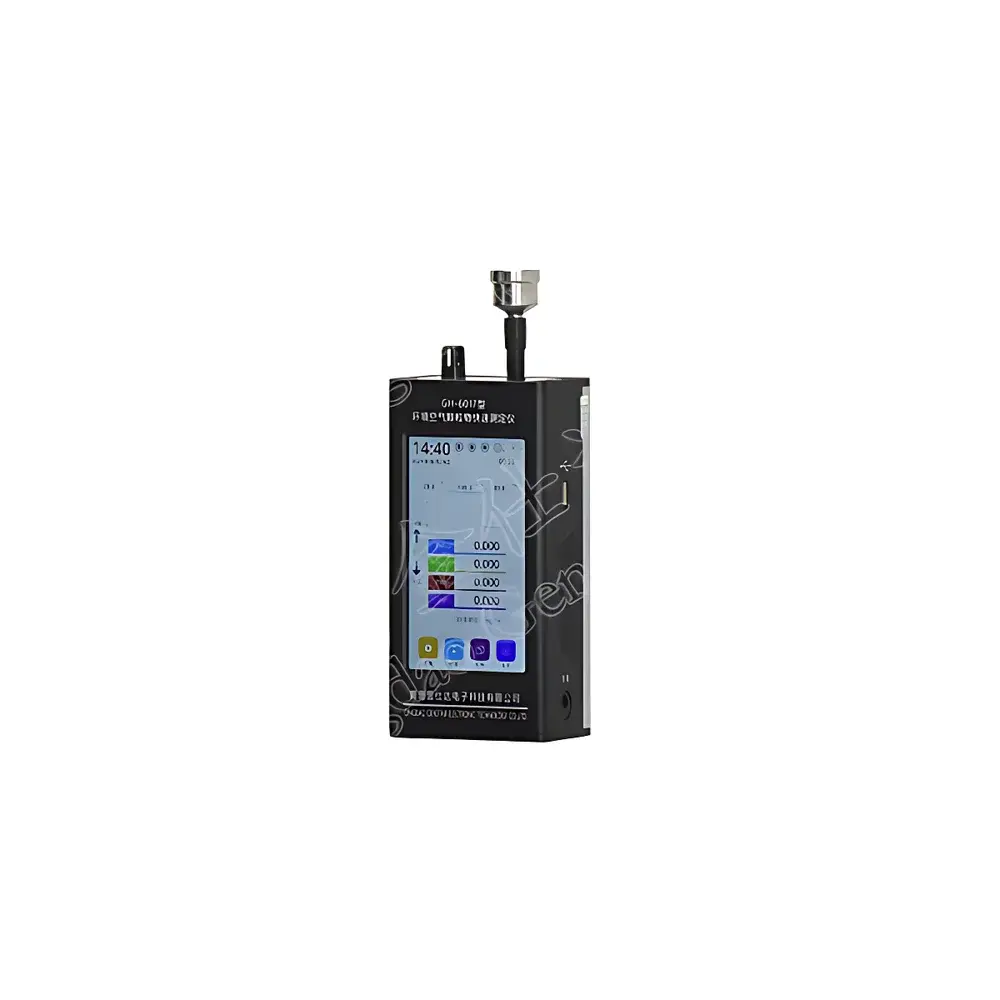
Genetec GH-6017A Laser-Based Ambient Air Particulate Matter Analyzer
| Brand | Genetec |
|---|---|
| Origin | Shandong, China |
| Manufacturer Type | Direct Manufacturer |
| Country of Origin | China |
| Model | GH-6017A |
| Measurement Principle | Optical Light Scattering (90° forward/backscatter geometry) |
| Measured Parameters | TSP, PM₁₀, PM₂.₅, PM₁ |
| Display | 5.0″ capacitive color touchscreen |
| Power Supply | Rechargeable Li-ion battery (≥24 h continuous operation) |
| Environmental Sensors | Integrated temperature, relative humidity, and barometric pressure sensors |
| Data Connectivity | Built-in Bluetooth 5.0 (supports real-time data streaming and wireless thermal printing) |
| Alarm Function | Audible threshold alert with user-configurable concentration limits |
| Sensor Architecture | All-metal precision optomechanical housing with imported high-stability laser diode (650 nm ±5 nm) and low-noise photodetector array |
| Compliance Standards | WS/T 206–2001, JJG 846–2015, GB 12358–2006, LD 98–1996 |
Overview
The Genetec GH-6017A Laser-Based Ambient Air Particulate Matter Analyzer is a field-deployable, real-time optical instrument engineered for quantitative measurement of airborne particulate mass concentrations using the principle of light scattering photometry. It operates on Mie scattering theory, where suspended particles in sampled air interact with a collimated 650 nm laser beam, generating scattered light intensity proportional to particle size and concentration. The detector system captures both signal amplitude and pulse width to discriminate particle size bins corresponding to PM₁, PM₂.₅, PM₁₀, and total suspended particulates (TSP). Designed for regulatory-grade environmental monitoring, the GH-6017A delivers stable, repeatable measurements under variable ambient conditions—enabling reliable assessment of ambient air quality across urban, industrial, indoor, and occupational settings.
Key Features
- Real-time simultaneous quantification of PM₁, PM₂.₅, PM₁₀, and TSP mass concentrations (µg/m³), with dynamic graphical display of temporal concentration trends
- Integrated environmental sensing: high-accuracy digital temperature (±0.3°C), relative humidity (±2% RH), and barometric pressure (±0.5 kPa) modules
- Advanced compensation algorithm that dynamically corrects raw scattering signals for temperature and humidity drift—ensuring metrological consistency per JJG 846–2015 calibration requirements
- Robust all-metal optomechanical sensor housing with sealed laser cavity and EMI-shielded photodetection electronics, minimizing cross-interference from vibration, electromagnetic fields, or ambient light
- High-efficiency imported diaphragm sampling pump delivering stable flow performance across variable backpressure conditions—critical for long-duration unattended operation
- Capacitive 5.0-inch color touchscreen interface with intuitive menu navigation, configurable alarm thresholds, and on-device data review (last 72 h)
- Bluetooth 5.0 wireless interface compliant with IEEE 802.15.1, supporting secure point-to-point data export to mobile applications and direct thermal printing without auxiliary hardware
- Portable form factor (≤1.8 kg) with integrated rechargeable Li-ion battery rated for ≥24 hours of continuous measurement at standard sampling flow
Sample Compatibility & Compliance
The GH-6017A is validated for use with ambient air, indoor air, cleanroom environments, and occupational breathing zones. Its optical design meets the fundamental physical assumptions of light-scattering-based aerosol instrumentation defined in WS/T 206–2001 and LD 98–1996. Calibration traceability aligns with national verification procedures outlined in JJG 846–2015, including zero-check, span verification, and linearity assessment using certified polystyrene latex (PSL) microsphere aerosols. Instrument output satisfies reporting requirements under GB 12358–2006 for workplace gas and particulate monitoring systems. While not certified for regulatory submission under EPA Method PS-1 or EN 12341, it serves as a qualified screening and trend-monitoring tool compatible with GLP-aligned field protocols.
Software & Data Management
Data acquisition and visualization are managed via embedded firmware supporting ISO/IEC 17025-aligned metadata tagging—including timestamp (RTC-synchronized), GPS coordinates (when paired with external module), sensor status flags, and environmental correction coefficients. Export formats include CSV and XML, both embeddable in LIMS-compatible workflows. Bluetooth transmission supports encrypted pairing and implements packet-level integrity checks to prevent data corruption during transfer. Firmware updates are performed over-the-air via authenticated USB or Bluetooth channels, maintaining audit trail records per internal revision control policy.
Applications
- Ambient air quality surveillance networks (urban background, roadside, industrial fence-line)
- Indoor air quality (IAQ) assessments in schools, hospitals, offices, and residential buildings
- Occupational health monitoring in mining, construction, pharmaceutical manufacturing, and powder-handling facilities
- Filter efficiency testing and HVAC system validation in cleanrooms (ISO Class 5–8)
- Field research in atmospheric science, aerosol chemistry, and exposure epidemiology
- Educational laboratories requiring hands-on instrumentation for environmental engineering curricula
FAQ
What calibration standards does the GH-6017A support?
It is designed for verification using NIST-traceable PSL aerosols (e.g., 1.0 µm, 2.5 µm, 10 µm) per JJG 846–2015; factory calibration certificates include uncertainty budgets referenced to national metrology institutes.
Can the instrument operate in high-humidity environments?
Yes—the built-in humidity compensation algorithm mitigates hygroscopic growth effects up to 95% RH; however, condensation inside the optical chamber must be avoided through proper inlet heating or desiccant filtration.
Is the GH-6017A suitable for regulatory compliance reporting?
It meets technical specifications for indicative monitoring under Chinese national standards but is not certified as a reference method instrument per EPA or EU directives; users should consult local regulatory authorities regarding acceptability for official submissions.
How is data integrity ensured during Bluetooth transmission?
All transmitted packets include CRC-16 checksums and sequence numbering; connection encryption follows AES-128 with device-pairing authentication to prevent unauthorized access or replay attacks.
What maintenance intervals are recommended?
Optical window cleaning every 72 operational hours in high-dust environments; annual full-system verification including flow rate check, laser power measurement, and photodetector linearity test per manufacturer service manual.
Related Products







